Follow our live coverage here.
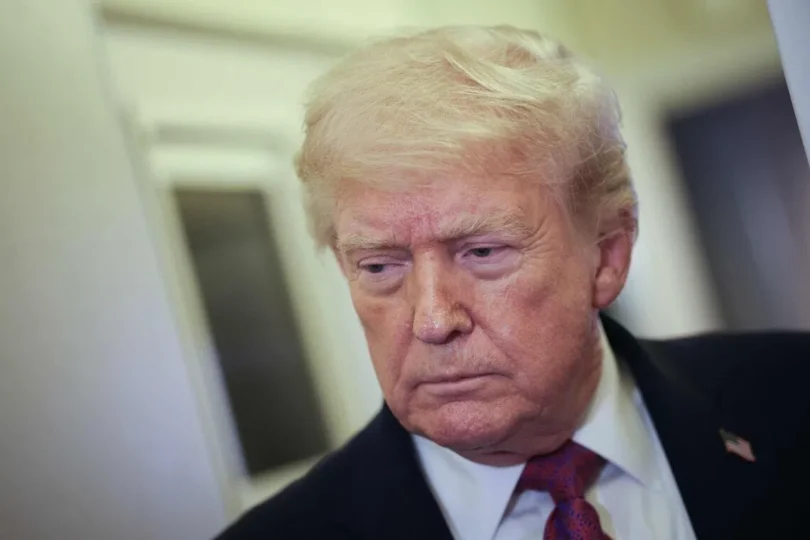
WASHINGTON – US President Donald Trump made cryptic comments on April 21 about China possibly providing weapons or other potentially lethal war supplies to Iran, a move that would test a US red line on aiding Tehran during the war.
The President suggested in an interview on CNBC on April 21 that the US caught a boat with a “gift” from China, after talking about the US restocking its munitions, hinting – without explicitly saying – that the present was some form of lethal aid for Tehran.
“We caught a ship yesterday that had some things on it, which wasn’t very nice – a gift from China, perhaps, I don’t know,” Mr Trump said. “I thought I had an understanding with President Xi, but that’s all right. That’s the way the war goes right?”
The White House did not respond to requests for comment on April 21.
Chinese Ministry of Foreign Affairs spokesman Guo Jiakun at a briefing on April 21, responding to a question about unverified reports of China being linked to chemical shipments for missiles said: “As far as I know, the vessel seized by the US is a foreign container ship. China rejects any false association and speculation”.
The Chinese Embassy in Washington emphasised that China handles the “export of military products prudently and responsibly and strictly controls the export of dual-use articles”.
While US officials have suggested Moscow has aided Iran throughout the war, China’s role has been less clear.
Beijing generally avoids supplying weapons to overseas wars or openly violating US sanctions.
Providing lethal aid to Tehran would risk potential economic penalties, after Mr Trump threatened 50 per cent tariffs on any country supplying weapons to Iran – specifying there “will be no exclusions or exemptions”.
US intelligence indicates that China is preparing to deliver a new air defence system to Iran in the coming weeks, including shoulder-fired anti-air missile systems, CNN reported earlier in April.
Mr Trump in an interview with Fox Business earlier in April said that Chinese President Xi Jinping assured him in a letter exchange that China was not providing weapons to Iran. Chinese officials have repeatedly denied that the country is sending weapons to the Islamic Republic.
Mr Trump and Mr Xi are scheduled to meet in Beijing in mid-May, after a previously planned meeting in April was postponed because of the Iran war.
“The reality is that President Trump’s position is weakened by entanglement in a war in Iran. He cannot afford a costly renewed trade war with China and likely does not want to derail his upcoming visit to Beijing,” said Jennifer Kavanagh, director of military analysis at Defense Priorities.
“Since the US is unlikely to respond, China’s risks are low.”
The US has been intercepting ships attempting to cross the Strait of Hormuz as part of a stand-off with Iran over the vital waterway in an attempt to pressure Tehran ahead of negotiations scheduled for this week.
After Iran kept the strait closed to oil and gas tankers and other vessels with threats of attacks since the US and Israel launched the war on Feb 28, Mr Trump said on April 13 the US would blockade the waterway – which was still being used occasionally by Iran-linked or ships from nations friendly to Tehran.
So far, the US has stopped one sanctioned oil tanker and one Iranian cargo ship. It has turned around a total of 28 vessels, according to the US Central Command.
There has already been speculation that China was helping Tehran’s war efforts – although it remains unclear to what extent – beyond being the main buyer of Iran’s oil and helping prop up its economy.
“This kind of lower-level, but still significant, military assistance is going to go on,” said Mr Michael Singh, who served as a senior director for the Middle East at the National Security Council during George W. Bush’s presidency.
“It’s really not something that China tries too hard to hide.”
Mr Trump’s decision to downplay the US interception of a ship from China is unsurprising, given Washington and Beijing have both chosen to navigate the turbulence of the Iran war without letting it interfere with broader US-China relations, said Mr Ryan Hass, director of the China Center at the Brookings Institution in Washington.
“Beijing is more focused on sustaining an uneasy calm in US-China relations,” Mr Hass said in an e-mail. “At the same time, Trump wants to demonstrate he has relations with China under control, particularly when the situation with Iran and elsewhere feels out of control.”
Beijing has previously indirectly assisted Russia during its invasion of Ukraine, including by allowing Chinese commercial companies to provide satellite imagery and know-how to build drones.
In the current Middle East war, Moscow has provided Iran with various forms of intelligence, including satellite imagery and drone targeting tactics, Bloomberg has previously reported.
Moscow and Tehran have deepened military cooperation in recent years after Moscow turned to some US geopolitical foes, including Iran and North Korea, for support after its global isolation following its 2022 invasion of Ukraine. BLOOMBERG