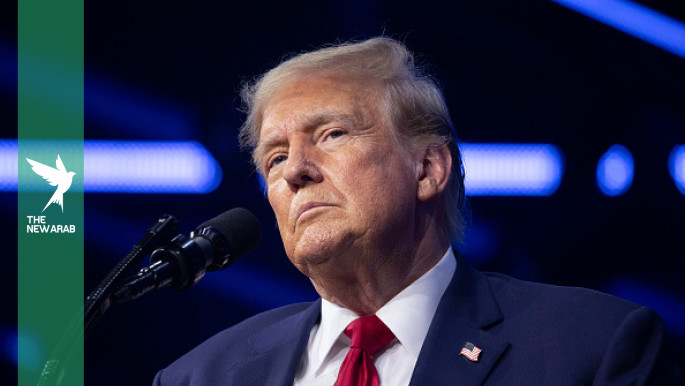
Trump’s threats to Iran once again underline the fragility of the ceasefire [Getty]
US President Donald Trump has threatened to resume military strikes against Iran if a long-term agreement is not reached by next week, even as he pointed to unspecified “good news” in ongoing negotiations and said a deal was likely.
Speaking to reporters aboard Air Force One, Trump said, “We received good news twenty minutes ago, and it looks like things are going well in the Middle East with Iran.”
Pressed on what that meant, he added: “You’ll hear about it. I think it’s a necessary step, a logical step, and I think it will happen.”
However, he made clear that the current ceasefire could soon collapse.
“I may not extend the ceasefire, but the blockade is going to remain. But maybe I won’t extend it, so you’ll have a blockade and unfortunately we’ll have to start dropping bombs again,” he said.
In a speech to the right-wing group Turning Point USA in Phoenix, Trump said the agreement under discussion would not involve any financial payments, adding that the process was “going well”.
He also claimed that Washington would receive “nuclear dust”, referring to enriched uranium, from Iran, insisting that Tehran “will never possess a nuclear weapon”.
Iran swiftly rejected that assertion.
Foreign Ministry spokesperson Esmail Baghaei said transferring enriched uranium “was never raised” in negotiations and “will not be moved anywhere”, comparing its importance to “the sanctity of Iranian soil”.
Despite the sharp rhetoric, Trump suggested there were no major outstanding disagreements and confirmed that talks between Washington and Tehran are set to resume in the coming days, with Pakistan expected to host a new round of negotiations.
A central flashpoint remains the Strait of Hormuz, a critical global shipping route through which around 20 percent of the world’s oil passes.
Iran on Friday announced it would reopen the strait to commercial traffic during the ceasefire period, while maintaining a ban on military vessels. However on Saturday, it said once again that the strait was closed.
Iranian officials have stressed that access to the waterway is directly tied to US actions. The Islamic Revolutionary Guard Corps said control of the strait had “returned to its previous state” because of the continuing US blockade of Iranian ports.
In a statement cited by Iranian state broadcaster IRIB, the IRGC’s joint military command accused Washington of “continued acts of piracy and maritime theft under the guise of a so-called blockade”.
“For this reason, control of the Strait of Hormuz has returned to its previous state, and this strategic waterway is now under strict management and control by the armed forces,” it added.
“Until the United States restores full freedom of navigation for vessels travelling from Iran to their destinations and back, the status of the Strait of Hormuz will remain tightly controlled and in its previous condition,” the statement said.
A senior lawmaker said only commercial ships authorised by the Revolutionary Guard could pass, and that vessels must comply with routes and “required tolls” set by Iran.
He warned the mechanism could change “if the US attempts to create any disturbance for Iranian ships”.
The US on Friday welcomed the reopening of Hormuz but Trump reiterated that its blockade of Iranian ports would remain in place until a final agreement is reached – a position that forced Tehran to once again close the vital waterway.
Asked about the prospect of Iranian tolls or restrictions, Trump said: “Nope. No way. No. Nope,” adding that such measures would not be accepted.
Uncertainty nevertheless remains over how freely vessels can transit the Strait of Hormuz, with access now effectively shaped by the standoff between continued US blockade measures and Iran’s conditional control of the route
The developments come amid a fragile ceasefire that has followed weeks of war waged by the US and Israel on Iran, as well as Israel’s brutal assault and invasion of Lebanon, which left thousands killed.