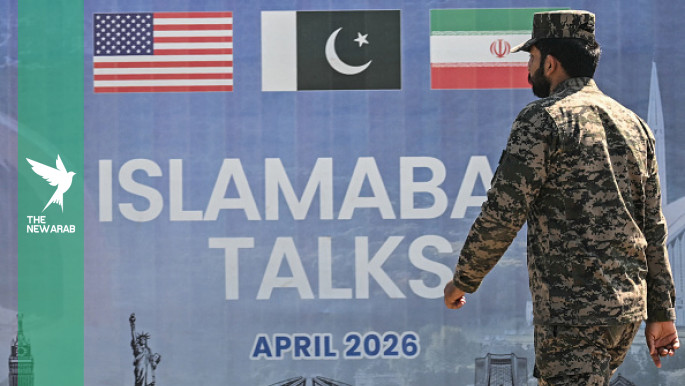
Iran and the US have given conflicting statements about the resumption of talks [Getty]
Conflicting reports have emerged over the timing of a potential new round of US-Iran talks, with officials offering contradictory signals on when negotiations could begin despite indications that discussions are advancing.
CNN reported, citing Iranian officials, that US and Iranian negotiators are expected to meet in Islamabad on Monday, with delegations arriving in the Pakistani capital on Sunday.
However, US President Donald Trump suggested a different timeline, telling Bloomberg that talks are “likely” to take place at the end of the week and that a deal could be reached within days. “Most of the main points” have already been agreed, he said, adding that “things will move very quickly”.
Iran, meanwhile, has indicated that no date has been set.
Deputy Foreign Minister Saeed Khatibzadeh said a new round of negotiations cannot proceed until both sides agree on a shared framework, following the failure of an initial round of talks.
“Until we agree on the framework, we cannot set a date,” he said, adding: “We do not want to enter into any negotiation or meeting that is destined to fail and could serve as a pretext for another round of escalation.”
Khatibzadeh stressed that any agreement must preserve Iran’s rights under international law, saying Tehran would not “accept to be an exception” or “abandon its rights”.
Despite the uncertainty over timing, there are signs that discussions are progressing.
According to three senior Iranian officials cited by The New York Times, the two sides are finalising a three-page memorandum of understanding outlining a framework for a permanent peace deal.
The document reportedly includes a proposed 60-day period to complete negotiations and reach a final agreement, with officials expressing optimism it could be signed in the coming days.
The talks are expected to take place in Pakistan, which has been attempting to mediate between the two sides and sustain a fragile ceasefire set to expire next week following a two-week truce.
While neither Washington nor Tehran has formally confirmed the negotiations, indirect contacts have continued in recent days.
Diplomatic efforts have widened beyond Islamabad, with Egypt and Turkey also pushing for a breakthrough.
Egypt’s foreign minister said mediators were working “very hard” to secure “a final agreement” and expressed hope a deal could be reached “in the coming days”.
Trump has indicated he may travel to Islamabad if an agreement is reached, praising Pakistan’s role as a mediator, particularly Prime Minister Shehbaz Sharif and army chief Asim Munir.
Further complicating the picture, Axios reported that a potential deal could involve the release of around $20 billion in frozen Iranian assets in exchange for Tehran giving up its stockpile of enriched uranium.
Trump rejected that claim, saying Iran would hand over its stockpile “without compensation”, while Iran has denied both the Axios report and Trump’s assertion.
Khatibzadeh also criticised Washington’s messaging, saying “the American side tweets a lot… sometimes confusing… contradictory”, in an apparent reference to Trump’s frequent public statements.
Trump said Iran is “ready today to do things it was not ready to do two months ago”, but warned that fighting could resume if talks fail, even as he insisted the war “will end soon”.