
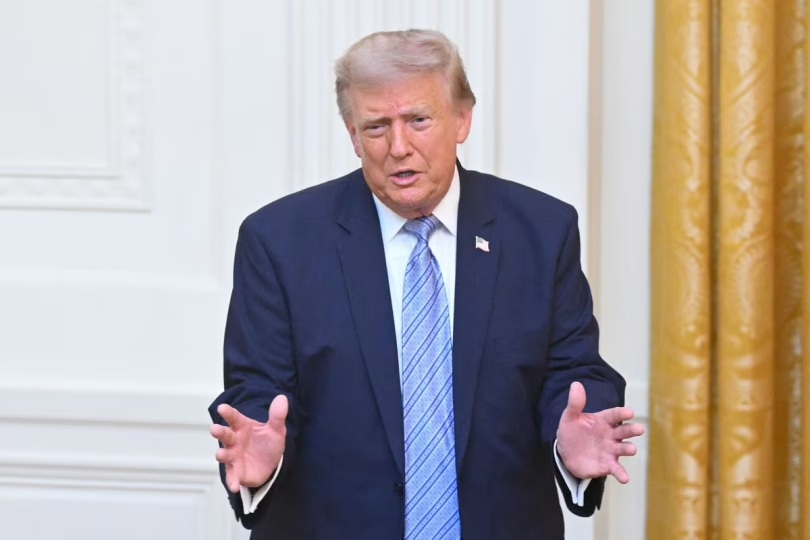
After what Trump administration officials had billed as an historic presidential address on “election integrity” revealed precious little in the way of new — or accurate — information about the election Donald Trump lost six years ago, it’s clear that the president and his closest allies aren’t backing away from their efforts to meddle in the November midterm elections.
On Friday, Secretary of Homeland Security Markwayne Mullin followed up on the president’s unsubstantiated claim that at least 250,000 non-citizens are registered to vote by vowing to restrict federal grants for states that don’t cooperate with the Trump administration’s push to scrub state voter rolls of anyone his department deems ineligible.
He told reporters at a White House briefing in the Eisenhower Executive Office Building that DHS is “going to make our security enhancements mandatory” so if states “want to be reimbursed to work or to run federal elections, they’re going to have to implement security issues.”
It’s more proof that not only can Trump and his team not let go of debunked claims that the 2020 election was somehow stolen from him, but it’s clear they are putting in the groundwork to question the midterms and other elections that don’t go the MAGA way.
Specifically, Mullin is demanding states participate in what the department calls the “SAVE Program” — an expansion of the DHS Systematic Alien Verification for Entitlements database that is intended to prevent aliens from being included on voter rolls.
The database has been the center of multiple court battles, leading one judge in Delaware to order DHS to scrap the effort to expand its functions to include election verification, citing what the court described as egregious violations of data protection and privacy laws stemming from the administration’s addition of Social Security data into the system.
But Trump and his allies aren’t satisfied with using federal funds to blackmail states into doing their bidding to restrict voting — despite the fact that voting by non-citizens is extremely rare and almost always the result of some sort of error rather than malfeasance.
The president is still pushing to use the U.S. Postal Service as a de facto arbiter of who can and can’t vote in the U.S. by way of legally dubious — and thus far blocked by courts — executive orders requiring the service to not deliver or handle election mail from states that don’t provide their voter data to DHS , or to only deliver ballots to homes of Americans on a pre-approved list.
Moreover, Trump continues to bang the drum over GOP-authored legislation called the SAVE America Act, and a related piece of legislation called the SAVE Act, both of which are ostensibly meant to address his baseless belief that the American election system is rife with fraud.
In his Thursday remarks, he accused anyone of opposing the unpopular partisan legislation of wanting to “cheat.”
“Unless you want to cheat, the only reason you wouldn’t do it is you want to cheat because your system is so bad and your candidates are so pathetic that you can’t get away or can’t get elected any other way,” he said.
Trump has spent much of the last year obsessing over the partisan voting restriction legislation, which in its current form would require Americans to provide both a photo ID and proof of citizenship, such as a birth certificate or passport, in order to vote in federal elections.
The fight over his pet anti-voting bills has already paralyzed the House of Representatives, where hardline Republicans have demanded the SAVE America Act be attached to all sorts of must-pass legislation in a gambit to force the Senate to choose between enacting it or shutting down the government, depriving the U.S. Intelligence Community of key surveillance authorities, or failing to reauthorize the nation’s defense for the next year.
Yet despite the enthusiasm for the bill in the House, it is, has been and will continue to be dead-on-arrival in the relatively more sedate Senate, where the de facto 60-vote supermajority for most legislation continues to make it almost impossible for the partisan bill to even be called up for a vote — which would likely fail because it lacks support from the entire 53-member Senate Republican Conference.
So with 109 days until voters choose whether his party will remain in unified control of Congress and his approval ratings remaining in the basement over voter dissatisfaction with his handling of the economy and his disastrous war against Iran, what options does that leave Trump for countering the electorate’s anger?
The answer is not many.
He and his allies can continue dumping documents pertaining to the 2020 election — even though what has been released thus far doesn’t come close to proving his allegation that China has attempted to subvert past elections (even though they do show that Russia did the same on his behalf six years ago).
Trump can also keep railing against the “deep state” and making noise about dubious claims of fraud and exaggerating the extent of non-citizen voting while complaining about non-existent fraud in postal balloting — something Republicans used to embrace to great success in elections before he turned against the practice in 2020.
But the sound and fury coming from the White House with respect to the conduct of American elections is almost certainly destined to signify nothing in the end.
And ironically, his tendency to obsess over voting and attack the very processes that made him President of the United States on two separate occasions is likely to turn off the very people he needs to vote for his party this fall to head off loss of the House and possibly the Senate.