
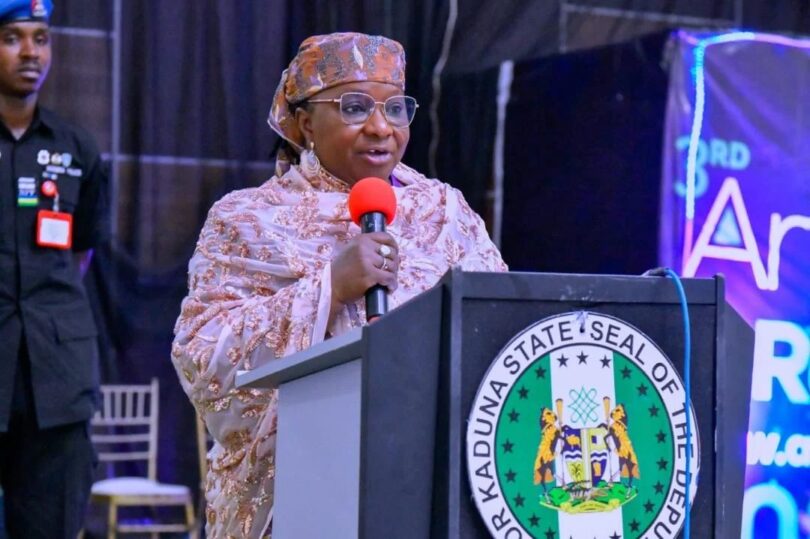
Kaduna State Governor, Uba Sani, is repositioning the state’s education sector to expand access to quality learning and equip young people with the knowledge, skills and character required for productive lives, Deputy Governor Hadiza Balarabe has said.
Mr Balarabe stated this on Tuesday at a community engagement organised by the Kaduna State Schools Quality Assurance Authority.
She described education as a shared responsibility involving government, teachers, school managers, parents, learners, communities and other stakeholders.
“Education is not the responsibility of government alone. It is a shared responsibility involving government, teachers, school managers, parents, learners, communities and all stakeholders,” she said.
According to her, education does not begin and end at the school gate but starts at home, is strengthened in the classroom and reinforced by the wider community.
“This is the very essence of this gathering. Bringing those who matter, together, to help shape the tomorrow of our dreams for our children,” she said.
Mrs Balarabe said the administration’s reforms were changing the experience of children in Kaduna classrooms, particularly through stronger quality assurance across the state’s 23 local government areas.
She said the government was providing Education Quality Assurance Officers with motorcycles and other operational support to enable them reach more schools, identify challenges early and assist school managers in addressing them.
She also cited the introduction of hybrid Computer-Based Testing for the Junior Secondary Certificate Examination, QR-coded certificates and enhanced examination monitoring as measures aimed at strengthening the integrity of the education system.
Mrs Balarabe said the administration had supported more than 800,000 students in Junior Secondary School and Senior Secondary School examinations since 2023.
The Deputy Governor said the reforms were intended to ensure that schools in remote communities received the same attention to standards as those in urban centres.
Digital monitoring
The Director-General of the Kaduna State Schools Quality Assurance Authority, Prof. Abubakar Usman Zaria, said the administration had overhauled the state’s approach to quality assurance.
“We have been transforming quality assurance—from fault-finding to value creation; from paper to data; and from inspection to continuous improvement,” he said.
Zaria said school monitoring was being moved from paper-based reporting to digital, real-time evidence through the EduMonitor App.
The authority, he said, had standardised and automated more than 20 quality assurance tools covering examination clearance and candidate affiliation, school categorisation, proposed school-site assessment, textbook assessment, private-school licensing and annual quality assurance reporting.
The tools also cover the tracking of examination materials through a waybill system.
Zaria said Kaduna’s Basic Education Certificate Examination certificates, Certificates of Consent and annual private-school operating licences now carry QR codes to strengthen verification and guard against fraud and forgery.
He said the authority had also introduced an Annual Quality Assurance Report as part of the licence renewal process for private schools.
“Quality should not be demonstrated only when a school wants a licence; it must be sustained every year,” he said.