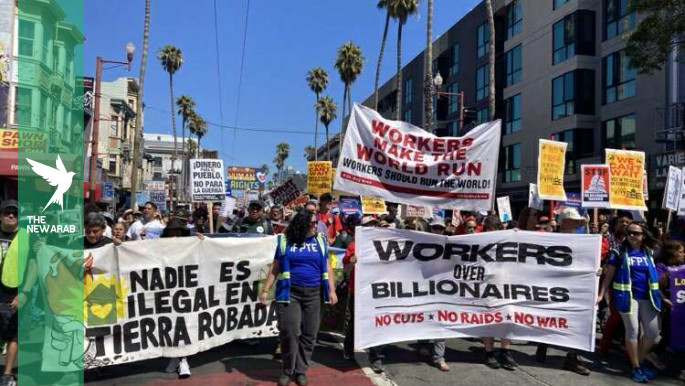
Demonstrators march for workers’ rights. [Brooke Anderson/TNA]
Thousands of cities and towns across the US will be holding May Day rallies on Friday amid high inflation and record-low poll numbers for US President Donald Trump.
On 1 May, International Workers Day, millions of Americans have pledged to ditch work, school and shopping to demonstrate for peace, workers’ rights, affordability and funding for social welfare. Friday’s demonstrations are expected to be among the largest in US history.
“This May Day, we’re flexing our economic power as workers, students, and everyday people to send a clear message to the Trump regime: we will not do business as usual while they trample our rights, terrorize our communities, and drag us into a senseless war in Iran,” reads the website for the national protest group Indivisible.
Rania Salem, a member of the Chicago-based US Palestinian community network, will attend the protest in the Chicago area on Friday.
“I think it’s important for us to come out on May Day, especially with what we’ve experienced with increased ICE [Immigration and Customs Enforcement],” she told The New Arab.
“In Chicagoland, we have a really important history of organising. The 8-hour workday started here,” she said.
May Day demonstrations are seeing growing popularity across the US, though it remains one of the few countries where it is not a national holiday, despite Chicago being the birthplace of the movement.
May Day, or International Workers’ Day, was sparked by the 1886 Haymarket riot and subsequent general strike in Chicago. It is credited for employee safety reforms and the eight-hour workday.
The annual commemoration gained major traction in the US in 2006 with the Day Without an Immigrant (also called the Great American Boycott), when millions of immigrant workers, mainly from Latin America, went on strike.
Over the past several years, Arabs and pro-Palestinian activists have become increasingly involved in May Day demonstrations, as major labour unions have become more vocal in their support for Palestinian human rights.
“The government is cutting funds for services. This will put a lot of people into poverty. But the government has money for genocide and war,” said Salem. “We need to stay strong for our people.”