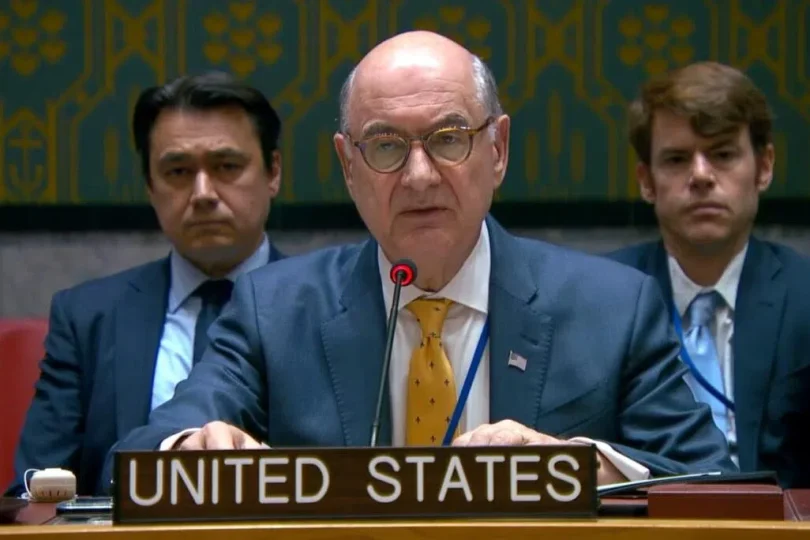
UNITED NATIONS, United States – The United States walked out of a UN Security Council meeting on July 27 when France’s ambassador took the floor, protesting French comments comparing the US to North Korea and other authoritarian states regarding votes on human rights.
Dan Negrea, an alternate representative to the General Assembly and a senior US delegation official, slammed what he called “disingenuous grandstanding” by Paris.
“There is a member of this council that will feign moral outrage and pretend to lecture the rest of us about every topic, whether it’s about the very conflict we’re discussing yet again today, or even those unrelated to international peace and security, like human rights,” Negrea said.
“That is why we walked out during France’s intervention” at the meeting, which focused on the war in Ukraine.
Such a walkout from the Security Council, the UN’s highest decision-making body where both France and the US are veto-wielding permanent members, is very rare.
On July 24, the United States was one of 10 countries to vote in the General Assembly against extending Volker Turk’s term as UN high commissioner for human rights, joining the ranks of North Korea, Russia and Nicaragua, among others.
“The US used to be a beacon of human rights. Not anymore,” France’s mission to the United Nations in Geneva posted in English after the vote on July 24.
“Today, it stands alongside North Korea, Nicaragua, Mali & Russia, isolated. And the world no longer listens to it.”
In his remarks on July 27, Negrea said: “I remind them that it is the United States that remains the beacon of liberty for the world. As such, we will not be affording them the benefit of listening to their politicised drivel.”
French Ambassador Jerome Bonnafont responded to the US walkout, saying: “This year we are celebrating the 250th anniversary of the United States. And everyone knows the role France has played in that.”
He said that France is working at the UN, both in the Security Council and the General Assembly, “to preserve this institution, its independence, and its capacity to act in service of the charter, in service of human rights, and in service of peace.” AFP