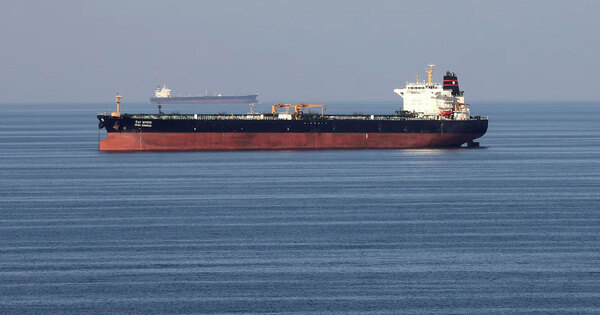
Washington DC [US], April 18 (ANI): The US Treasury Department has issued a fresh temporary waiver permitting the sale and transport of sanctioned Russian oil stranded at sea, in a move aimed at stabilising global energy markets shaken by the ongoing West Asia conflict.
The license, issued on Friday (local time), allows countries to purchase Russian crude and petroleum products loaded onto vessels as of April 17, with authorisation valid through May 16. It replaces a previous 30-day waiver that expired on April 11.
According to the license issued on the official website of the Treasury department, ‘(a) Except as provided in paragraph (b) of this general license, all transactions prohibited by the above-listed authorities that are ordinarily incident and necessary to the sale, delivery, or offloading of crude oil or petroleum products of Russian Federation origin loaded on any vessel, including vessels blocked under the above-listed authorities, on or before 12:01 a.m. eastern daylight time, April 17, 2026, are authorized through 12:01 a.m. eastern daylight time, May 16, 2026.’
However, the waiver maintains strict exclusions involving transactions with Iran, Cuba and North Korea. It stated, ‘(b) This general license does not authorize: (1) Any transaction involving a person located in or organized under the laws of the Islamic Republic of Iran, the Democratic People’s Republic of Korea, the Republic of Cuba, the Covered Regions of Ukraine, as defined by E.O. 14065, the Crimea Region of Ukraine, as defined by E.O. 13685, or any entity that is owned or controlled by or in a joint venture with such persons;’
The development comes amid the remarks made by United States Secretary of the Treasury Scott Bessent on Wednesday (local time), who said that the US will not renew the general license that allowed limited transactions involving Russian and Iranian oil amid ongoing geopolitical tensions.
‘We will not be renewing the general license on Russian oil and Iranian oil. That was oil that was on the water before March 11th. All that has been used,’ Bessent said during a media briefing.
According to Al Jazeera, Kirill Dmitriev, a Russian presidential envoy, had said the first waiver could free up around 100 million barrels of crude–nearly equivalent to one day of global oil production.
The decision has drawn criticism from some Western leaders. Ursula von der Leyen previously raised concerns that such waivers could undermine sanctions designed to limit Russia’s revenue streams tied to its war in Ukraine, as reported by Al Jazeera.
According to CNN, oil markets reacted sharply after the Iranian foreign minister said the Strait of Hormuz would open to all commercial vessels during the ceasefire. Brent crude dropped over 9 per cent, settling at USD 90.38 per barrel, its lowest level since March 10.
Meanwhile, Iran has asserted that maritime movement through the Strait of Hormuz will be strictly controlled by Tehran, stating that passage will be allowed only through designated routes and under Iranian approval, amid escalating tensions with the United States over regional security and negotiations.
Speaker of the Islamic Republic of Iran’s Parliament, Mohammad Bagher Ghalibaf, said, ‘4- Passage through the Strait of Hormuz will be conducted based on the ‘designated route’ and with ‘Iranian authorisation.’ 5- Whether the Strait is open or closed and the regulations governing it will be determined by the field, not by social media.’
On the other hand, US President Donald Trump on Friday (local time) said that any agreement with Iran would not take full effect until it is completely finalised, even as he claimed major diplomatic and security breakthroughs involving Tehran, Israel and Lebanon.
While speaking on ongoing developments in West Asia at the Turning Point USA event in Phoenix, Arizona, Trump said, ‘This will be a great and brilliant day for the world because Iran has just announced that the Strait of Hormuz is fully open and ready for business and full passage. But the naval blockade with the greatest navy in the world, from the greatest military the world has ever seen, we built it. During my first term, we built it…We’ll remain in full force and effect as it pertains to Iran until such time as our transaction with Iran is 100 % complete and fully signed’ (ANI).