What Baghdad has witnessed in recent days amounts to an “American blackmail operation” against the government of Prime Minister-designate Ali Al-Zaidi, with parliament expected to announce within days that it will hold a session to grant it confidence, according to political officials in Baghdad.
Arab Shia political sources in Baghdad told The New Arab that Iraq is facing dictates and pressure from US administration officials, led by threats involving the economy and the imposition of sanctions.
According to testimonies from seven members of Iraq’s ruling Coordination Framework coalition, all who spoke anonymously to The New Arab, the US has sent messages to Baghdad, imposing conditions for future cooperation with Ali Al-Zaidi’s government and placing “many vetoes” in its path.
One of the sources told The New Arab that the United States is imposing conditions not in support of Iraq, but in return for refraining from imposing sanctions on the country. The source described this as an unfamiliar scene since the 2003 US invasion and the overthrow of Saddam Hussein’s regime.
The source noted that phrases such as “disengagement from Iran”, “dissolving the factions”, “withdrawing their heavy weapons”, presenting those involved in shelling the US embassy in Baghdad for trial, distancing those affiliated with armed factions from the government scene, and preventing them from assuming any position had all reached Baghdad in what could be described as American “dictates”.
The source added that the threat of sanctions is usually the primary pressure tool used by Washington.
Another source told The New Arab that Arab Shia political forces agree on the impossibility of implementing a scenario of forcibly disarming the factions, believing this would trigger bloodshed in Iraq.
The source said those forces are seeking to create a framework by integrating or restructuring the Popular Mobilisation Forces system and by imposing a mechanism that allows the government to place all factional weapons under state control within depots and warehouses, similar to army and police stockpiles.
The source confirmed that “the number of Shia forces that could adopt Washington’s demands is zero. It is not true that anyone is aligning with the current American arrogance. We believe that if the Zaidi government is formed, it will face unprecedented security and political challenges because of American pressure regarding the factions and relations with Iran.”
Statements from four other sources agreed that Washington had made the dismantling or restructuring of armed factions one of the main conditions for supporting the new government, alongside talk of “purging” the security services and the army of their influence.
One source said that one influential party within the Coordination Framework proposed withdrawing faction positions from cities and provinces and moving them away from border areas as an initial step.
The source explained that Ali Al-Zaidi had formed a special committee that included the head of the Fatah Alliance, Hadi Al-Amiri; Asaib Ahl al-Haq leader Qais al-Khazali; Jund al-Imam leader and current Labour Minister, Ahmed Al-Asadi; and representatives close to the factions, including outgoing Prime Minister Mohammed Shia al-Sudani.
The committee aims to open channels of understanding with the armed groups and to brief them on the reality of the situation, the consequences, and the risks facing Iraq.
The source revealed a major split among the factions themselves, with some armed groups showing relative flexibility toward reorganisation or integration into official institutions.
Other prominent factions categorically reject the idea, seeing “American pressure as a direct attack on the axis of resistance” and an attempt to end their military and political role inside Iraq.
The source expected that efforts would turn toward senior Shia cleric Ali al-Sistani in Najaf as part of attempts to contain American pressure and prevent US sanctions from extending to Iraqi state institutions such as the central bank and the Iraqi oil marketing company SOMO.
The source said Washington has delivered such threats on more than one occasion in recent months.
Iranian Quds Force commander General Esmail Qaani warned during his visit to Baghdad last Sunday, 10 May, against “responding to Washington’s pressure”.
One source said Qaani stated, “They will not stop at weapons or dismantling the factions. Donald Trump’s project in the region is an Israeli project.”
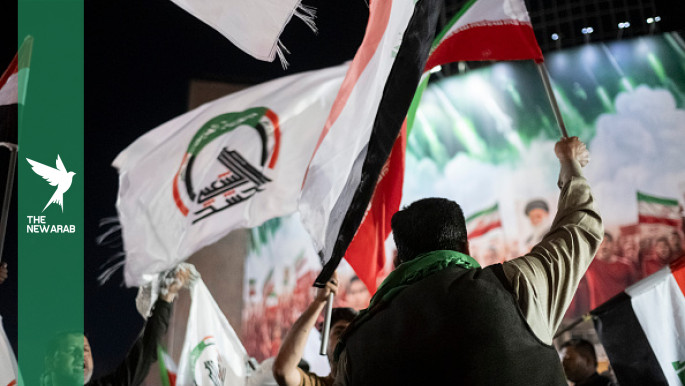
Kataib Hezbollah, Kataib Sayyid al-Shuhada, and Harakat al-Nujaba are among the factions rejecting any steps that would lead to the dismantling of their formations or the reduction of their influence.
These groups insist on retaining their weapons under the justification of protecting Iraq and confronting external threats. At the same time, Washington considers the continued existence of such armed groups outside government control to be an obstacle to any long-term strategic partnership with Baghdad.
Fears of economic sanctions
The economy is considered Iraq’s main vulnerability in the face of American pressure, with Baghdad fearing partial or total economic sanctions that could limit its ability to sell oil and access hard currency.
Since mid-2003, during the US invasion of Iraq, Iraqi oil revenues have automatically been deposited into a special account at the US Federal Reserve as part of what was then described as protecting Iraqi funds from claims by creditors of Saddam Hussein’s regime.
The US Treasury sends shipments of dollar cash to Baghdad on regular flights.
Last month, a delay in the arrival of $500 million in Iraq’s funds deposited in the United States led to a major decline in the dinar’s exchange rate against the dollar, which fell to 1,555 dinars per dollar.
Government financial adviser Mazhar Mohammed Salih attributed the delay to airspace closures caused by the war on Iran, ruling out deliberate American interference in delaying the transfer.
Sunni Arab and Kurdish parties are seeking to avoid taking a position on American pressure on the Coordination Framework coalition, with senior leaders declining to comment to The New Arab.
However, a member of the Taqadum party led by Mohammed al-Halbousi, one of the leading Sunni Arab parties, told The New Arab that “the public generally supports ending the militarisation of society, preventing the creation of a state within a state, strengthening government institutions, enforcing the rule of law, and moving toward a citizenship-based state”.
He added, however, that “the United States is imposing conditions without guarantees about the next day”.
He considered that “the existence of an Israeli interest behind American pressure on Iraq makes even opponents of the armed factions step back and refuse to support what Israel supports”.
In remarks described as the first of their kind since the start of the war on Iran on 28 February, Sheikh Kazem al-Fartousi, spokesperson for Kataib Sayyid al-Shuhada, which Washington recently designated a terrorist organisation, told The New Arab that “American pressure on Iraq regarding the resistance factions and resistance weapons is escalating within a political and security context aimed at reshaping Iraq’s security landscape in line with the American vision for the region”.
Al-Fartousi said that “merely discussing dismantling the armed factions, ending them, or reducing their combat capabilities is categorically rejected. The factions form an essential part of Iraq’s defence system and have proven their presence in confronting terrorist organisations and dangerous security challenges over recent years”.
He warned that “any external attempts to pressure toward disarmament or ending the factions’ role will not achieve the desired results and will not change the reality in Iraq”.
“We remain committed to our weapons as a tool to protect the country and deter any threats that may target Iraq’s security and sovereignty in the future,” he added.
Al-Fartousi stressed that “no matter how much pressure escalates, whether political, economic or security-related, it will not push the factions to change their fixed position”.
“The factions do not fear external threats and deal with developments according to national interest and the necessities of the security reality,” he added.
However, he concluded by saying that “the future of this issue should be discussed within a domestic national framework away from external dictates”.
The issue of armed factions and their weapons existing outside state authority places the anticipated Zaidi government before an early and highly complex test.
The government faces the challenge of balancing the need to preserve internal political alliances on the one hand and to respond to American and international pressure on the other, particularly amid growing discussion linking economic support, foreign investment, and security cooperation to the future handling of uncontrolled weapons and armed factions.
Iraqi political affairs researcher Hussein al-Asaad told The New Arab that “ongoing American pressure on Baghdad regarding dismantling armed factions represents a complex challenge for the anticipated Iraqi government, and this file has become directly linked to the future of international support and political understandings with Washington during the coming phase”.
He added that “the United States views the armed factions issue as a core priority in any understanding with the new Iraqi government, especially after escalating regional tensions and attacks targeting American interests and bases in recent periods”.
“Washington is clearly seeking to restrict weapons to state control and reduce the military influence of Iran-linked factions inside Iraq,” he said.
Al-Asaad said that “the next government will face an extremely difficult equation because it is required to preserve internal balances and avoid losing the armed groups politically allied with it, while at the same time attempting to ease American and international pressure that could affect economic support, investment and security cooperation with Iraq”.
He warned that “any hasty steps regarding this issue could create political and security tension inside the country”.
“For that reason, the next government is likely to move toward gradual solutions based on dialogue and understanding rather than direct or confrontational measures against the armed factions,” he added.
Article translated from Arabic by Afrah Almatwari. To read the original, click here.