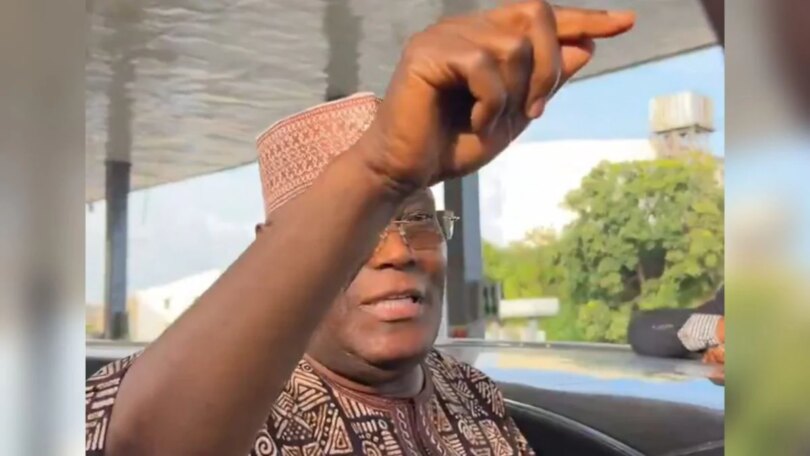
The ADC presidential candidate, Atiku Abubakar, and his running mate, Rotimi Amaechi, have reiterated their promise to reduce the cost of petrol, with Amaechi making the pledge during a stop at a petrol station.
Amaechi, who was driving Atiku, pulled up at the station with the former vice president as people around the facility gathered and waved at the ADC presidential candidate.
A member of the public asked the ADC team what they intended to do about the high cost of fuel.
Responding after stepping out of the vehicle, Amaechi said Atiku had already explained the plan to address the cost of petrol if elected president in 2027.
“Didn’t you listen yesterday? The president, if you elect President Atiku, he will bring down the price of fuel by introducing production subsidy,” Amaechi said.
Atiku, who barely stepped out of the vehicle, waved at the crowd around the station as they waved back at him.
The two ADC candidates subsequently left the petrol station, with Amaechi returning to the driver’s seat and driving Atiku away.
The brief interaction came amid renewed debate over fuel prices and the future of petrol subsidies, which has become one of the major economic issues in the buildup to the 2027 presidential election.
Atiku had used his Independence Day message on Thursday to outline his proposal for what he described as a production subsidy designed to reduce the cost of petroleum products without returning to the previous system of subsidising imported petrol.
The former vice president said an ADC government would introduce a capped and budgeted production subsidy tied to verified fuel refined in Nigeria, including products from modular refineries. Imported petrol, he said, would not qualify for the proposed scheme.
Atiku also said the subsidy arrangement would be publicly documented and independently audited, with the benefit passed on to consumers through lower pump prices.
“Working with my running mate and our partners in the African Democratic Congress, I will pursue a clear purpose: make life affordable again,” Atiku said in his Independence Day message.
His proposal came after he criticised President Bola Tinubu over the issue of transportation costs and the government’s promise that Nigerians would begin to see measurable reductions in transport fares from October 1.
“Before I forget, you promised Nigerians lower transport fares from October 1st. Today is October 1st. Did your promise materialize?” Atiku asked.
He also questioned the President’s reference to his proposal to make life more affordable, arguing that details of the promised transport fare reductions had not been sufficiently provided.
“In your Independence Day speech, you found time to attack my plan to make life affordable. But you did not tell commuters which additional routes became cheaper today. What the fares were before, what they cost now, or how many people can use them,” he said.
Atiku further challenged the Federal Government to publish the routes covered by the fare reductions, the old and new fares and the number of commuters expected to benefit.
“Show them the routes and the prices. Nigerians cannot board an announcement. Publish routes, the fares, and the number of people benefiting. Show Nigerians a cheaper journey you promised,” he said.
The fuel subsidy debate has also featured prominently in Amaechi’s recent campaign appearances. On Friday, the former Rivers State governor said he would withdraw his support for Atiku and campaign for Tinubu if petrol sells for N600 per litre.
“If fuel comes down to N600 tomorrow, I will withdraw as vice president for Atiku and I will campaign for Tinubu,” Amaechi said during an appearance on Channels Television’s Politics Today.
He also said his opposition to Tinubu was not based on personal hatred, stating, “Nobody hates Tinubu. I love Tinubu, he knows.”
The Tinubu administration removed the petrol subsidy on May 29, 2023, shortly after the President assumed office. The decision led to a sharp increase in petrol prices and contributed to higher transportation, food and business costs.
The Federal Government has defended the removal as part of its economic reforms, arguing that the subsidy imposed a heavy financial burden on the country and that government resources could be redirected to other areas.
Tinubu also addressed the subsidy debate during his Independence Day broadcast, urging Nigerians not to support politicians promising to restore petrol subsidies.
The Presidency has estimated that implementing Atiku’s proposed petrol subsidy could cost about N19.1 trillion annually, depending on crude oil prices and other factors.