
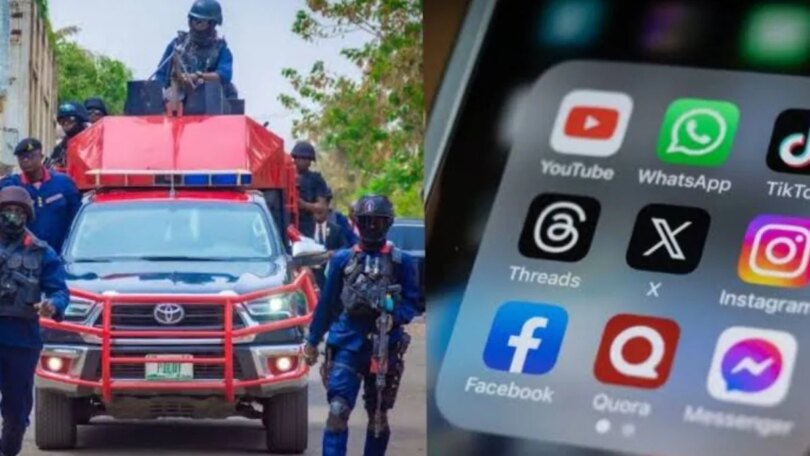
The NIPR and NSCDC have raised concerns over the role of misinformation and irresponsible social media use in worsening insecurity and tension in Nigeria.
The warning was issued on Saturday in Abuja during a nationwide roadshow organised by the Nigerian Institute of Public Relations ahead of the 2026 World Public Relations Forum, WPRF, scheduled to take place in the Federal Capital Territory in November.
The sensitisation campaign is aimed at encouraging Nigerians to verify information before sharing it, particularly at a time when social media platforms have become major channels for the rapid circulation of news, videos and other forms of content.
In Abuja, the Federal Capital Territory chapter of the NIPR began its awareness exercise from the Zoological Garden in Area 1.
The campaign focused on the need for responsible communication and the possible security consequences of spreading false or unverified information.
Speaking during the exercise, the FCT Commandant of the Nigeria Security and Civil Defence Corps, NSCDC, Dr Olusola Odumosu, warned that information circulated without proper verification could create fear, cause confusion and expose innocent people to attacks.
Odumosu particularly raised concerns about old photographs and videos being presented as recent incidents.
According to him, such material could easily mislead members of the public and create the impression that a crisis is taking place when there is no such incident.
“Somebody would just wake up from somewhere, bring a video that is as old as 20 years, where maybe a crisis happened, and you just tag it as happening now in Kano State. Such irresponsible communication heats up the polity,” Odumosu said.
The NSCDC commandant said the problem was made worse by the speed at which information travels on social media.
He noted that many people share content because it appears urgent or sensational without taking steps to establish whether it is genuine.
He warned that such behaviour could have consequences beyond online discussions, particularly when false reports concern security incidents, ethnic or religious tensions, banditry, kidnapping or attacks.
“People should get to know that it is not too good to send out information that can heat the polity, send out information that can make people start attacking themselves, send out information that can encourage banditry or kidnapping and all of that,” he said.
Odumosu also linked the campaign to the theme of the forthcoming World Public Relations Forum, “Responsible Communication: The Voice of the World”.
He said the theme was relevant to the security situation in Nigeria because the way information is communicated can influence how members of the public respond to events.
The warning comes as social media continues to play a major role in how Nigerians receive and distribute information.
While the platforms allow information to reach large audiences within minutes, misleading material can spread just as quickly.
The NIPR said the roadshow is part of activities leading to WPRF Abuja 2026, which will bring communication professionals and other stakeholders together to discuss emerging issues affecting the profession and the wider information environment.
Chairman of the National Planning Committee for WPRF Abuja 2026, Dr Suleiman Haruna, also drew attention to the growing influence of artificial intelligence on information production and distribution.
Haruna acknowledged that people have a constitutional right to express their views.
However, he stressed that such freedom should be exercised with consideration for the rights and safety of other people.
“People feel free to express themselves. And it’s a constitutional right for people to express themselves. But unfortunately, your rights stop where the right of the next person starts,” Haruna said.
He said the increasing use of artificial intelligence had introduced additional challenges for information integrity.
The technology has made it easier to create, alter and distribute different forms of content, making it increasingly important for people to establish the origin and authenticity of information before accepting or sharing it.
Haruna said the forthcoming forum would provide an opportunity to examine how information is created and consumed in the era of artificial intelligence.
A member of the planning committee, Inimfon Etuk, said the nationwide roadshow was designed to create greater awareness about the global forum.
Etuk said the event would bring together public relations practitioners and strategic communication stakeholders from Nigeria and other parts of the world.
The roadshow is therefore being used to take the message of responsible communication beyond professional circles and directly to members of the public.
The Chairman of the NIPR FCT Chapter, Stanley Ogadigo, said Nigeria secured the right to host the World Public Relations Forum after a competitive bidding process.
According to him, the 2026 edition will be the first time the global forum will be held in Nigeria.
The event will also take place alongside the 37th annual conference of the African Public Relations Association, APRA.
Ogadigo described the hosting opportunity as one that should attract broad support from Nigerians, corporate organisations and institutions.
He called for the forum to be treated as a national project and not merely an event for members of the public relations profession.
The NIPR FCT chairman said the gathering would also provide an opportunity for Nigeria to showcase its culture, hospitality and capacity to host major international events.
The World Public Relations Forum is scheduled for November 15 to 21, 2026, in Abuja.
The Inspector-General of Police, Olatunji Disu, had earlier pledged the Nigeria Police Force’s support for the event, with the NIPR stressing the importance of stronger cooperation between communication professionals and security institutions.
However, the NIPR and NSCDC are urging users to pause and verify information before forwarding it, particularly when the content relates to security incidents or could provoke public reaction.