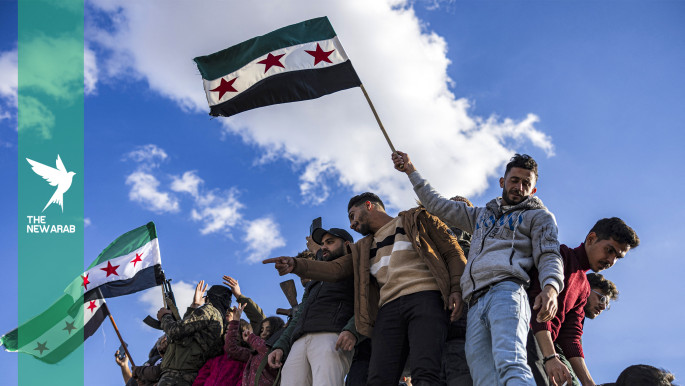
Damascus, Syria – A protest in central Damascus on Friday turned ugly as brawls broke out between protesters and counter-protesters, highlighting Syria’s continued internal divisions.
The ‘Law and Dignity’ protest was organised to demand a number of political and economic reforms, like an improvement to living conditions and public services, and the protection of rights.
This comes amid a deteriorating economic reality for many Syrians, a fragile security situation, and concerns about the patchy application of the rule of law.
Yasmine, 14, came to the protest with her parents because “she wants to have the same rights as everybody across the world”.
“I don’t want to have to dream about leaving my country just to have a normal life. As Syrians, we grow ten years older every day because we have been denied our rights,” she explained to The New Arab.
“I’m here because I want the government to hear my voice and know that I want to live, I don’t just want to survive.”
The demonstration was denounced by pro-government counter-protesters, who arrived ahead of the planned protest to raise Syria’s revolutionary flag alongside the white flag of the shuhada. According to them, the protest was organised by individuals associated with the former regime, working on behalf of external powers.
With little initial police presence, violence quickly broke out between the two sides, as counter-protesters attacked several individuals holding placards calling for reforms.
While riot police soon separated the two opposing sides, it did little to cool tensions. As protesters chanted revolutionary slogans espousing the unity of all Syrians, counter-protesters responded by hurling objects over the heads of the police lines and calling for the “regime thugs” to be kicked out of the country.
“We paid for our dignity at the cost of a million martyrs. After more than a decade of war, we need time to recover, yet these people criticise the government. Do they really expect us to become like Switzerland after a few months?” Abu Aboud, a counter-protester, told TNA.
“Look how our state protects them,” he said, pointing to the lines of police in riot gear. “Assad would never have protected us like this. This is what we fought for.”
The atmosphere was fiercely hostile. A journalist, Mirella Abu Shannab, was assaulted during a live broadcast. One individual attempted to drive his car through protesters but was apprehended by the security services before he managed to do so.
As TNA was leaving the protest, two individuals were being pulled apart by police. “We will be waiting for you,” the pro-government protester warned.
A protest riven by class division
Information was circulating online ahead of the protest that the organisers were remnants of the former regime, fuelling anger and threats of violence. In one video, a man filmed several of his weapons, threatening that “God willing, tomorrow, we will cut off your heads, pigs.”
There is little evidence that Assad remnants were behind the protest, although calls to protest were amplified online by individuals and accounts linked to the Assad regime. Instead, it appears to have been organised by a network of activists and dissidents abroad, mostly located in Germany and Turkey.
“There was also a clear divide between the sides defined by class and regionalism,” Malik al-Abdeh, the Editor-in-Chief of Syria in Transition, told TNA.
Although there were protesters from a range of backgrounds and religions, in general, they appeared to stem from the Damascene secular middle-upper class crowd.
Pro-government protesters, meanwhile, were more likely to be from the provinces or Damascus’ outer suburbs, which are often more conservative.
“Part of the anger is that those lower-class regional Syrians suffered most during the war. Whilst the class which is now protesting was largely shielded from the worst of it,” explains Al-Abdeh.
“It’s not that the demands aren’t legitimate, but that those protesting didn’t win the right to complain during the war.”
Demands for reform
The organisers of the event outlined ten demands ranging from economic issues like halting price increases and curbing monopolies to political reforms such as ensuring transitional justice and enabling a genuine political transition.
The Syrian government, in an attempt to restore the public finances, has cut a raft of subsidies on crucial goods, including fuel and electricity, that have brought skyrocketing prices. Electricity costs are up by between 60-800% depending on the tariff.
“Lifting fuel and electricity subsidies before wages and social protection could catch up has pushed households into a harder bargain than the transition promised them,” explains Nanar Hawach, senior researcher for the International Crisis Group (ICG).
In a country where 90% of the population remains under the poverty line, such price hikes can be crippling.
This is coupled with the Syrian lira’s continued inflation. The fall of the Assad regime and the removal of sanctions buoyed the lira, sending it as low as 9,000 to the dollar.
In recent months, however, it has weakened, now reaching 13,000 lira to the dollar – a troubling milestone that nearly mirrors its frailest point under the Assad regime.
Syrians are pushing back on “appointments that reward loyalty over competence, budgets and contracts that travel through a narrow circle, and a judiciary without the independence to question either,” Hawach tells TNA.
“These are structural choices, and structural choices can be revisited.”
Meanwhile, “corruption is making a comeback,” argues Al-Abdeh. It disappeared after the fall of the Assad regime, he explains, but is now returning, partly because many of the old regime employees are still in place and are returning to their old habits.
“Members of the new government are also insufficiently trained to identify and combat corruption,” he adds.
“The mood is darkening, but the question is, will it ever translate into a mass movement for change. I am doubtful.”
An attempt to build an opposition
Whilst Syria has witnessed a number of protests against specific governmental policies, this marks the first sign of dissent towards “the direction of travel, targeting the macro-features of the transition itself,” says Hawach.
“This protest was a proof of concept,” explains al-Abdeh. “They were likely hoping to see whether they could get the street to join them.”
Despite rumours swirling that the protest was going to be the biggest since 2011, in reality it attracted a relatively small turnout – numbering perhaps in the hundreds – from a relatively narrow part of Syrian society.
The organisers, being activists living abroad, “have limited reach within Syria itself and can’t command the Sunni street”. He clarifies that a real opposition would need to be a broad-based coalition that incorporates figures who have support in conservative, religious, and provincial circles.
“Equally, the government holds the Sunni sectarian card. They can credibly argue that, despite our failings, the only alternative is a return to minority rule,” says Al-Abdeh.
“For the working-class Sunni, even if you’re poorer than before, the feeling that your people are running the show is a powerful psychological tool for the government.”
Syria’s post-Assad transition is still in its early days. The country has yet to establish a parliament or draft a new constitution, leaving its trajectory uncertain.
For now, opposition to Syria’s new government remains limited, but the reaction to Friday’s protest has exposed how Syria remains deeply divided, not just over policy, but also over who has the right to demand change, and when.
Cian Ward is a journalist based in Damascus, covering conflict, migration, and humanitarian issues
Follow him on X: @CP__Ward
Edited by Charlie Hoyle