
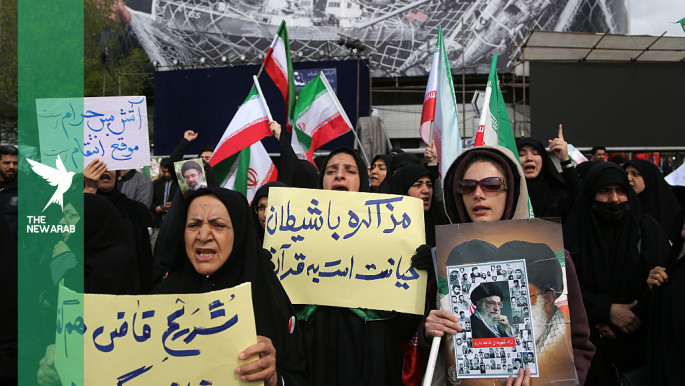
Iranians gather at Revolution Square, Tehran, to protest against the temporary ceasefire between the US and Iran on 8 April 2026. [Getty]
A major escalation of the Middle East war was narrowly averted on Tuesday evening after Iran and the United States agreed to a temporary ceasefire and to enter negotiations to permanently end the devastating six-week conflict.
The deal, brokered by Pakistani mediators, will see the US, Israel and Iran pause the conflict for two weeks and came hours after Trump had threatened that Iran’s “whole civilisation will die” if it did not make a deal.
This is what we know – and what we don’t – about the potential turning point in the conflict.
A ceasefire on Iran’s terms
Writing on Truth Social, Trump announced that a 10-point proposal submitted by Iran would form a “workable basis on which to negotiate”.
Though Trump reiterated that the US military had exceeded all its objectives, details of the plan published by Iran have since revealed just how many of its maximalist demands it succeeded in putting on the negotiating table.
According to Iran’s Supreme National Security Council, the proposal involves a recognition of Iran’s right to enrich uranium, the lifting of all sanctions and the withdrawal of US forces from the region. All attacks against Iran and its regional allies would end, Iran would remain in control of the Strait of Hormuz, and compensation would be paid for its wartime losses. All of this would be codified in a legally-binding UN Security Council resolution.
The plan also includes a commitment by Iran not to build a nuclear weapon, according to Iranian media.
Iran was triumphant following the deal’s announcement, describing it as an “undeniable, historic, crushing defeat” of the US.
“Iran has achieved great victory and forced the criminal America to accept its 10-point plan,” the council said in a statement.
A major climbdown?
Though Iran has made some changes from its previous ceasefire gambit – notably walking back its rejection of a temporary truce – the proposal indicates that the White House is readying itself to make serious concessions to bring an end to the war.
Trump had until yesterday demanded that Tehran agree to all his pre-war conditions, which included banning nuclear enrichment, curbing its missile programme, and breaking ties with its regional allies. Now, the right to enrich uranium – previously a red line for the US administration – appears to be up for discussion.
The proposal also includes points of negotiation that before the war would have been unthinkable. The Trump administration is now seemingly open to discussing the future status of the Strait of Hormuz, signalling a potential break with a decades-long precedent of guaranteeing the free movement of Middle East energy. Similarly, Iranian demands for compensation and a US military pullback were dismissed by US officials as unserious when they were first made a few weeks ago.
The status of the strait
There have been conflicting accounts of what has been agreed regarding the crucial Strait of Hormuz.
While Trump said Tehran committed to the “complete, immediate” opening of the waterway, Iranian media reports have suggested a more limited agreement.
An unofficial proposal carried by the semi-official Fars news agency stipulates “limited daily passage of ships through the Strait of Hormuz for two weeks, under the title of the Safe Passage Protocol, which is supervised and governed by the country’s specific rules”.
Reports suggest that Iran will continue to charge a $2 million transit fee to all ships crossing the strait, which will be shared with Oman. The arrangement would provide Iran with billions of dollars of new revenues every year should it remain in place. Oman has since denied that it would collect levies on ships in the waterway.
Several vessels transited the strait via the corridor delineated by the Revolutionary Guards in the hours following the truce, according to tracking data, suggesting Iran is continuing to control shipping activity.
Shipping through the critical chokepoint has marginally increased in recent days as Iran made deals with individual countries to allow their ships safe passage.
Eyes on Lebanon
Fresh Israeli attacks in Lebanon this morning are threatening to unwind the ceasefire just hours after its announcement.
Israeli officials have insisted that the agreement does not apply to its war with Hezbollah and have launched new strikes across the south of the country. Tehran has since warned it would end its ceasefire with Israel if it does not halt its attacks in the coming hours.
This comes despite Pakistani Prime Minister Shehbaz Sharif announcing that the ceasefire would be applied “everywhere including Lebanon”.
Hezbollah has not announced any new attacks on Israeli forces since the ceasefire came into effect.
Talks to start this week
Negotiations are expected to start on Friday and will take place in Islamabad alongside Pakistani mediators. The talks will last for two weeks but could be extended if there is no agreement in place.
The Trump administration is still considering whether to meet directly with Iran’s negotiating team, White House press secretary Karoline Leavitt said yesterday.