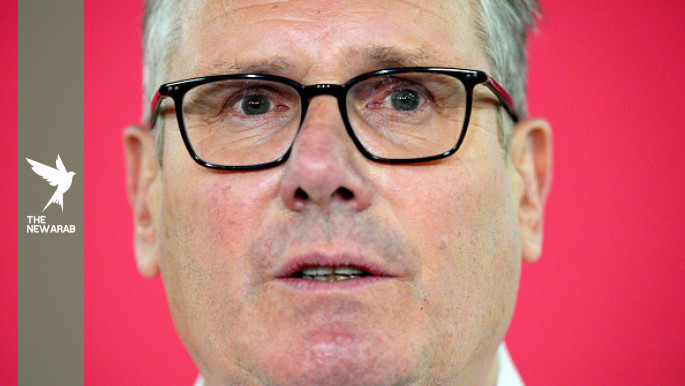
Keir Starmer is facing calls to leave office, but his strongest rivals are yet to launch an official challenge [Getty]
UK Prime Minister Keir Starmer has so far resisted calls to resign despite more than 80 Labour MPs urging him to make way for a new leader.
Starmer appears to have dug in his heels for now, saying he will “get on with governing”. His position largely rests on the fact that no single candidate has yet secured the backing of 20% of Labour MPs, equivalent to 81 of the party’s 403 lawmakers, needed to launch a formal leadership bid.
The New Arab takes a look at who could be in the running to replace Starmer and their records on the Middle East.
Wes Streeting
Health and Social Care Minister Wes Streeting, 43, has frequently been named in reports as plotting a leadership bid, even prior to the recent crisis.
Streeting is viewed as being on the right of the party and as a protégé of disgraced former UK ambassador Peter Mandelson, who was appointed by Starmer and later sacked over links to convicted sex offender Jeffrey Epstein.
While Streeting is less popular among Labour’s traditionally left-leaning grassroots, leadership election rules introduced under Starmer in 2020 shifted more power to the Parliamentary Labour Party (PLP), raising the threshold required to get on the ballot from 10% to 20% of MPs.
The rule changes strengthened the leader’s position against challengers and sidelined the party’s left, effectively preventing the rise of left-wing backbenchers such as former leader Jeremy Corbyn.
Under the current rules, Streeting would likely be able to launch a bid with support from parliamentary colleagues. Analysts have suggested the present circumstances may favour him, particularly as his strongest potential rival, Manchester Mayor Andy Burnham, does not currently hold a seat in parliament. Many of the MPs publicly calling for Starmer’s resignation are also considered allies of Streeting.
Streeting narrowly retained his Ilford North seat in 2024 by just 528 votes after losing 20% of his vote share. His closest challenger, British Palestinian candidate Leanne Mohamad, ran on a pro-Palestine platform that directly challenged his staunchly pro-Israel stance.
Streeting, a member of Labour Friends of Israel (LFI), received nearly £30,000 from pro-Israel lobby groups, according to a 2024 report by Declassified UK. This included a 2022 visit to Israel funded by LFI, making him the first member of Starmer’s then-shadow cabinet to visit the country.
In February, as further revelations emerged regarding Mandelson’s links to Epstein, Streeting attempted to distance himself by publishing private text messages between the two.
“Morally and politically, I think we need to join France,” Streeting wrote to Mandelson in July 2025, referring to Paris’s recognition of Palestinian statehood.
“Morally, because Israel is committing war crimes before our eyes. Their government talks the language of ethnic cleansing, and I have met with our own medics out there who describe the most chilling and distressing scenes of calculated brutality against women and children.”
The messages were widely seen as sharply contrasting with both Streeting’s and the Starmer government’s public position on the Gaza genocide.
Andy Burnham
Andy Burnham is the Mayor of Manchester and a former minister under Gordon Brown.
After losing heavily to Jeremy Corbyn in the 2015 Labour leadership contest, Burnham rebuilt his political profile through regional politics, winning the Manchester mayoralty three times since 2017.
Burnham is widely seen as the preferred “soft Left” candidate within Labour, enjoying support from both members of the Socialist Campaign Group, once aligned with Corbyn and some centrist MPs.
In what many viewed as an attempt to block his return to Westminster, Labour’s National Executive Committee (NEC) prevented Burnham from standing in the Manchester Gorton and Denton by-election in February. Labour later lost the seat to Green Party candidate Hannah Spencer.
Burnham’s supporters, notably absent from the calls for Starmer’s immediate resignation, face the challenge of orchestrating a managed transition that would allow time for Burnham to enter parliament through a by-election. This is believed to be one reason some MPs have instead urged Starmer to outline a roadmap ahead of Labour’s September conference.
On the Middle East, Burnham voted in favour of Tony Blair’s 2003 invasion of Iraq before later criticising aspects of the so-called War on Terror. His shifting positions on some issues have led critics to label him a political chameleon, though supporters argue that flexibility may work to his advantage.
Burnham joined Labour Friends of Israel in 2015, the same year Labour shifted leftward under Corbyn’s leadership.
During his unsuccessful leadership campaign, Burnham said his first overseas visit would be to Israel and described the country as a “democracy that has a long history of protecting minorities and promoting civil rights”.
He has also previously described the Boycott, Divestment and Sanctions (BDS) movement as “spiteful”.
Angela Rayner
Angela Rayner stepped down as deputy prime minister, deputy Labour leader and housing secretary in 2025 after admitting she had unintentionally underpaid taxes on a property purchase and was found to have breached the ministerial code of conduct.
Following Labour’s disastrous local election results, Rayner criticised the party’s decision to block Burnham’s return to parliament. She also urged Starmer to “meet the moment” and respond to the challenges facing Labour, while stopping short of calling for his immediate resignation.
Rayner’s recent statements, coupled with the unresolved nature of her tax affairs, suggest she may choose not to run herself and instead support a Burnham candidacy.
Ed Miliband
Energy Secretary Ed Miliband, associated with Labour’s ‘soft left’, has also been floated as a possible successor to Starmer, although his previous spell as party leader may weaken his prospects.
Miliband led Labour between 2010 and 2015 but failed to defeat Conservative Prime Minister David Cameron at the 2015 general election.
He later said the experience had “inoculated” him against wanting the leadership again.
Before succeeding Gordon Brown in 2010, Miliband became the first leadership contender to make the Iraq War a central issue, saying it had caused “a catastrophic loss of trust in Labour”.
Miliband, who entered parliament two years after the Iraq invasion, later said he had previously been less outspoken because he was “part of a collective responsibility”.
In 2013, he voted against British airstrikes on Syria following a chemical weapons attack by the regime of Bashar al-Assad. After Assad’s ouster in December 2024, Miliband said he had “no regrets”, citing what he called lessons from the Iraq war.
In a 2014 speech to Labour Friends of Israel, Miliband said he was “proud to be a supporter” of the group, linking his affinity for Israel to his Jewish heritage.
While describing himself as a “strong friend of Israel”, he also criticised Israel’s 2014 assault on Gaza as “wrong and unjustifiable”.
More recently, Miliband abstained on an SNP motion in November 2023 calling for an immediate ceasefire in Gaza.
Shabana Mahmood
An MP since 2010, Shabana Mahmood was promoted to home secretary in September after serving as justice secretary, becoming the first Muslim woman to hold either role.
However, her positions in office have contrasted sharply with those she held as a backbencher. Mahmood has taken a hard line on immigration and overseen restrictions on pro-Palestine activism.
During her tenure, UK police arrested thousands of protesters for displaying placards expressing support for the proscribed group Palestine Action, while Mahmood also oversaw the banning of London’s annual Quds Day rally in March.
Before entering government, Mahmood described herself as a “passionate and determined supporter of Palestinian rights” and frequently attended pro-Palestine demonstrations.
In 2014, she urged supporters on Twitter to attend a protest outside a Sainsbury’s branch in Birmingham in support of the BDS movement.
In November 2023, Mahmood followed the party line by abstaining on a vote calling for an immediate ceasefire in Gaza, although she later signed and backed a motion calling for a truce in February 2024.
Agencies contributed to this report.