It cannot be doubted that the [UK] government’s proscription of the actionist group [Palestine Action] would have an impact on how any jury might understand the actions against Elbit Systems, writes Asim Qureshi. [GETTY]
In July 2000, Mohamad Hammoud and his brother ran a multi-million-dollar cigarette smuggling operation in the US by transporting $7.9 million worth of cigarettes from North Carolina to Chicago – taking advantage of different tax regimes to turn a profit. Out of this criminal conspiracy, there was an additional charge under 18 USC §2339(B), better known as the material support to a designated foreign terrorist organisation (FTO). Hammoud was accused of sending $3,500 to Hezbollah leaders and thus became the first individual to be convicted of a material support charge in the US.
Lesser known of this case was the use of Section 3A1.4 in the federal sentencing guidelines, known as the terrorism enhancement. Where there is a base sentence for a convicted offence, the Patriot Act permitted a severe increase in the sentence if there was a connection to terrorism, even if no terrorist act or plot was indicated.
Hammoud found himself in a position where his maximum potential sentence of 135 months for the cigarette smuggling was turned by the judge into 1860 months – essentially a sentence of 155 years in prison.
While in the case of Mohamad Hammoud, there was a charge of material support for terrorism through the alleged transfer of money to Hezbollah, there are a range of cases where there was no charge or conviction of any terror-related offence, where the terrorism enhancer was still used.
The most well-known of these cases is that of the Pakistani woman Aafia Siddiqui, who, in a sham arrest and trial, was convicted of attempted murder of US officials abroad – an entirely concocted arrest by the FBI. Although the prosecution in her trial explicitly stated that they would not be bringing in any charges relating to terrorism, the terrorism enhancement was still applied to her sentence.
If one is to suspend disbelief and accept the FBI’s version of events, Siddiqui did not hurt a single person, and yet due to the terrorism enhancement being arbitrarily applied without any indication of terrorism in the trial itself, she was given an 86-year sentence – one that she continues to serve to this day.
Pre-criminal
Material support charges in the US and the federal sentencing guidelines have led to manifold injustices in the course of a quarter of a century of the War on Terror, one that continues to create convictions on the most spurious grounds. US terrorism policymaking operates like a threadworm to British policymaking – always finding its way into its darkest recesses.
Contrary to popular understanding of how terrorism laws work in the UK, they are largely used where there is no violence – they are used for what are generally termed pre-criminal offences. When individuals are caught committing acts of violence, the UK Crown Prosecution Service usually brings charges under the Offences Against Persons Act or the Fire and Explosives Act.
A thoughtful person might ask why terrorism laws are not used against actual violent offenders. The answer to this is that terrorism laws are largely a political tool based on the repression of communities that are often in a position of dissent to the state. Thus, Muslims, left-wing groups and environmental activists are often targeted under such powers for refusal to comply with counter-terrorism stops, or for downloading or reading material considered to be ‘extremist’ – these convictions are largely in that pre-criminal space where there is no suggestion of a violent crime.
In 2018, following from the use of the terrorism enhancement sentencing guidelines in the US, the UK introduced a ‘terrorism connection’ sentencing tariff increase where there was a conviction for a violent crime – such as hijacking or murder. By 2021, they introduced Section 69 of the Sentencing Code, under which any offence not covered by a terrorism offence, but for which a ‘terrorism connection’ can be identified by the judge, sentencing can be aggravated by that connection – this would include non-violent offences that had a sentence of over two years.
This has become a means by which the state is able to increase the lengths of sentences for individuals who are not charged with terrorism, but the state wishes to increase their tariff through the back door.
Filton 24
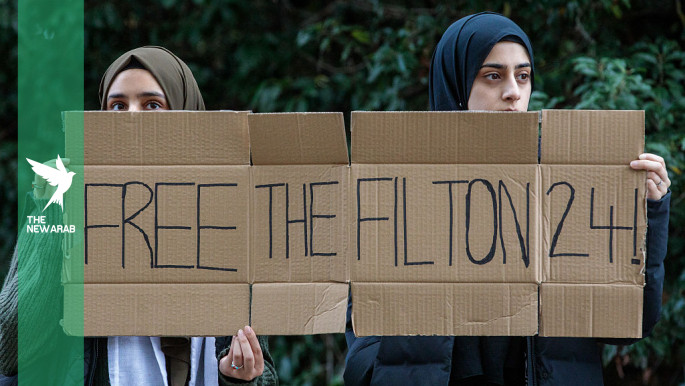
During the first trial of the Filton 24, where the six individuals who were caught inside the Elbit Systems factory were prosecuted for criminal damage, there was no indication that the CPS would bring terrorism charges against the group – but they did indicate that they intended to bring a ‘terrorist connection’ – an error on their part as they were forced to acknowledge how it might prejudice the first trial.
In a pre-trial hearing, the judge Justice Johnson stated that he would consider a terrorism connection for the purposes of sentencing – except – that he denied any reporting on his desire to apply this sentencing code. Although the six were acquitted of the most serious charges in the first trial and received a hung jury on the remaining charges, the second trial resulted in convictions for four of the six for criminal damage in April 2026.
The jury was denied any knowledge that the judge might apply a higher tariff to their sentence based on the ‘terrorism connection’, and thus were denied the ability to assess what was at stake for the defendants before them.
Normally, the sentence of the four would result in time served due to the 18 months they spent remanded in custody, but now they face the prospect of an aggravated sentence if the judge applies that ‘terrorism connection’ tariff at its most severe. This will be followed by a period of anywhere between fifteen and thirty years during which they must notify the police of their movements once they are released.
This entire trial has been mired in inappropriate conduct by the UK government, who have made very public claims about the Filton actionists and Palestine Action, thereby prejudicing any prospect of them having a fair trial.
The ‘terrorism connection’ in the case of the Filton 24 is not impacted by the proscription of Palestine Action, but it cannot be doubted that the government’s proscription of the actionist group would have an impact on how any jury might understand the actions against Elbit Systems.
Who’s really inflicting terror?
It’s worth reminding ourselves of who we are talking about here – the ones who are being assessed as being connected to terrorism. The Filton 24 took action against an Elbit Systems factory that was producing drones and quadcopters that execute Palestinians in the streets of Gaza, the machinery that is directly involved in genocide.
To make plain the gross use of the word ‘terrorist’ to this group, we would do well to reflect on the words of Jordan Devlin, one of the acquitted Filton actionists: “Terrorists make bombs to destroy lives, not destroy bombs to save lives. These activists done what our government should be doing… The word terrorist has lost its meaning now. The British government have abused the Terrorism Act to the point that it is no longer fit for purpose, the watering down of the word terrorist is more of a threat to public safety than Palestine Action ever was.”
A UK Labour government led by Keir Starmer has consistently sided with the genocidal settler-colonial state of Israel, and in the process of that choice, has sought to repress expressions of pro-Palestine support. The apogee of Palestine activism has been through direct action – the only method of actually stopping the killing of Palestinian people as weapons leave the UK.
What we learn through this first instance of the ‘terrorism connection’ being instrumentalized in the case of the Filton 24 defendants is that the UK government will continue to play a role in ensuring that support for Zionism is maintained, regardless of the cost to its own citizens.
Dr Asim Qureshi is the Research Director of the advocacy group CAGE and has authored a number of books detailing the impact of the global War on Terror.
Follow him on Twitter: @AsimCP
Have questions or comments? Email us at: editorial-english@newarab.com
Opinions expressed in this article remain those of the author and do not necessarily represent those of The New Arab, its editorial board or staff.