BY EHI BRAIMAH
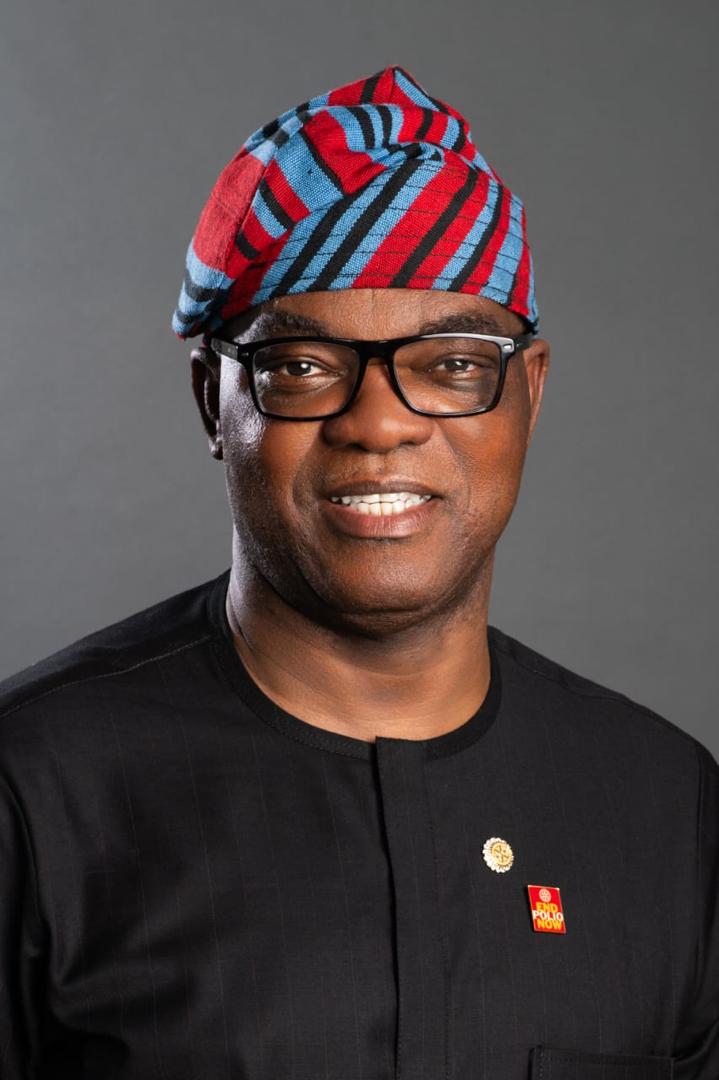
Yinka Babalola, Rotary International President
Peace is one of those words that everyone celebrates but not fully understood. Governments proclaim it, religious leaders preach it, international organisations promote it, and communities yearn for it.
Yet, across the world, conflicts persist, social divisions deepen, economic pressures intensify and public confidence in institutions continues to face serious challenges. The paradox is that humanity has invested enormous resources in development, technology, diplomacy and security, but sustainable peace, which is not essentially the absence of war, remains elusive.
This is why the All-Nigeria Rotary Peace Summit, scheduled for November 7, 2026, in Lagos, deserves attention beyond the Rotary community. Convened by Rotary International President Olayinka Babalola, the summit comes at a particularly important moment for Nigeria and the international community. Its theme, “Good Governance, Justice and Equity: Foundations for Sustainable Peace,” captures a fundamental truth: peace cannot be sustained where injustice thrives, institutions fail, opportunities are unequally distributed and citizens lose confidence in the social contract.
The gathering will bring together international peacebuilding experts, academics, media owners, journalists, policymakers, civil society leaders and security experts to examine practical solutions to Nigeria’s peace and development challenges. This multidisciplinary approach is important because peace is not the exclusive responsibility of governments, the military or security agencies. It is a collective undertaking that requires the participation of every segment of society.
Apart from containing conflicts after they erupt, Nigeria can build institutions, relationships and economic conditions that prevent conflicts from taking root in the first place.
The global warning: prosperity alone does not guarantee peace
The importance of the summit becomes clearer when viewed against developments around the world. From the protracted war between Russia and Ukraine to conflicts in the Middle East, Sudan and other parts of Africa, the international security environment remains fragile. The consequences extend beyond battlefields. They include displacement, food insecurity, disrupted trade, energy instability, humanitarian emergencies and increased pressure on national budgets.
Even countries traditionally associated with political stability and relatively strong institutions are experiencing social tensions. Across parts of Europe, demonstrations have been driven by rising living costs, unaffordable housing, stagnant wages and concerns about public services. Protests in France, Italy, Belgium, Spain, Germany and other countries illustrate how economic frustration can become a source of social discontent when citizens believe their circumstances are deteriorating and their concerns are not receiving adequate attention.
The lesson is instructive: peace is not guaranteed by wealth, geography or a country’s level of development; it must be continuously nurtured through responsive leadership, social inclusion, economic opportunity and institutions that command public trust.
The Institute for Economics and Peace (IEP), whose Director of Partnerships, Lea Perekrests, will deliver the summit’s keynote address, has made the relationship between peace and development central to its research. Its Global Peace Index assesses 163 countries and territories, representing 99.7 per cent of the world’s population, using 23 indicators across societal safety and security, ongoing domestic and international conflict, and militarisation. Its research also examines the economic consequences of violence and the conditions that enable peaceful societies to endure.
This makes Perekrests’ contribution particularly relevant. Nigeria needs to look beyond conventional security responses and understand the institutional, economic and social foundations upon which lasting peace is constructed.
Nigeria’s peace challenge is also a governance challenge
Nigeria’s security difficulties are complex, interconnected and geographically widespread. Insurgency in the North-East, banditry and mass abductions in the North-West, farmer-herder conflicts in parts of the North-Central region, separatist agitation in the South-East, communal violence, kidnapping and criminality in other parts of the country all point to the limitations of treating insecurity exclusively as a military or policing problem.
Security agencies have important responsibilities, but military operations alone cannot resolve the underlying grievances that sustain violence. Where communities feel abandoned; citizens cannot obtain justice; competition over land and resources becomes violent, and young people see little prospect of economic advancement, the conditions for instability become more pronounced.
This is where the summit’s theme becomes especially significant. Good governance, justice and equity are not abstract academic concepts; they have practical consequences for the daily lives of citizens.
Good governance begins with accountability, transparency, responsible leadership and the effective delivery of public services. It requires governments to listen to citizens, respect constitutional boundaries, manage public resources prudently and demonstrate that public office is a responsibility rather than a privilege.
A government that builds roads, schools, hospitals and other infrastructure is performing an important development function, but development must be inclusive. Citizens should not have to belong to a particular ethnic group, religion, political party or geographical location to enjoy the benefits of citizenship.
Equity means that everyone has a fair opportunity to participate in national life, access public services, pursue economic advancement and obtain justice without discrimination; it is not the same thing as receiving identical treatment.
Justice is equally fundamental. When citizens lose confidence in the justice system, they may begin to seek alternative means of resolving disputes, sometimes outside the law. Perceived impunity, prolonged trials, selective enforcement of laws and unequal access to legal representation can weaken the legitimacy of public institutions.
A society cannot sustain peace when people believe that the powerful operate above the law while ordinary citizens bear the consequences of its enforcement. Nigeria must therefore confront an uncomfortable reality: insecurity is a reflection of institutional weaknesses, unresolved grievances, poverty, exclusion and the erosion of public trust.
The economic cost of violence and the dividend of peace
There is also a compelling economic argument for prioritising peace. Violence destroys wealth, discourages investment, disrupts agricultural production, weakens tourism, increases insurance and security costs, and diverts public expenditure from education, healthcare and infrastructure to emergency interventions.
For a country struggling to attract investment, create jobs and diversify its economy, insecurity carries consequences far beyond the immediate loss of lives and property. Investors require predictable environments, functioning institutions, secure transportation networks and confidence that contracts and property rights will be protected.
The 2026 Global Peace Index provides a sobering international picture. According to the IEP, global peacefulness declined for the 12th consecutive year, with 61 active state-based conflicts recorded, the highest number since the Second World War. More than 181,000 people died in conflict-related violence in 2024. Nigeria ranked 143rd out of 163 countries in the 2026 index.
These figures should provoke serious reflection among Nigerian policymakers and citizens. They reinforce the argument that peace is not simply a humanitarian aspiration; it is an economic asset and a prerequisite for sustainable development.
A peaceful society creates the environment in which businesses can thrive, children can attend school without fear, farmers can cultivate their land, professionals can contribute their talents and communities can pursue development without constant disruption.
Conversely, the cost of insecurity is borne disproportionately by ordinary people, particularly those living in vulnerable communities. Displaced families lose their homes and livelihoods, children lose access to education, women face heightened risks of violence and exploitation, and young people become vulnerable to recruitment into criminal networks.
Nigeria must therefore begin to regard investment in peacebuilding as an essential component of its economic development strategy, not an optional addition to the national budget.
Why Rotary’s intervention matters
Rotary International has a long-standing commitment to peacebuilding and conflict prevention, which is one of its seven areas of focus. Its approach recognises that peace is built through practical service, education, community development, dialogue and the strengthening of relationships across cultural, religious and national boundaries.
Through its peace programmes, Rotary supports peace education, professional development, research and the training of individuals who can help prevent and resolve conflicts. Rotary Peace Fellowships, for instance, provide opportunities for emerging and established leaders to acquire specialised knowledge and skills in peacebuilding and conflict resolution.
This philosophy is particularly relevant to Nigeria, where the challenge is not only to stop violence but to build a society in which differences can be managed peacefully. Rotary’s strength lies in its community-based structure. Its clubs are present in different parts of the country, bringing together professionals, business leaders, public servants and other citizens who can mobilise resources and build partnerships around common interests.
This places Rotary in a useful position to complement government efforts, facilitate conversations across divides and support practical community interventions. The decision by Rotary International President Olayinka Babalola to convene an All-Nigeria Peace Summit is therefore significant. It creates an opportunity to bring the country’s Rotary family and a wider coalition of stakeholders into one conversation about Nigeria’s future.
It also demonstrates the potential of Rotary’s international network to connect local challenges with global expertise and experience. The keynote address by Lea Perekrests will be an important feature of the gathering. As Director of Partnerships at the Institute for Economics and Peace, she brings an institutional perspective that can help participants understand the relationship between governance, social cohesion, economic development and peace. The opportunity to draw from IEP’s research should enrich the conversation and encourage evidence-based recommendations rather than general declarations of good intentions.
From dialogue to action: What Nigeria must take away
The greatest test of the summit will be what happens after November 7. Nigeria has no shortage of conferences, policy dialogues, stakeholder meetings and high-level declarations. The country has also produced numerous reports identifying its development challenges. What is often missing is the political will, institutional discipline and sustained collaboration required to translate recommendations into measurable outcomes.
The summit agenda plans to establish practical pathways for action.
First, conversations will focus on strengthening community-based peacebuilding structures. Traditional rulers, religious leaders, youth organisations, women groups and community associations must be involved in early warning, mediation and conflict prevention. These institutions often understand local tensions long before they escalate into violence.
Second, Nigeria needs to review its justice system and address the perception that justice is available only to those who can afford it or have influential connections. Timely access to justice, respect for human rights, impartial law enforcement and accountability for wrongdoing are indispensable to public confidence.
Third, governments at all levels must recognise the relationship between economic exclusion and insecurity. Education, skills acquisition, employment opportunities, healthcare and access to basic infrastructure should not be seen as mere development targets; they are investments in social stability.
Fourth, the media must recognise its responsibility in promoting peace. In an age of social media, misinformation, inflammatory rhetoric, hate speech and the deliberate manipulation of ethnic and religious sentiments can escalate tensions rapidly. Journalists and media owners have a responsibility to defend freedom of expression while upholding professional standards, accuracy, fairness and responsible reporting.
Finally, young people must be central to the peacebuilding agenda. Nigeria has a large youthful population whose energy, creativity and entrepreneurial potential should be harnessed for national development. Young people should not be spectators; they should participate in designing and implementing solutions.
The organisers will produce a summit communiqué with clearly defined priorities, implementation timelines and measurable indicators. A follow-up mechanism involving Rotary districts, government agencies, civil society and the private sector would help ensure that the discussions do not end when delegates leave the venue.
Peace begins with responsible leadership
Ultimately, the responsibility for building a peaceful Nigeria rests with everyone, but leadership carries a special obligation. Political leaders must understand that governance is creating conditions in which citizens feel protected, respected and confident about their future. Politicians should think beyond just winning elections, controlling institutions or exercising power.
Democracy must deliver more than periodic elections and guarantee equal citizenship, protect fundamental rights, provide opportunities and establish institutions that work for everyone.
Religious leaders are required to preach tolerance and demonstrate it in their conduct. Traditional institutions should also continue to promote reconciliation and peaceful coexistence; the private sector should invest in communities and create opportunities, while the media should resist becoming an instrument of division. Citizens, too, must reject violence, intolerance and the temptation to resolve disagreements through force.
For Rotary, the summit is an opportunity to demonstrate that its commitment to Service Above Self extends beyond charitable projects to the larger question of how societies can live together peacefully.
President Olayinka Babalola deserves commendation for bringing this important national conversation to Lagos. As the second Nigerian to become President of Rotary International, his decision to convene stakeholders around peace, governance, justice and equity also provides an opportunity to demonstrate the capacity of Nigerian Rotarians to contribute meaningfully to national and global development.
Nigeria needs peace, not as a slogan but as a lived experience. The All-Nigeria Rotary Peace Summit is designed to be a catalyst for a national commitment to building a more just, inclusive and peaceful society.
Peace is not inherited, nor can it be imposed permanently through force; it is built through fairness, trust, responsible leadership and the willingness to recognise the humanity of others. That is the message Nigeria must take away from Lagos on November 7. Peace is everybody’s business, but good governance, justice and equity are its indispensable foundations.
Braimah is District Governor-nominee of Rotary International District 9112. He is also a PR specialist, marketing strategist, and publisher/editor-in-chief of Naija Times (www.ntm.ng) and Lagos Post (www.lagospost.ng). In addition, Braimah is a strong advocate for African prosperity; member of the Media & Communications Committee of the 2026 All-Nigeria Rotary Peace Summit and can be reached through [email protected]