
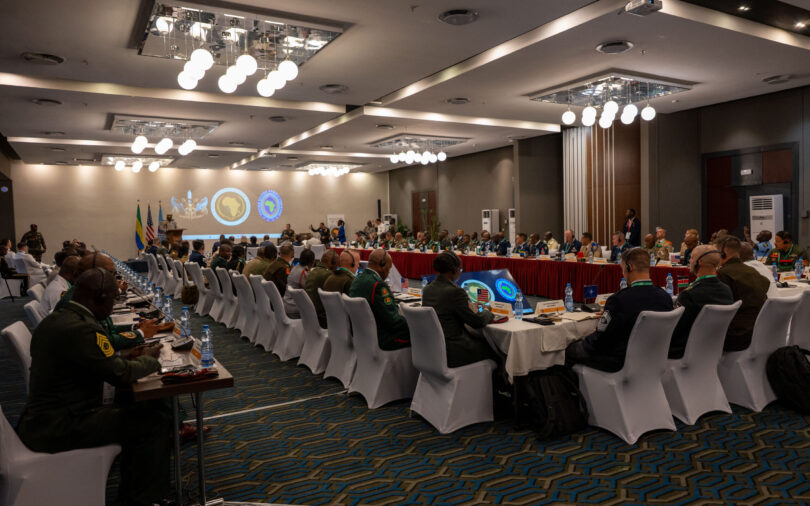
The gathering brought together 127 senior enlisted leaders and other participants from 26 African countries, alongside the U.S. European, and NATO partners.
Nigeria’s participation in an African senior-enlisted forum reflects an investment in the soldiers, professional systems, and relationships needed to manage cross-border threats.
For him, as he interacts with participants from Nigeria and other African countries at the forum, that lesson has remained constant through a career spanning conventional units, civil affairs, special operations, Afghanistan, and Africa-focused assignments.
It was also the practical idea behind this eighth Africa Senior Enlisted Leader Conference―or ASELC―held in Libreville, Gabon, from 14 to 17 September; participants began arriving on the 14 September with the opening ceremony taking place the next morning.
The gathering brought together 127 senior enlisted leaders and other participants from 26 African countries, alongside the U.S. European, and NATO partners.
Nigeria’s participation may not attract the same attention as a presidential meeting, a major military operation, or a new defence agreement. But it carries a practical security significance.
Nigeria is not simply another African participant. It is one of West Africa’s principal security actors, with armed forces engaged in counterterrorism, counterinsurgency, border-security operations, peace-support missions, and maritime security in the Gulf of Guinea.
Nigeria’s presence at ASELC 2026 was not a promise that a conference on non-commissioned officers would resolve Boko Haram, ISWAP, banditry, maritime crime, or wider West African insecurity. It was an investment in the people on the ground, especially the soldiers and enlisted leaders who carry out missions, as well as in the professional systems and regional relationships needed when security problems cross borders.
ASELC focused on senior enlisted leaders, often called non-commissioned officers, or NCOs. NCOs are not commissioned commanders. Their ranks and responsibilities differ among national militaries, but their practical role is broadly similar.
They train troops, enforce standards, mentor junior personnel, maintain discipline, supervise routine work, and translate a commander’s intent into practical action by units operating on the ground.
That role matters because commanders can issue direction, but missions are carried out by people―soldiers―who must understand it, prepare for it, execute it under pressure, maintain equipment, communicate changes, and behave professionally in difficult conditions.
Mr Banfield described that as the “superpower” of a capable NCO corps. “We are not the commanders in our formations,” he said. “We are here to make this commander better, take his mission statement and his vision, and transmit that down to the enlisted force and those troops that are down on the front line.”
For Nigeria, this is not an abstract military-management issue. Operations against insurgent and terrorist groups, anti-banditry deployments, border patrols, maritime missions, and peace-support operations all require junior and mid-level leaders who are well trained, trusted, disciplined, and able to use sound judgment when circumstances change.
The question is not whether Nigeria has enlisted leaders. It does. The question is how Nigeria and other African militaries can continue to develop, educate, empower, and connect them as missions become more complex, technologically demanding, and regional.
Nigeria benefits when partner militaries can cooperate more effectively. Its security environment is regional. Armed groups, weapons, illicit financing, trafficking networks, maritime threats, displacement, and violent extremist movements do not stop at national borders.
That makes professional interoperability important. It does not require African militaries to use identical doctrines or copy another country’s force structure. It means that forces must be able to share information, communicate effectively, train together, understand each other’s procedures, and develop enough professional trust to act together when joint operations become necessary.
Nigeria’s Chief of Defence Staff, Olufemi Oluyede, a General, reaffirmed Nigeria’s commitment to international collaboration against insecurity at the 2026 African Chiefs of Defence Conference.
He highlighted regional intelligence, integrated border management, defence cooperation, interoperability, and joint operations as essential elements of the response to shared threats. Those priorities are closely connected to the type of professional exchange ASELC sought to encourage.
Nigeria’s attendance in Libreville therefore comes at a time when its security environment is becoming more interconnected with developments across West Africa, the Lake Chad Basin, the Gulf of Guinea, and the wider continent.
ASELC did not occur in isolation from Nigeria’s wider security engagement with the United States. In February, AFRICOM Commander Gen. Dagvin Anderson visited Abuja with Mr Banfield and other U.S. officials.
They met President Bola Tinubu and senior Nigerian security leaders, including the National Security Adviser, Minister of Defence, Chief of Defence Staff, service chiefs, and intelligence officials.
Lt. Gen. John Brennan Jr., AFRICOM’s deputy commander, also visited Abuja in January for security discussions―he joined Nigerian officials to launch the inaugural U.S.-Nigeria Working Group, creating a more structured mechanism for bilateral security engagement.
Nigeria’s participation at ASELC should therefore be understood as one part of a wider period of security diplomacy and professional engagement. Nigeria retains authority over its security decisions and military operations. But international cooperation can strengthen the relationships, information-sharing practices, and institutional capacity required to confront threats that are increasingly transnational.
Nigeria attended the inaugural ASELC in Grainau, Germany, in 2017. It also participated in the 2022 edition in Rome, the 2023 conference in Zambia, the 2024 edition in Malawi, and the 2026 meeting in Gabon. Nigeria’s participation in the 2025 edition could not be independently verified.
Nigeria was one of nine West African countries represented in Libreville. The others were Benin, Cabo Verde, Côte d’Ivoire, Ghana, Liberia, Mauritania, Senegal, and Sierra Leone.
The gathering brought together anglophone, francophone, and lusophone countries with different military traditions, coastlines, border challenges, and immediate security priorities. Yet they face overlapping risks, including violent extremism, illicit trafficking, maritime insecurity, and the challenge of sustaining capable, professional, and accountable armed forces.
Zimbabwe attended ASELC for the first time in 2026, adding another southern African perspective to the discussions.
Mr. Banfield said the conference was not designed to make countries adopt a U.S. model. Instead, participants were asked to assess the present condition of their enlisted forces, define the future they want, identify obstacles, and consider opportunities for mutual support.
“I am not of the mindset that every model needs to look exactly like the United States model,” Mr Banfield said. “We need to respect what is best for those individual countries and those individual militaries.”
The most consequential dimension of ASELC may therefore be African-to-African learning. Some armed forces have moved faster than others in developing professional military education, mentorship structures, career pathways, and meaningful enlisted responsibility. A regional forum gives senior enlisted leaders an opportunity to compare practical lessons with counterparts who understand similar resource limitations, institutional histories, and operational pressures.
Holding the conference in Gabon placed Nigeria’s senior enlisted leadership in a Central African and Gulf of Guinea setting. Nigeria and Gabon are not each other’s principal defence partners, and they do not face identical threats. But both have interests in maritime stability, stronger military institutions, and more effective security cooperation across the Gulf of Guinea and the wider Atlantic coast.