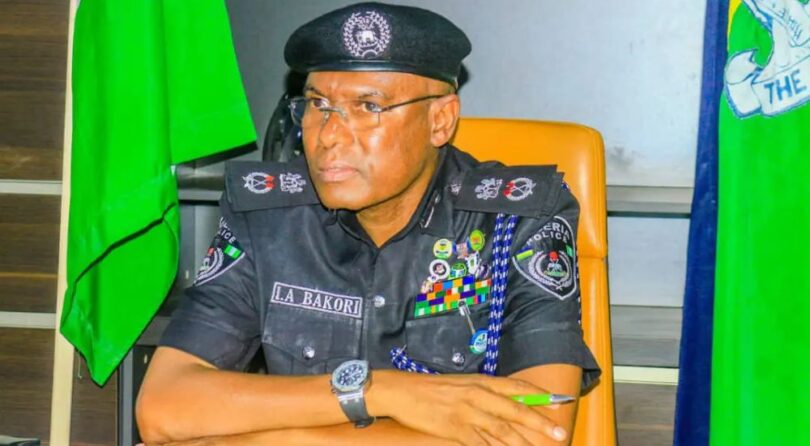
The Kano State Commissioner of Police, Ibrahim Adamu Bakori, has defended the blockade of a venue booked by members of the Tinubu Must Go (TMG) movement for a meeting, citing security concerns and the need to prevent a breakdown of law and order.
Bakori said the police were concerned about the safety of the organisers and residents, particularly as the meeting was expected to attract about 700 people.
In an interview with DCL Hausa, the commissioner acknowledged that the organisers had the right to assemble but argued that notifying the police would have allowed the command to assess potential risks and make security arrangements.
Members of the movement protested on Sunday after allegedly being prevented from accessing the private venue they had booked for the meeting.
One of the conveners, Abba Hikima, a lawyer, alleged in a live video on his verified Facebook page that more than 10 mobile police vehicles had been deployed to the venue to prevent the gathering.
Hikima described the action as a violation of the group’s fundamental rights, arguing that the law did not require police permission to organise a meeting.
Bakori said he contacted Hikima on Saturday night after seeing social media posts about the planned gathering. He said he asked the lawyer to notify the command and discuss the meeting so the police could provide security for participants and other residents.
“What happened is that, in the first place, it is their right to come and organise their gathering. Nobody will stop them, and the law does not require them to inform us. However, notifying us is important because it allows us to regulate the event and ensure there is no tension, that nobody attacks them and that they do not engage in any activity in Kano that can constitute an offence,” the commissioner said.
According to Bakori, he asked Hikima to postpone the meeting and meet with the police to discuss security arrangements. He said the lawyer promised to consult other members of the movement and respond but did not answer subsequent calls.
The commissioner said the police were concerned about the number of expected participants, their identities and where they would stay during their visit to Kano.
He cited a security incident in Sabon Gari about two weeks earlier, when, according to him, police seized weapons and arrested some individuals who had allegedly travelled to the state for political activities. He said investigations into the incident were ongoing.
“We were concerned about another gathering that was expected to attract about 700 people. We did not know who they were or where they would stay. We need to protect them and the residents of the state. That is what happened,” he said.
Bakori denied that the police action was politically motivated or linked to the movement’s opposition to President Bola Tinubu.
He said the police did not prevent people from expressing their views or organising events, adding that Hikima had previously visited his office to lodge complaints that the command investigated.
He said, “You cannot stop people from expressing their views. If you ask him how many times he has come to my office with complaints, you will find out that we have investigated them and taken appropriate action, including punishing those responsible
“There is nothing political about this. It is about understanding the situation and protecting the people of Kano State and Nigeria.”
The commissioner also said political groups had held events in Kano in the past, with the police providing security.
However, Hikima accused the police of violating the movement’s rights to freedom of expression and peaceful assembly.
In an earlier video, he said the group planned to use the meeting to mobilise Nigerians to vote President Tinubu out of office in the 2027 general elections.
The movement describes itself as a non-partisan platform for public enlightenment and has criticised the Tinubu administration’s economic policies, which it says have worsened hardship among Nigerians.
Citing Sections 39 and 40 of the Nigerian Constitution, which guarantee freedom of expression and peaceful assembly and association, respectively, Hikima argued that the meeting did not require police permission.
He vowed that the group would return to organise further meetings and protests because its activities were lawful.