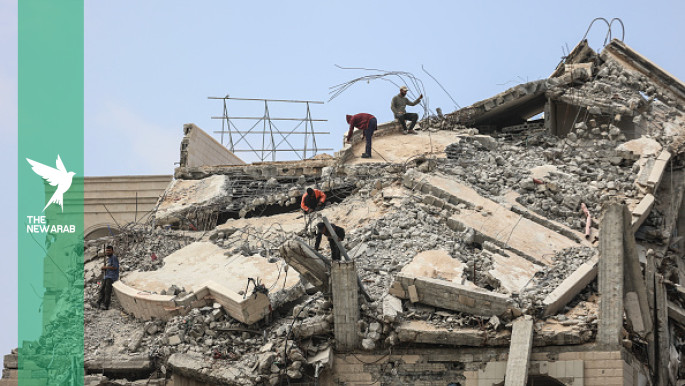
Informed Palestinian sources say that nearly 75 per cent of pledged funding, part of a broader $US17 billion commitment from ten countries, remains frozen. [Getty]
On Wednesday, Ali Shaath, head of the “National Committee for Managing the Gaza Strip,” announced initial Israeli approval to enter Gaza, signalling a tentative step toward new administrative arrangements in the war-torn coastal enclave.
Although the announcement signalled potential movement after months of diplomatic deadlock, it quickly reignited a deeper and more complex question: who can realistically govern Gaza in the aftermath of war, and under what conditions?
Framed by some as part of broader efforts to organise the so-called “day-after” scenario, the development has instead laid bare the depth of political fragmentation, the limits of international mediation, and the enduring weight of Israeli control over Gaza’s fate.
What may be a procedural breakthrough is entangled in a web of structural constraints that have long defined governance in the Strip.
Conditional approval without tools
Shaath said in a press statement that the approval was conveyed through international mediation led by the US-backed “Board of Peace’s” High Representative for Gaza, Nikolay Mladenov, presenting it as part of a coordinated effort to introduce a new administrative framework in Gaza.
According to Shaath, the committee is fully prepared to begin its work as soon as logistical and political obstacles are resolved.
However, the approval itself is conditional, lacking clarity on the scope of the committee’s authority or the guarantees required for it to function effectively.
More critically, it comes without the financial backing needed to sustain even the most basic operations.
Informed Palestinian sources say that nearly 75 per cent of pledged funding, part of a broader $US17 billion commitment from ten countries, remains frozen. Only three states, the UAE, Morocco, and the United States, have reportedly delivered on their promises.
The shortfall leaves the committee facing a stark contradiction: political permission to enter Gaza, but no meaningful capacity to act.
Representatives linked to the “Board of Peace” have warned Palestinian factions that available funds are far short of what’s needed to launch the committee’s work.
This could mean the body arrives in Gaza as a symbolic presence, unable to rebuild infrastructure, restore services, or respond to a severe humanitarian crisis.
Many see this gap as intentional, reflecting a pattern where international efforts in Gaza focus on administrative mechanisms without addressing underlying structural constraints.
Hamas and the limits of imposed arrangements
If financial paralysis casts doubt on the committee’s viability, Hamas’s position poses an even more immediate political obstacle.
The movement has made it clear that it does not view the current proposal as detached from the broader ceasefire negotiations and is unwilling to accept new arrangements while existing commitments remain unmet.
Senior Hamas official Osama Hamdan said in press statements bluntly that the group has refused to move to a second phase of negotiations, accusing Israel of violating the terms of the first phase for more than 200 days.
He described what is happening in Gaza as “systematic daily aggression”, pointing out that any discussion of governance cannot be separated from the ongoing military reality.
Hamdan’s criticism extended beyond Israel to include international mediators. He accused Mladenov of failing to pressure Israel into compliance and even of “complicity” with Israeli policies.
Such rhetoric underscores a deep erosion of trust, not only between Palestinian factions and Israel, but also toward the international actors attempting to broker solutions.
Political analyst from Gaza, Akram Atallah, argued that, in this context, talk of empowering the national committee remains largely theoretical.
“The issue is not the announcement of approval, but its substance and limits. Israel has consistently offered positive signals in public while maintaining a dense system of restrictions on the ground that ultimately neutralises any Palestinian administrative body,” he told The New Arab.
Atallah said that Gaza is “one of the most complex environments imaginable” and situates the proposal within its current internal landscape.
He added that governance on the Strip cannot be reduced to administrative arrangements alone, given the coexistence of military structures, political actors, and a society under extreme strain.
“Introducing a committee into this reality without a comprehensive political agreement risks placing it in confrontation with existing forces rather than enabling it to function alongside them,” he said.
He explained that Hamas’s continued influence makes any attempt to bypass it unrealistic.
“Whether one agrees with Hamas or not, it remains a central actor on the ground. Any plan that ignores this fact is unlikely to succeed. The real question is whether there is a genuine willingness to reach internal Palestinian understandings, and so far, there is little evidence of that,” he continued.
Managing crisis, not resolving it
Beyond internal divisions, analysts point to Israel’s strategic calculus as a decisive factor shaping the committee’s prospects.
Rather than facilitating a stable governance framework in Gaza, many argue that Israel continues to prioritise crisis management over resolution.
Gaza-based analyst Mustafa Ibrahim told TNA that the challenge is more than just entering Gaza; it’s surviving in a collapsed environment with devastated infrastructure, scarce resources, and tight movement control.
“Any entity that enters without real tools, opening crossings, ensuring fuel supply, and enabling reconstruction will quickly find itself powerless […] in a place like Gaza, powerlessness translates rapidly into loss of legitimacy,” he said.
Ibrahim cautions that the committee could become “part of the problem rather than the solution” if it fails to deliver tangible improvements in daily life for the Palestinian population in Gaza.
Hossam al-Dajani, another Gaza-based political analyst, told TNA that Israeli policy aims to preserve strategic advantage, not resolve the problems.
“Israel manages instability to suit domestic politics, especially before elections, by maintaining Gaza as a threat rather than supporting stable Palestinian governance,” he said.
Al-Dajani urges caution in interpreting the notion of Israeli “approval”.
“We must ask what this approval actually means: Is it a genuine step toward a solution, or merely a tool to absorb international pressure? Experience suggests the latter,” he said.