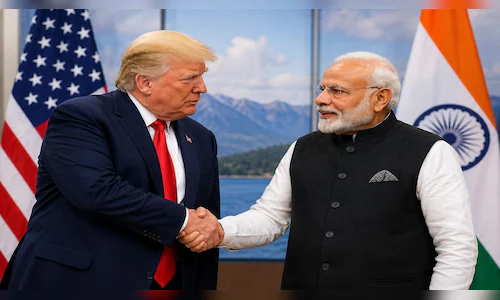
The bilateral meeting — their first formal engagement in 16 months — saw both leaders exchange praise for each other’s leadership. Trump described Modi as calm under pressure and a tough negotiator, while Modi acknowledged Trump’s leadership efforts. Trump also said an India-US trade agreement was “very close” and indicated he was looking forward to visiting India soon.
The meeting came days after three Indian sailors were killed in US strikes linked to an incident involving commercial shipping in the Gulf of Oman. During the talks, Modi raised concerns about the safety of seafarers and stressed the importance of freedom of navigation.
While the diplomatic warmth was evident, former Commerce Secretary Ajay Dua said the real test would be whether it translates into a meaningful trade agreement.
Trade deal faces key sticking points
According to Dua, the upcoming visit of US Trade Representative Jamieson Greer to India could provide the clearest indication of whether both sides are ready to conclude the first tranche of a trade pact.
“I hope that the warmth which the two leaders expressed towards one another would turn into something more substantive, something more productive for India,” Dua told CNBC-TV18.
He said Washington has continued to press India to open sectors such as agriculture and dairy, areas that New Delhi has historically protected in trade negotiations.
For India, agriculture is not merely a commercial activity, Dua argued. “Agriculture is a way of life, a vocation for most people in India, and not just a commercial activity.”
India has consistently defended this position in trade talks with several countries and is unlikely to make major concessions in these sectors.
Why Section 301 remains a concern
Even if an interim trade agreement is signed, another challenge could emerge in the form of Section 301 investigations under US trade law.
The provision allows the US administration to investigate trading partners and impose additional duties if it believes unfair trade practices or excess capacity are harming American interests.
Dua warned that any fresh tariffs imposed under Section 301 could undermine the benefits of a trade pact.
He suggested that both countries should seek assurances that products covered under the first tranche of any agreement would not be subjected to such measures.
Otherwise, additional duties could effectively neutralise some of the gains achieved through the negotiations.
Could a deal be signed by July?
Despite the unresolved issues, Dua remains optimistic that an agreement could be concluded in the coming weeks.
He noted that negotiations have been ongoing for months and pointed to earlier remarks by US officials suggesting that most elements of the agreement have already been settled.
“I think so,” Dua said when asked whether a deal could be reached by mid-July.
He even suggested that July 4, America’s Independence Day, could provide a symbolic opportunity for Trump to announce the agreement, provided the legal and technical review process is completed in time.
The former Commerce Secretary noted that negotiators from both sides have already held multiple rounds of discussions and that the remaining issues appear relatively limited.
Trump’s support pledge and the China factor
Beyond trade, Trump’s comments that the United States would stand by India if it were attacked also attracted attention.
Former Foreign Secretary Shashank believes the statement should be viewed in the context of growing US-China tensions rather than as a signal of a major shift in India’s strategic position.
According to him, Washington has become increasingly concerned about China’s stance on issues such as Taiwan, prompting the United States to strengthen ties with partners across the Indo-Pacific.
“I think the United States is really riled by the position taken by China,” Shashank said.
He argued that while the US may be looking to deepen strategic cooperation with India, New Delhi’s priorities remain different.
India unlikely to embrace a NATO-style role
Shashank said India is not interested in becoming part of a NATO-like security arrangement in Asia.
Instead, India’s focus remains on maintaining regional stability, improving relations with neighbours and preserving its strategic autonomy.
“We are not looking at this in terms of NATO, or the Quad becoming NATO, or AUKUS,” he said.
Rather than joining military blocs, India would prefer to work with regional partners to maintain peace and encourage economic and technological cooperation.
Shashank also suggested that some in Washington may believe India could eventually play a role similar to that of NATO allies in balancing China’s influence. However, he does not see that happening.
“I think that will also not happen,” he said.
Warm words now, tougher negotiations ahead
The Modi-Trump meeting has undoubtedly injected fresh momentum into India-US relations and raised expectations of an early trade breakthrough.
However, experts caution that the goodwill displayed by both leaders will ultimately be judged by outcomes rather than optics.
Whether negotiators can bridge differences over agriculture, avoid potential tariff disputes and finalise an interim trade agreement may determine whether the warmth seen at the G7 summit translates into tangible gains for both countries.