
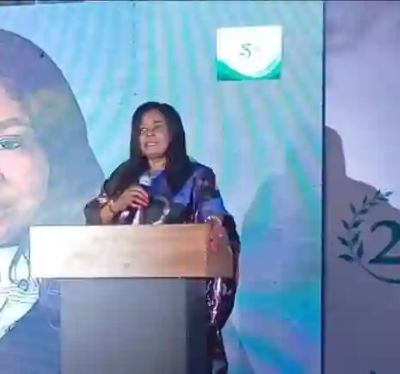
At the 25th anniversary celebration of Women for Women International Nigeria in Lagos, two powerful voices delivered a message that went beyond celebration. Their words were a reminder that the future of women’s empowerment depends on courage, responsibility and the willingness to confront new challenges.
Thelma Ekiyor, International Chief Executive Officer of Women for Women International, and Leymah Gbowee, Nobel Peace Laureate and peace advocate, approached the evening from different perspectives, but their messages carried the same central idea: women cannot be left behind as the world changes.
For Ekiyor, the starting point was remembering the women whose lives are often reduced to numbers. Speaking about Women for Women International’s work in conflict-affected communities, she reflected on the danger of becoming disconnected from the human reality behind headlines about violence, displacement and insecurity.
A report may mention hundreds of people affected by conflict, but behind those figures are mothers, daughters, families, and communities trying to survive. That human reality, she explained, is what drives the organisation’s work.
Women for Women International has spent 25 years working in some of the most challenging environments, supporting women who have experienced poverty, conflict and exclusion. Ekiyor honoured the women who shared their experiences during the anniversary celebration, describing them as examples of strength and resilience.
But her message that evening was not only about recognising the work already done. It was also a challenge to those in the room.
She called for greater local ownership of social impact, arguing that empowering women should not be viewed as a responsibility belonging only to international organisations or foreign donors.
The transformation of women and communities, she suggested, requires everyone to play a role.
Her remarks carried a simple but powerful message: if a small investment can help a woman start a business, educate her children or rebuild her confidence, then society must ask itself what more it can do.
While Ekiyor focused on the realities women face today, Gbowee looked toward one of the defining forces shaping tomorrow: technology.
Delivering a keynote address on: “AI Prospects and Risks,” she examined the opportunities artificial intelligence presents, while also warning about the dangers of allowing innovation to move forward without considering who may be excluded.
Drawing from personal experiences, she highlighted how many women continue to face barriers in accessing opportunities, finance and technology.
She reminded the audience that while the world is moving rapidly into a digital future, millions of women are still struggling to gain access to basic tools that would allow them to participate fully.
For Gbowee, artificial intelligence is neither an enemy nor a solution by itself. Its impact will depend on the values guiding its development.
Technology can improve healthcare, education and economic opportunities. It can help communities access information and create new possibilities. But without fairness and inclusion, it can also widen the gap between those who have power and those who do not.
One of her strongest concerns was the question of who controls technology and whose voices shape the systems that increasingly influence everyday life.
Women, she argued, should not only be users of technology. They must also be involved in creating the policies, ideas and decisions that determine how technology affects society.
She warned that innovation without integrity could deepen inequality, particularly for women who are already facing social and economic disadvantages.
Despite the challenges, Gbowee’s message was not one of fear. It was a call for responsibility. She described technology as a powerful tool that can support peacebuilding and empowerment, but she reminded the audience that technology cannot replace human connection.
Artificial intelligence can provide information, but it cannot sit with a grieving mother. It can analyse data, but it cannot enter communities and rebuild trust between people.
That human responsibility remains with people.
Together, Ekiyor and Gbowee’s messages reflected a shared vision: progress must always be measured by whether it includes those who are most vulnerable.
The future cannot be built by technology alone, nor by programmes alone. It must be built by people who recognise the dignity, ability and potential of every woman.
As Women for Women International Nigeria celebrated 25 years of impact, their messages served as both a reflection on the journey so far and a warning about the road ahead.
The next chapter will require innovation, but it will also require compassion. It will require new ideas, but also a commitment to ensuring that women have a voice in shaping the future.
Because when women are included in the decisions that define tomorrow, the benefits extend far beyond women themselves.
They reach families, communities, and entire societies.