Islamabad:
Amid fears of water shortage during the severe heatwave, a desperate Pakistan hosted an “international conference”, warning that every “world order that is on paper” will collapse if the Indus Waters Treaty (IWT) is not upheld. India had suspended the water-sharing treaty, brokered by the World Bank, as one of the punitive measures against Pakistan after the Pahalgam terror attack in April 2025 that killed 26 civilians.
The treaty has governed the distribution and use of the Indus River and its tributaries between the two nuclear-armed neighbours since 1960.
Pakistan is worried about a possible water crisis as the usual sweltering summers are likely to become even more devastating this year amid the El Niño weather pattern taking hold over the equatorial Pacific waters.
Pak’s “International Conference”
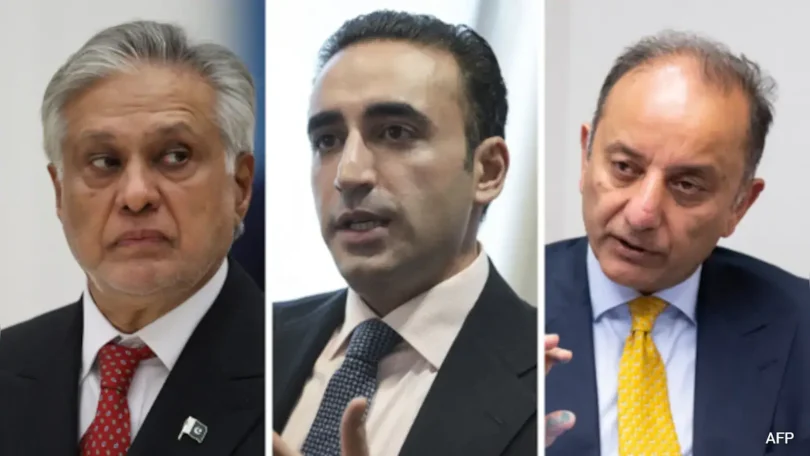
Speaking at the so-called international conference titled ‘The Indus Waters Treaty: A Key Instrument for Peace and Regional Stability’ in Islamabad, Pakistan’s deputy prime minister, Ishaq Dar, claimed India’s decision to revoke the Indus Waters Treaty (IWT) was “illegal” and said water should never be used as a political tool.
“No party can unilaterally suspend or terminate its obligations under a treaty that contains no such provision,” Dar claimed while addressing a seminar on the Indus Waters Treaty in Islamabad, Radio Pakistan reported.
He said the Indus Waters Treaty is not merely a water-sharing arrangement but a “vital instrument of regional peace, stability and cooperation”.
“Shared waters must never be weaponised. They should remain a bridge between nations, guided by cooperation, dialogue, and respect for international law for the benefit of present and future generations,” he said.
He described water as essential to human dignity, food security, economic development, and environmental sustainability, arguing that rivers crossing international borders should foster cooperation rather than confrontation.
He also reiterated Pakistan’s position that any attempt to divert, interrupt or reduce water allocated to Pakistan under the treaty would be treated as an “act of war,” referring to a decision adopted by Pakistan’s National Security Committee after India announced the suspension. Dar claimed that any attempt to deprive Pakistan of the waters “rightfully allocated” to it would have “profound consequences” for regional peace and security.
In his address at the seminar, Pakistan Peoples Party (PPP) chief Bilawal Bhutto Zardari said that the Indus River was not for negotiations. The former foreign minister proposed a new “international convention against the weaponisation of waterways”.
“If anyone believes that Pakistan will surrender Sindh, they do not know Pakistan. They do not know Sindh. They do not know Punjab. They do not know Balochistan. They do not know Khyber Pakhtunkhwa. They do not know Kashmir or Gilgit Baltistan. They do not know the people who have lived by these rivers for thousands and thousands of years. We want peace, but peace with dignity. We want dialogue, but dialogue under law. We want coexistence, but not submission. So from this seminar, from this city, from this moment let a message go forth. Pakistan will defend its water, its people, its treaty, its sovereignty and its future,” he said.
Issuing hollow warnings to cover up Islamabad’s diplomatic isolation, Bhutto Zardari said, “any attempt to undermine Pakistan’s water rights would receive a national response”.
He further stated that “Pakistan would not compromise on the fundamental rights of its people”. Failing to address India’s core security concern regarding state-sponsored militancy, Bhutto Zardari argued that “the use of water as a weapon was contrary to international law”.
“Pakistan must speak clearly. The Indus is not a pressure point. The Indus is not a bargaining chip. The Indus is not a weapon to be placed in India’s hands. The Indus is a lifeline of Pakistan. And any attempt to turn that lifeline into a noose must be treated as a threat to the survival of our state. This is the message that Pakistan must deliver to India. This is the message that Pakistan must deliver to the world. Not in panic, not in hysteria, not in recklessness, but with the cold clarity of a people who know what is at stake,” he added.
One of the strongest remarks came from Pakistani Minister Musadik Malik, who claimed that the future of the treaty would determine the credibility of international agreements worldwide.
“The Indus Waters Treaty has witnessed three wars between the two nuclear powers. If this treaty doesn’t hold, no world order that is on paper post World War II will remain secure,” Malik said.
“When a law needs to be tested, it must be done at the weakest point and not the strongest point. The Indus Waters Treaty is the strongest pact the world has ever seen,” Malik added.
Pakistan in recent months has repeatedly accused India of violating the treaty since New Delhi announced its suspension. During Tuesday’s seminar, Mehar Ali Shah, chairman of Pakistan’s Indus River System Authority, alleged that India reduced water flows in the Chenab River in recent months in violation of the treaty.
India’s Reaction
There was no immediate comment from New Delhi. However, speaking at a United Nations event marking World Water Day 2026, India’s Permanent Representative Harish Parvathaneni said New Delhi was compelled to put the treaty in abeyance after repeated provocations and failure of bilateral engagement. He said the Indus Waters Treaty will remain in abeyance until Pakistan takes credible and irreversible steps to end support for terrorism.
The Treaty
The treaty has come under renewed strain after India suspended its participation in the agreement following the killing of 26 tourists in Jammu and Kashmir in April 2025. New Delhi blamed Pakistan-based militants for the attack, a charge Islamabad denied.
The attack triggered one of the sharpest deteriorations in relations between the two nations in decades. Both countries downgraded diplomatic and trade ties, closed their main land border crossing and revoked visas for each other’s nationals. The tensions later escalated into border strikes in May 2025 after India launched Operation Sindoor. Relations have remained frozen since.
Brokered by the World Bank and signed in 1960, the Indus Waters Treaty regulates the distribution of water from the Indus River system. Under it, India controls the eastern rivers, Ravi, Sutlej and Beas, while Pakistan receives the waters of the western rivers — the Indus, Jhelum and Chenab.
Until May 2025, the treaty survived multiple wars between the two countries, including conflicts in 1965 and 1971, as well as the 1999 Kargil conflict, and has long been regarded as one of the few enduring agreements between the neighbours.