“Coming at a time when the political landscape ahead of the 2027 general election is taking shape, the obvious objective is to besmirch my person and reputation and confer an undeserved political advantage on the former President’s relative. Nigerians, however, know better. They are too discerning to be distracted by stale allegations resurrected for political convenience.”
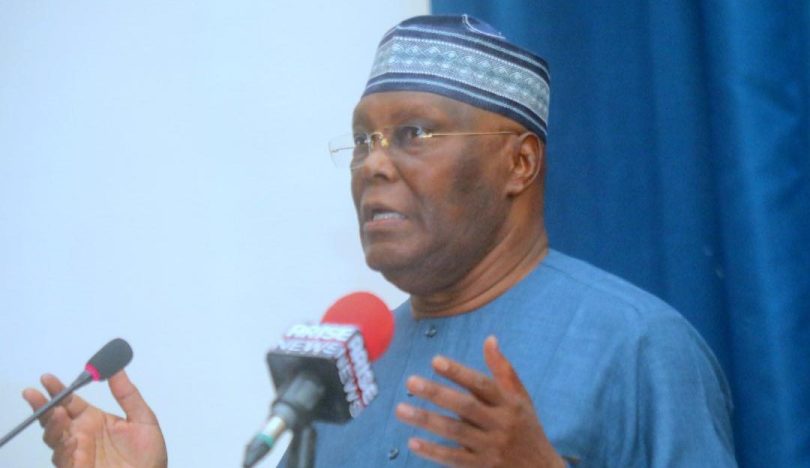
Vice President under Olusegun Obasanjo (1999 -2007), Atiku Abubakar, has alleged that the former President is covertly supporting his relative ahead of the 2027 presidential election.
Abubakar, the presidential candidate of the African Democratic Congress (ADC), has challenged Obasanjo to come out in the open and declare his preferred candidate openly to ensure transparency.
Abubakar’s challenge follows Mr Obasanjo’s recent claim that the former VP provided the late House of Representatives Speaker, Ghali Na’Abba, with ₦5 million to initiate impeachment proceedings against him during their tenure.
In a statement released Friday by his Senior Special Assistant on Public Communication, Phrank Shaibu, Abubakar described the revived allegations—dating back to 2003—as a deliberate attempt to damage his political standing.
“Coming at a time when the political landscape ahead of the 2027 general election is taking shape, the obvious objective is to besmirch my person and reputation and confer an undeserved political advantage on the former President’s kinsman,” the statement read.
“Nigerians, however, know better. They are too discerning to be distracted by stale allegations resurrected for political convenience.”
Abubakar argued that if Mr Obasanjo had chosen a political side, he should have stated it clearly rather than relying on claims that can no longer be verified, as the primary witness, Mr Na’Abba, is deceased.
“He should simply declare [his preferred candidate] and allow Nigerians to judge it on its merits, rather than attempting to influence public opinion through allegations that can no longer be tested,” he added.
While Atiku did not explicitly name President Bola Tinubu, his reference to Mr Obasanjo’s “kinsman” is widely interpreted as a dig at the president, given their shared South-west origin.
The relationship between Messrs. Obasanjo and Tinubu, once political allies in the early Fourth Republic, has deteriorated over the decades due to disputes over governance and electoral politics. Their first major standoff occurred in 2003 when the Obasanjo administration withheld local government allocations from Lagos State after Mr Tinubu created 37 Local Council Development Areas.
Tensions escalated during Mr Obasanjo’s reported efforts to secure a third presidential term in 2007, which Mr Tinubu vehemently opposed. More recently, ahead of the 2023 election, Mr Obasanjo endorsed Labour Party candidate Peter Obi, further deepening the rift between him and Mr Tinubu. Since Mr Tinubu took office, Mr Obasanjo has been a vocal critic of the administration’s economic reforms, citing rising poverty and inflation.
Regarding the bribery allegation, Atiku questioned the timing, noting that Mr Obasanjo waited until after Mr Na’Abba’s death to make these claims.
“If this allegation were true, why did he never make it while Mr Na’Abba was alive? Why wait until the only man who could confirm or refute the claim has departed this world?” Atiku asked. “It is unfair to his memory and contrary to our cultural values to conscript the dead into contemporary political battles when they no longer have a voice.”
Mr Na’Abba, who served as speaker from 1999 to 2003, led the House in several confrontations with Mr Obasanjo’s executive, peaking in 2002 when the legislature moved to impeach the president. Although the Senate briefly supported the move, intervention from former heads of state, including Shehu Shagari and Yakubu Gowon, ultimately halted the process.
Mr Na’Abba, who died on 27 December 2023, later expressed regret in a 2018 interview that the impeachment process was not seen to its conclusion. Atiku has now challenged Mr Obasanjo to produce evidence of his claims, asserting that as president at the time, Mr Obasanjo held the state’s full investigative powers to address any criminal conduct if it actually occurred.