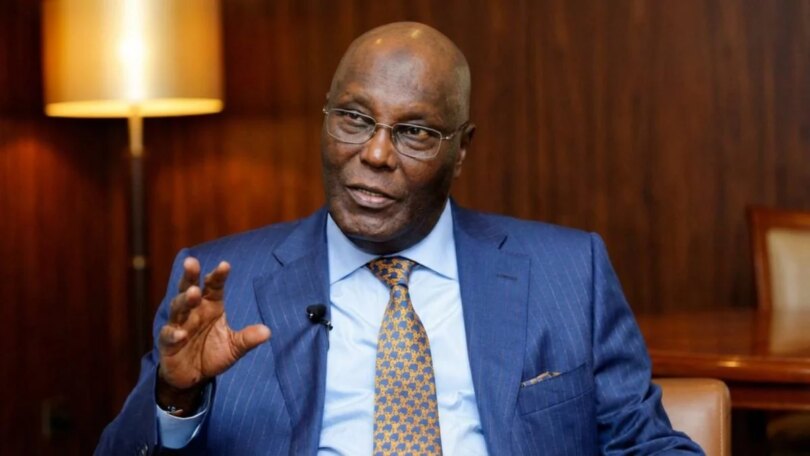
The presidential candidate of the African Democratic Congress (ADC), Atiku Abubakar, is facing growing discontent among party leaders in the South-West over allegations that he has sidelined the party’s established structures in the region ahead of the 2027 general election.
Several ADC leaders, including state chairmen, governorship candidates and other party officials, have accused the former Vice-President of conducting his political activities through personal friends and allies while neglecting the party executives and structures expected to drive his presidential campaign.
The development has reportedly created dissatisfaction among party members and contributed to the slow pace of political activities in the South-West, a region considered crucial to Atiku’s ambition of defeating President Bola Tinubu in 2027.
The South-West comprises Lagos, Ogun, Oyo, Osun, Ondo and Ekiti states.
The region is particularly important to the presidential contest because of Tinubu’s political influence there. During the 2023 presidential election, Tinubu won Ogun, Oyo, Ekiti and Ondo states, while Atiku, who contested under the Peoples Democratic Party (PDP), secured Osun. Peter Obi of the Labour Party won Lagos State.
According to the Punch, the disagreement became pronounced during a meeting involving ADC governorship candidates and other party leaders in Ibadan, Oyo State, on September 4.
At the meeting, the party leaders reportedly complained to the ADC National Secretary, Rauf Aregbesola, that Atiku was not involving the established party structures in his political activities across the region.
They were said to have demanded clarification from the national leadership on whether the former Vice-President intended to work with the party structures or preferred to conduct his political activities through his personal associates.
One of the governorship candidates who attended the meeting said that nearly all the ADC leaders present expressed dissatisfaction with the situation.
According to the candidate, who spoke on condition of anonymity, the meeting was heated as members insisted that Atiku should recognise and respect the party structures that produced its candidates for the 2027 elections.
“The meeting was hot. We told the national secretariat, through Aregbesola, that Atiku must respect the party structure and channel his campaign through it,” the candidate said.
“Many of us at the meeting complained about the sidelining of the party in the South-West by our presidential candidate. We rejected his practice of using his friends and loyalists to run political activities that the party should ordinarily have been engaged in.
“We insisted that the party structures that produced all the governorship, national and state assembly candidates for the 2027 elections are the genuine party structures with which Atiku must engage.”
Following the complaints, Atiku reportedly held a virtual meeting with South-West ADC leaders on September 5, during which he reaffirmed his commitment to the party and promised to address their concerns.
An ADC leader who participated in the meeting disclosed that Atiku asked each state in the region to submit five names of party members for appointment to his presidential campaign committee.
“He promised that there would be a change and that the party would henceforth be carried along in his political activities. But little has really changed since then,” the party leader said.
However, the complaints reportedly persisted, with some party insiders alleging that Atiku was unwilling to commit sufficient financial resources to political activities in the region.
One party official claimed that the presidential candidate had refused to provide financial support to the party, citing an incident involving the six South-West state chairmen who travelled to Abuja for a meeting with him on September 17.
“You can imagine a situation where the party chairmen in the six South-West states went to Abuja to attend a meeting with him and our presidential candidate refused to give them transport fare. The chairmen are not happy with him for that. Maybe he is just targeting his 25 per cent in the region,” the official alleged.
An ADC House of Assembly candidate in Ekiti State also expressed concern about what he described as the lack of visibility of Atiku’s campaign in the region.
He blamed the situation on the alleged failure to involve the party structures, arguing that the development had discouraged members who expected the presidential candidate to give the region greater attention.
“You can see nothing is happening in the South-West ADC. Everywhere is dull, and that is because the party has not been engaged by our presidential candidate. Only his friends have been involved in his campaign activities,” he said.
Similarly, the Chairman of the Association of ADC Local Government Chairmen in Lagos State, Adewole Ijaogbomo, accused some individuals of taking over Atiku’s political activities in the state at the expense of established party leaders.
He alleged that some of those championing the former Vice-President’s campaign were more interested in positioning themselves for access to campaign funds than strengthening the party.
“Most of the people championing Atiku’s cause in the South-West, especially in Lagos State, are just positioning themselves to grab the campaign fund for their selfish interests. The main party leaders are not being carried along in all their activities,” Ijaogbomo said.
He added that most recognised ADC leaders in Lagos were being excluded from the campaign activities and urged Atiku to intervene before the disagreement affected the party’s chances in the 2027 election.
“A few people are trying to take over the campaign activities. The majority of the party leaders are not involved in Lagos State. The real ADC leaders are being excluded from Atiku’s political activities. I see that Atiku doesn’t want to offend anybody, but he must address this matter urgently,” he said.
However, the South-West ADC Chairman, Akin Omole, dismissed suggestions that Atiku was deliberately marginalising party members, arguing that the nature of the coalition made it necessary for the presidential candidate to maintain relationships with political associates outside the party’s formal structure.
Omole acknowledged that some of Atiku’s friends and political allies had remained involved in his political activities but insisted that their participation should not be interpreted as an attempt to undermine the ADC.
He explained that the party was a coalition involving politicians from different political backgrounds, making it unrealistic to expect Atiku to abandon longstanding political relationships.
“On the issue of whether he’s carrying them along, you know this is a coalition. We came from different political parties. We cannot deny the fact that there have been some old alliances, people who have been together in some political parties before now,” he said.
“We should not suffer the illusion of not agreeing with the reality of being a friend to a candidate. It happens everywhere. But I want to tell you, we are a family. I’m satisfied with my involvement in the party. Nobody takes away what is legitimately mine.”
Omole further argued that political candidates needed relationships beyond their immediate party structures to build the alliances required to win elections.
“Every candidate must develop a relationship outside the party, and we must agree that it’s all these factors that contribute to the success of a candidate. So, we cannot push his friends away from him,” he added.
The South-West chairman also confirmed that the September 4 Ibadan meeting took place, explaining that its primary objective was to develop strategies for delivering the region to Atiku in 2027.
According to him, the meeting resulted in the subsequent engagement with Atiku in Abuja, where issues surrounding the party’s campaign arrangements were discussed.
“If there is anybody who has any complaint, let him channel it through the party. But to the best of my knowledge, that is not a loud complaint. There could be pockets of complaint, but it’s not loud enough to constitute a problem for the party,” Omole said.
He also rejected claims that Atiku’s failure to provide transport money for the party chairmen who travelled to Abuja demonstrated a lack of commitment to the region.
Omole maintained that political parties should not depend entirely on presidential candidates to finance their activities, insisting that state chapters had their own sources of funding.
“We’re a political party, made up of many people. We have passed the era where somebody will be held responsible for the fortune of a political party. We have passed the era of moneybags where the candidate should bear all financial burdens of the party,” he said.
He added that the delegation travelled to Abuja as party officials and should not have expected Atiku to finance their transportation.
The Lagos State ADC Chairman, George Ashiru, also dismissed the allegations of marginalisation, describing the complaints as premature because Atiku had yet to announce his campaign coordinators and inaugurate campaign councils across the states.
Ashiru argued that party executives and members of presidential campaign committees did not necessarily have to be the same people, explaining that campaign councils were strategic bodies that could operate independently of the party’s formal leadership.
He said some party members were becoming anxious because they had yet to see significant campaign activities, leading to speculation and accusations against those involved in the process.
“Some people are so focused on money coming from the presidential candidates. Whether there is money or not, there is this frenzy that time is going, and they begin to wonder: what’s happening? We are not hearing anything. And instead of them to call the man himself and let him use his own mouth to announce it, they will be speculating and smearing other people’s names,” Ashiru said.
He added that the establishment of campaign committees would provide an opportunity for party members to be involved in the presidential campaign.
“Atiku has yet to flag off his campaign and yet to announce his campaign coordinators in all the states,” he said.
“Campaign council is an independent institution; the members are not compulsorily party executives. It is not normal to put party executives in the campaign committee, which is a strategy organisation. The party is to give them support; that is how it is done. At the appropriate time, what is due to the party will be given to it.”
Meanwhile, the Osun State chapter of the ADC dismissed speculation about a possible disagreement between Atiku and Aregbesola, following the exclusion of the former Osun State governor from the ADC Presidential Campaign Council announced on September 25.
Aregbesola, a prominent political figure in the South-West and the party’s National Secretary, was not listed among the members of the presidential campaign council, raising questions about his involvement in Atiku’s 2027 ambition.
However, the Osun ADC Publicity Secretary, Oluwaseun Abosede, insisted that there was no disagreement between the two politicians and dismissed suggestions that the party was experiencing a leadership crisis.
“There is no rancour between Ogbeni Rauf Aregbesola and Alhaji Atiku Abubakar. They are fine, and there is no leadership crisis within the ADC as some people may want the public to believe,” Abosede said.
He also maintained that the party had a political roadmap for the South-West, adding that its leaders were working behind the scenes to strengthen the party’s structures and attract more supporters ahead of the election.
According to him, the ADC was engaging different interest groups, building political relationships and consolidating its presence across the region.
“Politics is not always about making noise or rushing to announce every move. Sometimes, the most consequential work takes place quietly, through consultation, organisation, relationship-building and the consolidation of structures,” he said.
Abosede added that the absence of frequent public campaign activities should not be interpreted as a lack of preparation, insisting that the party would begin its campaign activities at the appropriate time.
Atiku’s camp also rejected the allegations, describing claims that the former Vice-President had sidelined ADC executives in the South-West as false.
His Director of Strategic Communication, Phrank Shaibu, argued that the state campaign coordinators and councils had not been announced or inaugurated, making it impossible to claim that any established campaign structure had been excluded.
“The claim that state party executives in the South-West have been sidelined is untrue. The state coordinators and their respective campaign councils have neither been announced nor inaugurated at the state level. There is therefore no state campaign structure that has been constituted and then excluded,” Shaibu said.
He maintained that Atiku remained committed to the party and respected its leadership, structures and members.
“Atiku is a party man who respects the party’s structure, its members and its leaders. The suggestion that he has been running his political activities by bypassing them is opposition conjecture, not a genuine complaint from our members,” he added.