The Federal Government has unveiled plans to expand access to eye care services for 25 million vulnerable Nigerians, pledging to distribute five million reading spectacles and provide 25,000 subsidised cataract surgeries by 2027.
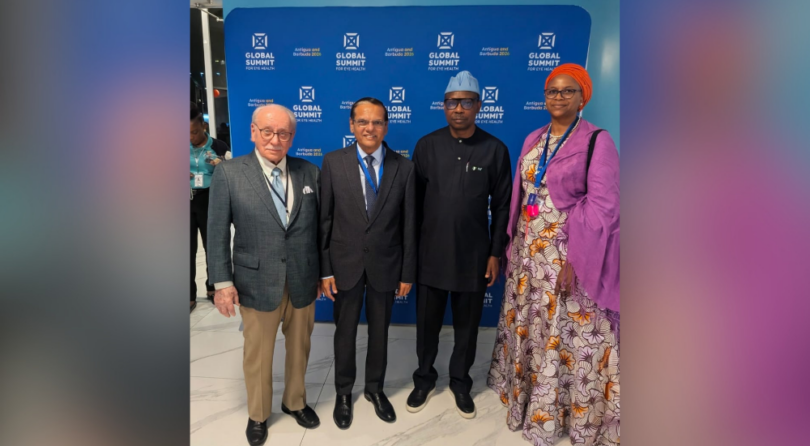
The Minister of State for Health and Social Welfare, Dr Iziaq Salako, disclosed this at the closing session of the Global Summit for Eye Health in St. John’s, Antigua and Barbuda, where he outlined Nigeria’s commitments to tackling avoidable blindness and vision loss.
Salako said the targets were part of the Federal Government’s efforts to make eye care more accessible and affordable, particularly for women, older persons and residents of underserved rural communities.
He said the government would also integrate Primary Eye Care into the Basic Health Care Provision Fund (BHCPF) and train 15,000 primary healthcare workers to strengthen the delivery of eye care services across the country.
The minister further pledged to increase Nigeria’s active eye care workforce by 20 per cent and improve the country’s Effective Cataract Surgical Coverage by 30 percentage points by 2030.
Describing eye health as a fundamental human right, Salako said avoidable vision loss affects not only individuals but also education, household welfare, personal safety and national productivity.
He recalled the JigiBola eye care initiative introduced in Lagos State about 25 years ago, noting that the programme, in which he participated as a young medical officer, had evolved into a broader national intervention known as the Effective Spectacle Coverage Initiative, or JigiBola 2.0.
According to him, the development demonstrates how successful state-level health interventions can be expanded into national programmes to address critical healthcare needs.
Salako also highlighted Nigeria’s participation in the World Health Organisation’s Global Cataract Surgery Initiative, known as SEE 2045, which seeks to accelerate efforts towards eliminating cataract-related blindness globally.
He, however, stressed that achieving the country’s eye health targets would require sustained domestic funding, stronger public-private partnerships, collaboration with international development partners and accountability for commitments made.
The minister called on participating countries and global partners to translate their pledges into practical interventions, including access to spectacles, timely referrals and affordable cataract surgeries.
He also commended Antigua and Barbuda, Bangladesh, Tanzania and China for their commitments to expanding access to eye care, particularly in rural and underserved communities.
Salako disclosed that approximately $60 million had been pledged towards assistive technology, while 15 private-sector commitments valued at over $468 million had been secured for accelerated eye care implementation.
He added that about 143 other commitments had also been made by organisations outside government.