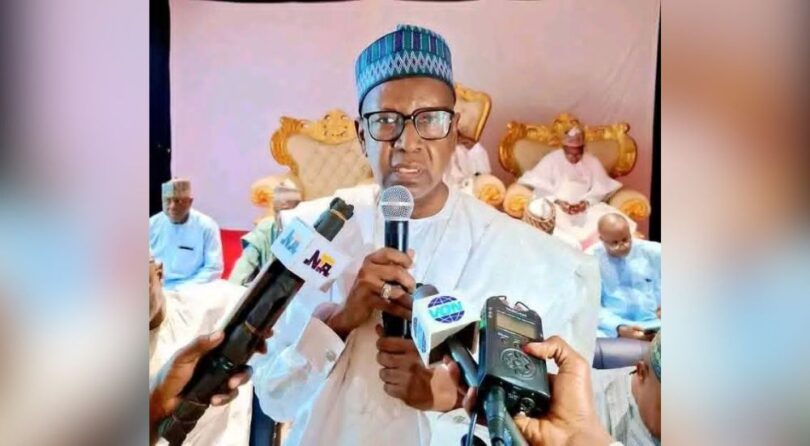
The senatorial aspirant for Sokoto East Senatorial District under the APC Umar Ajiya has unveiled his political agenda to centred on security, education, and equitable distribution of national resources.
Declaring his intention on Sunday in Sokoto, Ajiya described his bid as a response to the call of his constituents, pledging to represent their interests with commitment and integrity at the National Assembly.
“This is a defining moment for me. My people have entrusted me with this responsibility, and I am determined to justify that confidence through purposeful representation” he said.
“I am like a bridge between Sokoto East and the federal government and I know the political importance of effective legislative engagement, particularly in influencing the appropriation process”
“Representation at the Senate is not symbolic rather it is strategic. I will work closely with Senate leadership and fellow lawmakers to ensure that Sokoto East and Sokoto State are not sidelined in national budgeting and development programmes”
He stressed the need for fairness in the distribution of federal projects across states, arguing that inclusive governance is key to national unity and progress.
On national issues, Ajiya aligned his campaign with the growing political discourse on insecurity, describing it as the central challenge shaping Nigeria’s future.
He said that insecurity remains the most urgent issue confronting Nigeria that affects every sector.
According to him, addressing it requires not just government action, but a united front involving all citizens.
He cautioned against irresponsible reporting, urging the media to play a constructive role in national security while holding authorities accountable.
As part of his campaign promises, Ajiya outlined a three-point agenda of strengthening security through intergovernmental collaboration, revitalising the education sector, and promoting people-centred development.
He expressed concern over the impact of insecurity on education, noting that the displacement crisis has forced many schools out of operation.
“Our children are paying the price of insecurity. Some schools have been converted into shelters for displaced persons, disrupting learning. Rebuilding the education system will be a priority”
He also called for policies that directly improve livelihoods, particularly in rural communities where agriculture remains the primary source of income.
While acknowledging ongoing efforts by both federal and state governments, he argued that stronger legislative advocacy and oversight are needed to accelerate development.