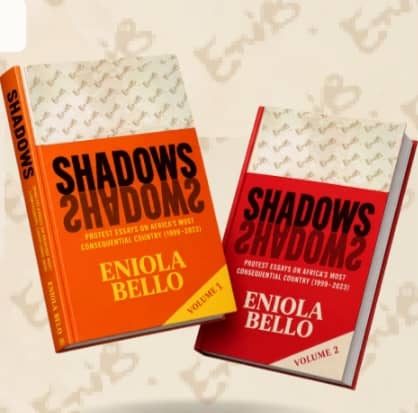
Publishers: Cable Books, Lagos, 2026
Author: Eniola Bello
Reviewer: Prof Okey Ikechukwu, mni
(Ch.MC, Fnipr, Ficmc, Fnarc, SFubs, Fspsp, Fimc, Fapra, AFniia)
Overview of Volume 1
This book is the first of a 928-page twin volume work, which is a collection of 25 years of Eniola Bello’s opinion articles, presented here as seventy essays and arranged according to publication date. It tracks five successive administrations of Obasanjo, Yar’Adua, Jonathan, Buhari, and the early Tinubu period, showcasing the recurring crises of Nigerian governance under these respective regimes. Electoral fraud, executive-legislature feuds, corruption scandals, insecurity, fuel-price shenanigans, and the severe and persistent gap between constitutional promise, leadership claims about delivery and the lived experiences of Nigerians are all serially captured as they occurred in real time.
The author brings the entire collection together here as “Protest Essays” in two volumes which, indeed, they are. In going further to say that the collection is about “Africa’s Most Consequential Country”, he is telling us two things. The first is that he deems everything he has written in this book a protest against what is unacceptable in leadership and governance, even where it is purely descriptive of symptoms and consequences. The second is that the country under reference here is Nigeria which, with its huge population and profile as Africa’s most notable nation, remains a matter of concern to the world.
But, before we go into his reasons for such a venturesome claim, let us me put it on record that Eniola Bello, or Eni-B should henceforth be declared, and addressed as, a Protestant by Self-proclamation. And this first volume of the Protestant’s work opens with a Prologue, wherein we hear about the blood curdling 1998 encounter with the Abacha-era military intelligence chief, Col. Frank Omenka. Even those who never knew, or had any encounter with, Omenka trembled on behalf of those who did, whenever they heard either the man’s name, or about his “exploits”.
Bishop Matthew Hassan Kukah’s Foreword situates the book in a tradition of African protest writing. The author’s own Introduction frames the collection through the recurring image of a boy chasing his own shadow. This image was, for the writer, an emblem of Nigeria’s unfinished, self-eluding search for a workable political order; and a realistic and sustainable identity.
From here the book moves into a into a rather the section titled “Governance”, which runs chronologically from June 1999, that is immediately after Nigeria’s return to civil, through 2022, to the eve of the Tinubu presidency.
Thus, we have in the book a substantial front matter, namely a Foreword, Introduction and Prologue, followed by a back matter in the form of Acknowledgement and name index. It is important to note here that the writer’s career, as well as the context of our national politics at the times covered in his writings explain how the book reads.
He was in the Media Theatre of War through much of the period he wrote about; and this fact alone gives the essays an insider’s access and immediacy which no outsider can successfully simulate. Omenka anecdotal episode, as part of behind-the-scenes details is outstanding. His pieces on Anambra’s godfather politics and the political undulations associated with could only have come from a participant observer with a volition for factual, narration garnished with personal interest in promoting specific societal values.
So, I stand before you with the first Volume of Shadows, which is a 468-page book organized around some dated newspaper columns of national and historical significance. on which I shall make some observations, look at the Voice and Craft, touch on Recurring Themes Across Administrations. I will also, in the course of that, point out some details for reconsideration, by way of conclusion.
I shall say nothing about why The Protestant chose me as his victim here, by imposing on me the task of reading and reviewing a work of nearly one thousand pages at very short notice.
Now, to my observations.
Observations
A first-person archive of the Fourth Republic
The real value of this work lies in the fact that it is a dated, column-by-column record of actual events as they happened, rather than a reconstruction of experiences afterwards; in an Ali Mazrui fashion. Every single essay here is anchored to a specific week’s news, or set of national events. The real-time immediacy of a governor’s convoy ambushed, a Senate probe convened, a fuel subsidy withdrawn, etc., gave this book the appeal that makes it less of a memoir function and more of a serial, eyewitness’s lived diary of Nigerian public life.
When read consecutively, the essays in this Volume show the reader that the same pathologies recur under presidents of very different temperaments and pretensions to leadership excellence. For instance, we find the contested census-style ethnic balancing of political positions, godfatherism, executive high-handedness and more across board. It is probably this that effectively thematizes the book’s strongest underlying message, namely, that Nigeria’s problems have outlived every single administration and still subsist.
Voice and craft
The author’s style has the unmistakable imprint of a seasoned newsroom editorialist. Short and punchy paragraphs, frequent rhetorical questions, anaphora, like “What matters is… What matters is…”), and a commendable fondness for subtly exhilarating and extended metaphors abound. Take this for instance: Tinubu’s troubles “multiplying in a spiral” like smoke from a magician’s pipe; Nigeria’s political order as an ever-elusive shadow.
His prose is perhaps at its strongest in narrative set pieces, like the genuinely griping and unsettling Prologue’s account of the Omenka reality and in the essays where the author builds an argument through accumulated, concrete details. In his dismantling of Rep. Ado Doguwa’s public boasting about fathering 28 children he moved from an anecdotal on the man’s curious boast to a much wider argument about population control, issues of policy, entitlement mentality and the almajiri crisis in northern Nigeria.
Recurring themes across administrations
This volume builds a cumulative case, starting with essays on Obasanjo’s early years and ethno-religious balancing in appointments, to the friction between the presidency and the National Assembly. It moves through Yar’Adua’s crisis of legitimacy and his prolonged medical condition to Jonathan’s partially sleepwalking presidency, circling back repeatedly to fuel subsidy removal, corruption scandals, and a weakening security response to Boko Haram.
The section on Buhari is the most sustained in its criticism of a government’s many missteps. It returns, again and again, to shameless nepotism, appointments skewed in favour of the president’s home region/state. In a comparison captured in the essay “Buhari: As He Was in 1984…”, the author x-rayed the latter’s conduct as elected president and as the military head of state and saw him as still the same man in his negative proclivities three decades later.
The structure of this volume makes it easy for a patient reader to see this collection’s core theses demonstrated live, rather than merely claimed; namely, that Nigeria’s governance challenges and failures are systemic and can be seen to outlast any single leader’s promises of lasting change.
Sequence and General Impression
Reading 400-plus pages on one theme, as a chronological, single-category, also demands a lot of reading strength. But the arrangement gives the book coherence, as themes that would have otherwise blocked a “flow of understanding” were reserved for the second volume of the work.
The production of this volume is professional. The back-of-book index of names is a welcome convenience in a book this dense with Nigerian political figures across two decades.
Points to Note, Going Forward
As I conclude this review of a book that, itself, is the editorialized testament of a seasoned media executive, I would like to draw attention to the fact that the author leans hard on the same small set of rhetorical devices — anaphoric repetition, rhetorical-question cascades, the extended metaphor as an essay’s organizing device. The reader encountering these as standalone weekly columns will enjoy the undulations more than a reader going through dozens of essays read in sequence at one.
But that is the point of the book being a collection otherwise autonomous media interventions, deploying the very tools that give each piece the flavour that makes it appealing on its own. It is like looking at, and admiring, a church member’s jewellery during major celebrations, and then seeing the assembled pictures of the same church member for all occasions, from which you then notice that it reveals a limited number worn at different times and within decent intervals.
The author may wish to consider the fact that the average reader lacks a working knowledge of Nigerian political history, as seen in the acronyms, party names, and second-tier officials mentioned in the work. A short biographical or explanatory footnote apparatus (even minimal) could be added, to widen the book’s impressions on readers may not have lived through this period.
Because protest journalism, to which the author has confessed himself committed, is usually tendentious, the book sometimes reads as advocacy rather than analysis; wherein government defences are often summarized and then rebutted in the same paragraph. But, again, the issue is whether what is in the book is what the author wanted to achieve. It is. A patriot confronted with the unrestrained plunder of his country, and armed with a pen and a platform, used both to make his interventions as an unapologetic advocate.
The chronological sequencing stands defended from the standpoint of historical record keeping. It captures the same recurring issues like fuel subsidy, misgovernment and nepotism across two decades. Perhaps a subsequent edition of the book would need a thematic cross-index, or brief interstitial framing notes, explaining how an older essay connects to a later one on the same subject. This will strengthen author’s subsisting thesis that our problems are not merely episodic and regime-determined.
Finally, a short retrospective postscript on a handful of the most consequential essays is needed for them to double as a history and not just archival material of past commentary.
Overall Assessment
This volume of Shadows is a compelling primary-source document of Nigeria’s Fourth Republic, as written by someone who had a genuine front-row seat, who is competent to comment authoritatively on the issues raised and who showed great courage in presenting them without apologies.
Part of the book’s strengths lie in its narrative vividness, its moral clarity and the cumulative weight instances of the same failures and challenges across five presidencies. It also exists in the author’s insight and his ability to capture the issues without extenuation.
As a reference work on a great columnist’s piece of journalism history, it offers much to a reader would take it in smaller doses, essay by essay, the way it was originally written and published. Any weaknesses perceived in this regard are largely the weaknesses of the anthology form of presentation: the repetition of stylistic devices when essays are read back-to-back.
This volume of Shadows is a time-driven advocacy for true nationhood. It is honest about what it set out to achieve and should be so acknowledged.
Overview of Volume 2
The second volume of Shadows completes a project that was halfway completed after 468 pages, and which got rounded up in the 460 pages of the second volume. The front matter of repeats Kukah’s Foreword and the author’s Introduction. This is consistent with the two-volume structure, and also rhymes with the “shadow” metaphor governing the project.
This collection is the more varied of the two books, as it goes beyond the single long “Governance” section of the first volume, to track party intrigue, godfatherism, PDP and APC succession battles, and presidential elections from the late Abacha transition through the 2023 Tinubu victory.
The collection moves from essays on Nigeria’s retired military rulers, religious and ethnic tension, Boko Haram, and the moral character of public life, to a handful of essays from the author’s reporting trips to Japan, China, and a Chicago visit tied to Tinubu at the time. It showcases tribute with an obituary-style and anniversary essays on figures like Abiola, Bola Ige, and Pope John Paul II, before closing with a first-person Epilogue recounting the author’s own encounters inside Nigerian Government Houses across several states.
Like in Volume 1, the essays are also dated and arranged chronologically within each section; closing with an Acknowledgement after a name index.
Observations
Consistency of Political Narratives
Readers of Volume 1 will recognize the same rhetorical toolkit in the Politics section of this volume. Anaphora, rhetorical-question cascades, and the use of extended metaphor as an organizing device are now applied to party primaries, godfather disputes, and succession battles rather than presidential administrations in this volume. In the essay “Grandmasters of the Game” and “2023 and the Tinubu Conundrum”, we see a tracking of the mechanics of power transfer within a party. We also see how the dynamics of zoning arrangements, delegate arithmetic, and backroom deal-making determine outcomes that are later dressed up as democratic choices. The element of institutional dysfunction mentioned in Volume 1 also presents itself here as elections change faces, but without changing the underlying principle of subversion.
Wider-Range Focus
It is in this volume that we see the author’s full range of colours as a writer on display. The essays on politics retain the same brisk, editorializing voice we have in Volume 1. The Society and Travel section shows a more reflective, sometimes gentler, author who is even willing to let a scene or a piece of dialogue carry the argument without throwing in a direct commentary.
In “A Night in a Japanese Home,” we find an account of a homestay in Hiroshima during a press junket, as warm, purely observational travel writing. It is free of the polemical register that dominates the writer’s political essays. This was a welcome change of pace that shows that the author is capable of enjoying the evening breeze without complaining about the wind speed.
An Experiment Worth Noting
A close look at the essay “Telephone Conversation” (April 2000) shows it to be one of the collection’s most inventive piece. It is an imagined afterlife, staged entirely as dialogue, in a phone call between the late Chief MKO Abiola and the late General Sani Abacha. Here, Abiola needles his former jailer about his fate, making this departure from the straight op-ed form used almost everywhere else in both volumes a welcome respite. The result is a stronger emotional impact, which a conventional essay on the same subject would not have had; giving the reader a varied the reading experience of the 900-plus combined pages.
Profiling the Epilogue
Looking at “Notes from Government Houses”, a first-person memoir of the transactional, and often degrading, culture the author witnessed around Nigerian governors on official visits, especially of how young women from local universities were paraded for state guests, night-outs bankrolled by public office. It portrayed an endemic casual corruption of hospitality that marks the piece as one of the strongest essays in the twin-volume work.
It is also as candid and self-implicating as a writing could be. Perhaps without knowing it, the writer includes his own discomfort and complicity as an observer rather, while convinced that he is writing only about others. Put together, the author’s sentiments and the sordid reality it depicts retroactively sharpen some essays in the Politics-section, wherein the same governors are presented in different contexts.
Structure and Thematization
The four distinct sections of Volume 2 appear to offer more textural variety than Volume 1. Though the sections are uneven in size, with Politics running to roughly 250 pages, while the Travel section captures only five essays. We note in this review that particular pieces in the Politics section could have been accommodated in the Society section; and that some could actually have come under Tribute, rather than Society.
Further Observations
A reader moving from Politics into Society may struggle to see why, say, essays on Babangida’s culpability for June 12 sits in the Society, rather than the Politics section, or why some Tribute pieces (the Abiola essay, in particular) overlap significantly with material already covered in Politics. A future edition of the book would require a short editorial note, explaining the sorting principle.
Final Submission
Whereas Volume 2 seems to be the stronger of the two books because of its variety, with the political essays extending Volume 1’s central argument about institutional dysfunction, the two together give a fuller picture of the scope of the author’s works. The “Telephone Conversation” experiment and the Government Houses epilogue are easily the two most memorable pieces across both volumes, showing us a writer with more range than the bulk of the political columns, taken alone. When read as the second half of a single project, Volume 2 rewards patience, because some of its best material not found on the periphery.
I invite us to celebrate this remarkable chronicling of a critical aspect of our national history by a master wordsmith who has bestrode the Nigerian journalism landscape with deep concern, uncontrived candour and genuine patriotism. The two volumes should find their way into every university library, as well as the book shelves of every serious media practitioner within and outside Nigeria.
Book Review: Title: SHADOWS: Protest Essays on Africa’s Most Consequential Country (1999–2023), Volumes 1 and 2