“It is not every organisation that reaches out to the commission for a partnership that we just roll out the red carpet and partner with them.”
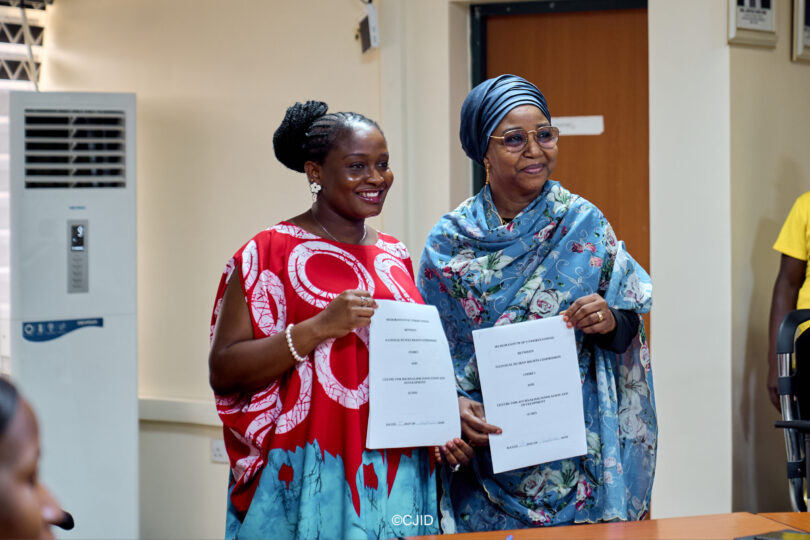
The Centre for Journalism Innovation and Development (CJID) and the National Human Rights Commission (NHRC) have signed a three-year Memorandum of Understanding to integrate verified data from CJID’s Press Attack Tracker into the commission’s monthly human-rights dashboard.
The Executive Secretary of the NHRC, Tony Ojukwu, was represented at the event by the Director, Legal Services and Enforcement, NHRC, Rabi Anwar, alongside directors and other top executive members of the commission.
Ms Anwar stressed that the partnership with the CJID aligned with its statutory mandate under the National Human Rights Commission Act 1995 (as amended).
“The commission is a primary agency of government established to ensure the rights of all Nigerian and non-Nigerian citizens within the Nigerian territory, and we take our mandate very seriously.
“It is not every organisation that reaches out to the commission for a partnership that we just roll out the red carpet and partner with them. You have met all the necessary criteria, and we are more than happy to work with you,” Ms Anwar said.
CJID’s delegation was led by its Director of Operations, Adebimpe Abodunde, alongside the Deputy Director, Partnerships and Special Projects, Bisan Habu, and other team members.
Mr Habu said the MoU builds on an existing relationship between both organisations, including their collaboration on World Press Freedom Day in May 2026. He said the discussions that followed focused on how CJID and the commission could work more closely on journalist safety, press freedom and the use of evidence to support institutional response.
Ms Abodunde, speaking on behalf of CJID’s leadership, said the partnership creates an opportunity to connect the organisation’s documentation of press freedom violations more directly with the commission’s human-rights mandate.
Ms Abodunde also mentioned that the organisation has systematically documented attacks on journalists and press freedom violations through its Press Attack Tracker (PAT), launched in 2017. The tracker currently contains 1,899 verified attacks, with historical records going back as far as 1986.
“Behind those numbers are journalists who have been assaulted, detained, threatened, harassed or prevented from doing their work. Each incident matters on its own, but documenting them over time also allows us to see patterns: where attacks are happening, who is responsible, the forms they take, and how the environment for journalism is changing.
“Documentation is one part of that responsibility. We also need credible pathways for evidence to reach institutions with the mandate to respond.
“An attack on a journalist is a human rights issue. When journalists are attacked or prevented from doing their work, the consequences extend beyond the individual journalist. It affects the media’s ability to inform the public and citizens’ ability to participate meaningfully in a democratic society.”
Ms Abodunde further noted that the partnership includes integrating verified data from CJID’s Press Attack Tracker into the NHRC’s monthly human-rights dashboard, where the CJID will periodically provide verified PAT data and the commission will incorporate that evidence into its wider human-rights monitoring.
Other areas of the relationship include joint advocacy, capacity building, public awareness and other initiatives around press freedom and human rights. She added that the CJID will also establish a dedicated press freedom and human rights reporting category at the annual CJID Excellence in Journalism Awards.
“For us, this is an important development. Attacks against journalists documented through PAT will become part of a broader national picture of the human rights situation in Nigeria. It also creates an opportunity for the evidence to receive greater institutional attention and to inform responses where appropriate,” she added.
The Press Attack Tracker is a CJID initiative launched in 2017 to document, verify and analyse attacks on journalists and press freedom violations. Its database includes historical records dating back to 1986 and currently contains 1,899 verified attacks across five West African countries. The tracker provides evidence on the nature, location and patterns of attacks and supports research, advocacy and efforts to improve journalist safety and press freedom.
The Centre for Journalism Innovation and Development (CJID) is a West African media innovation and development organisation that uses journalism, research, data and technology to strengthen democratic accountability. Founded in 2014, CJID works across areas including investigative journalism, media freedom and journalist safety, fact-checking and information integrity, civic technology, elections, climate and natural resources, artificial intelligence and digital governance. CJID works with journalists, newsrooms, civil society, researchers and public institutions across Africa.