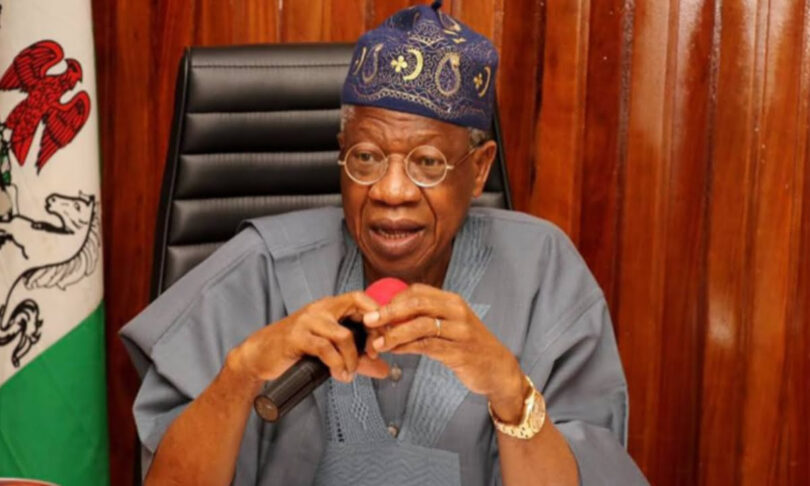
A former Minister of Information and Culture, Alhaji Lai Mohammed, has reiterated that democracy is the most effective system of governance despite its inherent flaws.
Mohammed made this statement on Wednesday during a high-level interactive session at St John’s College, Cambridge, organized by the Cambridge University Nigeria Society.
The event gathered Nigerian students and scholars in the diaspora for an open discussion regarding the state of democracy, governance, and development in Nigeria.
In response to concerns raised during the session about the efficacy of democracy in light of low educational access, he emphasized that the true challenge does not lie in the principle of equal voting rights, but rather in the socio-economic conditions that influence voter behavior.
He pointed out that enhancing access to education, healthcare, and infrastructure, especially in underserved areas, is essential for improving democratic outcomes.
Discussing the connection between insecurity and social exclusion, the former Minister stated that insurgency and banditry are partly fueled by poverty, lack of education, and marginalization. He stressed that military action alone is inadequate, advocating instead for a comprehensive approach that incorporates non-kinetic strategies such as education and economic development.
Earlier in his speech, Mohammed emphasized the vital role of communication in governance, referring to it as the “lifeblood” that links leadership to the populace.
He contended that governance in the contemporary era cannot thrive without intentional, strategic, and credible communication.
“Communication is not merely a supportive function of governance; it is fundamental to it.
“It serves as the connection between the state and its citizens, the mechanism through which policies are articulated, legitimacy is established, and trust is maintained,” he said.
Drawing from his distinctive experience as both an opposition spokesperson and a government spokesperson, he underscored the evolution of political communication in the digital age.
“We have transitioned from a top-down approach to engaging in real-time public dialogue. Today, citizens do not merely receive information; they question it, challenge it, and actively influence the narrative,” he stated, cautioning that governments must evolve to this changing landscape by becoming more transparent, responsive, and consistent in their communication strategies.
Reflecting on his tenure, Alhaji Mohammed highlighted the administration’s implementation of multi-platform communication strategies that encompassed traditional media, digital platforms, and direct engagement with citizens as a significant achievement.
“We shifted communication from one-way broadcasting to meaningful interaction. We listened as much as we communicated, and we integrated citizens’ feedback into governance,” he remarked.
Drawing on examples from his recent publication, Headlines and Soundbites: Media Moments That Defined an Administration, he emphasized the importance of communication in governance and demonstrated how communication strategies were crucial in crisis management, narrative shaping, and defending national interests.
Regarding Nigeria’s response to the COVID-19 pandemic, he characterized communication as the nation’s most vital tool in the absence of vaccines and treatments.
“During a period when there was neither cure nor vaccine, communication served as our most potent weapon. We utilized it to encourage behavioral changes, social distancing, mask-wearing, and hygiene practices, which proved to be highly effective,” he noted.
He pointed out that the high level of public adherence to these measures significantly contributed to mitigating the pandemic’s effects in Nigeria and lowering projected fatalities.
Addressing the $9.6 billion P&ID arbitration case, Alhaji Mohammed remarked that communication also played a crucial role in the outcome, explaining that the government employed a dual strategy that combined legal action with vigorous media engagement.
“We recognized that our battle extended beyond the courtroom and into the realm of public perception. It was essential for us to redefine the global narrative and frame the situation as one of fraud against Nigeria,” he stated.
Regarding the EndSARS protests, he characterized the incident as a prime illustration of how misinformation and disinformation can exacerbate crises.
“The digital era has not only increased the velocity of information dissemination but has also heightened the proliferation of false information. Unverified accounts can escalate tensions and misrepresent the truth,” he cautioned.
He further commented on the contentious choice to suspend Twitter (now referred to as X), labeling it as one of the most challenging decisions of his administration.
“It was a difficult decision. We were acutely aware of the economic and social ramifications. However, in governance, the public’s interest must take precedence over personal interests,” he remarked, emphasizing that the choice was motivated by concerns regarding national security and the responsible management of digital platforms.