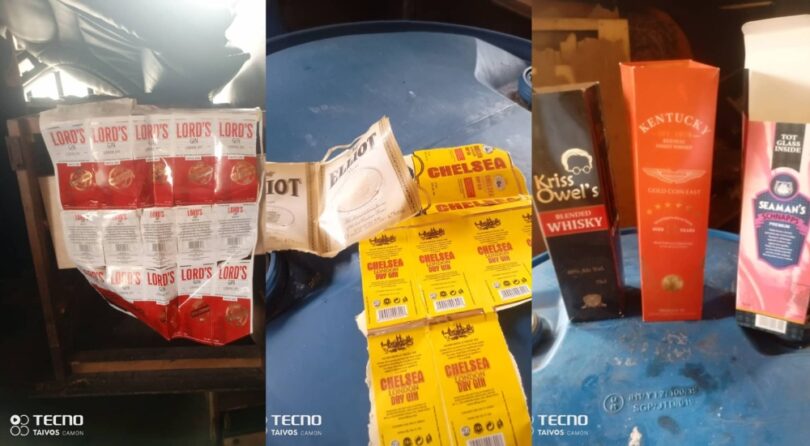
Chinese-made bottle caps, labels, cartons and counterfeit glass are driving the production of fake spirits across Africa, the Alliance Against Counterfeit Spirits (AACS) said, warning that the trade poses a direct threat to public health and government revenue.
Speaking at a one-day workshop, organised by the Spirits and Wines Association of Nigeria (SWAN) and themed “Combating Illicit Trade in the Spirits and Wines Industry in Nigeria,” AACS Experience Executive and Non-executive Director David Francis said the influx of “dry goods” from China has changed the scale of counterfeiting since the COVID-19 pandemic.
“What we’re now seeing particularly since the COVID-19 pandemic is the emergence of fake bottles. And fake bottles are genuinely problematic for us because at least in the old days of genuine bottles you had some kind of restriction in terms of the amount that could be produced. But what we’re seeing now coming out of China is the production of fake glass,” Francis said.
Francis said China remains the biggest source of dry goods, with recent raids netting almost 50,000 Cognac caps, 12,000 fake bottles with production moulds in Shandong province, and 70,000 Cognac bottles ready for export.
“When we target these dry goods, we really get ahead of downstream assembly and production of counterfeiters, but also actually we access scale,” he said.
The health risks are severe, Francis warned. “Last year in Brazil, in October, November 2025, 14 consumers died in the Brazilian market through the consumption of methanol-tainted counterfeit alcohol. This is a public health challenge that we must take extremely seriously,” he said. He added that the incident caused legitimate spirit sales in Brazil to fall by about 70% overnight.
Presenting figures on the extent of the illicit trade in West Africa, Donovan Hackart, an expert investigator and risk management consultant, said Chinese dry goods are fueling counterfeiting in West Africa.
Data presented at the workshop showed that 339,105 dry goods valued at $2,859,420.89 were seized in 2023, 375,121 valued at $2,263,825.45 in 2024, and 284,612 valued at $1,666,223.06 in 2025, bringing the total to 998,838 items valued at $6,789,469.40.
AACS enforcement across Africa revealed that in Nigeria alone, 36 premises were raided in 2023 with products valued at $317,261.62 seized; 66 premises in 2024 with $2,323,722.80 in products; and 105 premises in 2025 with $14,488,786.86 in products.
Across Cameroon, Côte d’Ivoire, Ghana, Nigeria and Togo, 75 premises were raided in 2023 with products valued at $3,273,209.75; 162 premises in 2024 with $2,687,870.83; and 157 premises in 2025 with $14,586,300.41.
On his part while welcoming participants Managing Director of SWAN, Michael Ehindero, said the conversation “is about the value of human life.”
He told participants that illicit trade includes counterfeiting, smuggling, illegal production and tax evasion, and manifests as fake products, adulterated alcohol made outside licensed facilities, and parallel imports that bypass safety checks.
“These liquids are often made without quality controls, without regulatory oversight, and without regard for human health. They may contain harmful substances, unsafe alcohol levels, or toxic additives—posing serious risks including poisoning, long term health damage, and in extreme cases, death,” Ehindero said.
He added that beyond health, illicit trade drains tax revenue and damages Nigeria’s reputation, citing government advisories warning visitors about counterfeit alcohol during festive periods such as “Detty December.”
“The fight against illicit trade requires stronger public private collaboration, intelligence gathering and effective regulatory enforcement, improved consumer awareness, and above all, a shared commitment to protecting lives,” he said.
SWAN, whose members include Bacardi, Diageo, Guinness Nigeria, Moet Hennessy, Nigerian Breweries and Pernod Ricard Nigeria, said the workshop marks the start of a larger campaign against illicit trade in the sector.