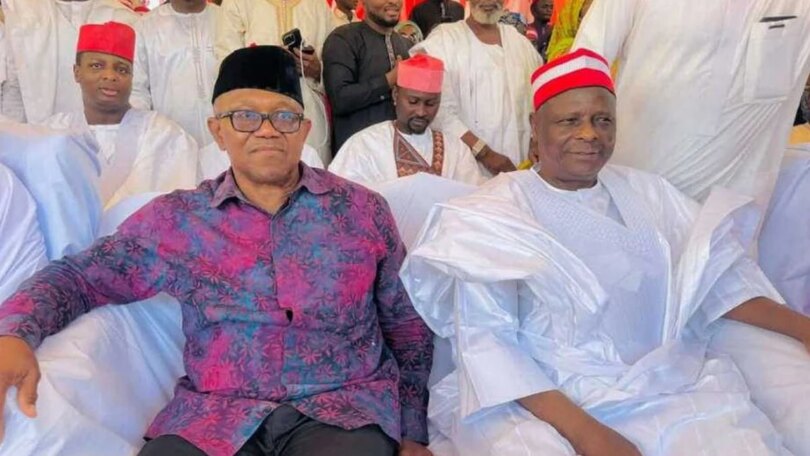
The Nigeria Democratic Congress (NDC) is facing a fresh internal disagreement over the role and control of support groups backing its 2027 presidential ticket of Peter Obi and Rabiu Kwankwaso.
This latest dispute centres on the relationship between the party and organisations such as the Obi-Kwankwaso Movement, Obidient groups and Kwankwasiyya.
Some of the groups insists that their existing structures cannot be placed under the direct control of the NDC.
The disagreement has become more pronounced after the NDC moved to establish clearer structures for support groups ahead of the 2027 general elections.
While the party maintains that support organisations must complement its official structures, the Obi-Kwankwaso Movement has insisted that political cooperation does not mean surrendering its identity, leadership or grassroots structures to the party.
The dispute is coming days after the NDC rejected a 59-member Presidential Campaign Council announced by the Obi-Kwankwaso Movement.
The movement had unveiled the council on September 17 as part of its mobilisation plans for the 2027 election.
However, the NDC later said the structure was not authorised by its leadership.
The party’s National Chairman, Senator Cleopas Moses, said the public should disregard the campaign council because it did not originate from the party or receive approval from its National Working Committee.
The National Leader of the NDC, Senator Seriake Dickson, had argued that support groups should focus on mobilisation and support for candidates instead of creating structures that could compete with the party.
“Support groups don’t compete with the political party that is sponsoring candidates. Support groups don’t compete for supremacy, for space. Support groups are what they are, support groups,” Dickson said.
He also questioned the decision of the OK Movement to establish a presidential campaign council, describing the move as outside the traditional role of a support organisation.
Dickson maintained that the NDC was ready to accommodate different support groups but expected them to operate within their designated roles.
The OK Movement, however, has rejected the suggestion that it is simply an appendage of the NDC.
Its Director-General, John Ughulu, said the movement was independently established and had developed its own structures across the country.
Ughulu said members of the movement came from different political backgrounds but were united by their support for Obi and Kwankwaso.
He argued that the movement’s cooperation with the NDC did not remove its right to maintain its own leadership and organisational arrangements.
“The OK Movement therefore makes it clear that we will not accept any attempt by any individual or group to undermine, appropriate, dissolve or otherwise interfere with the legitimate structure and leadership of the movement,” Ughulu said.
He further argued that both the political party and independent movements had separate responsibilities.
“The meaning of ‘independent’ is straightforward. The NDC has the right to constitute and manage its own campaign structures. Likewise, an independent political organisation has the right to constitute and manage its own organisational structures, subject always to the law,” he said.
The movement has also maintained that its national, state, local government and ward structures belong to the organisation and would not be handed over to the NDC.
In a related development, the NDC has also taken steps to formalise its own presidential campaign structure.
The party said consultations involving Obi, Kwankwaso and its leadership were ongoing before the official Presidential Campaign Council would be announced and inaugurated.
According to the NDC, an organogram for the campaign structure had already been prepared, while Obi and Kwankwaso were given the opportunity to make nominations for several key positions.
The party has also appealed to its candidates and support groups to avoid internal disagreements as preparations for the 2027 elections intensify.
“There are no battles to fight within the NDC. The common opponent to defeat is the ruling APC,” the party said.
However, the disagreement is no longer limited to the NDC leadership and the OK Movement.
The Kwankwasiyya Movement has also weighed in on the controversy.
Its spokesman, Habibu Muhammed, called for understanding between the political party and the various movements supporting the Obi-Kwankwaso ticket.
Muhammed acknowledged that the NDC was still developing its structures and suggested that some of the disagreements could be connected to the process of building a new political organisation.
“The truth is that the NDC is evolving and they are trying to do things differently. That is why there are some forms of misunderstanding here and there. But I believe that at the end of the day, everybody will be on the same page,” he said.
He also maintained that movements such as Kwankwasiyya and the Obidient Movement had historically operated independently of political parties.
According to him, not every supporter of Obi and Kwankwaso is necessarily a registered member of the NDC.
He therefore urged the party to create an arrangement that would allow the different movements to maintain their identities while supporting the same candidates.
“The most important thing is for the party to understand this as well and work out something that will be better than just fixing things that are not literally important, as it is doing now,” he said.
The issue has also attracted a response from Obi himself.
The NDC presidential candidate recently rejected the 59-member campaign council announced by the OK Movement, saying support groups should support the party rather than take on responsibilities belonging to the party.
“First, NDC is the political party we all belong to. And I agree entirely with the position of the leader (Seriake Dickson),” Obi said.
“OK Movement, Obidient group, Kwankwasiyya, and other support groups are supporting groups. They must play their role as support groups, supporting the party.
“They should not play the role of the party. We’ve found a situation where one of the supporting groups is using the nomenclature, that is forming Presidential Campaign Council. It shouldn’t be. No.”
Obi also said he was not consulted before the OK Movement campaign council was formed.
“Not at all. And I say it here, it is wrong. You are supporting — OK Movement is Obi and Kwankwaso. So whatever you do must have express approval of both of us,” he said.
The National Coordinator of the Obidient Movement Worldwide, Dr Yunusa Tanko, has meanwhile urged the different groups to avoid disagreements.
Tanko said the NDC remained the platform on which Obi was contesting and urged supporters to recognise the party’s position.
“The party is a vehicle in which our principal is running. He is contesting on the platform of the NDC,” he said.
Tanko also called for support for legitimate processes that would strengthen the party and its candidates.
The NDC, for its part, has previously rejected suggestions that it is opposed to the Obidient and Kwankwasiyya movements.
The party’s National Secretary, Osa Director, said the NDC recognised the importance of the two movements and maintained that they remained important to its political mobilisation.
“The NDC and the OK Movement are united and committed to the objective of ensuring victory for our presidential candidate and his running mate, Peter Obi and Rabiu Musa Kwankwaso,” he said.