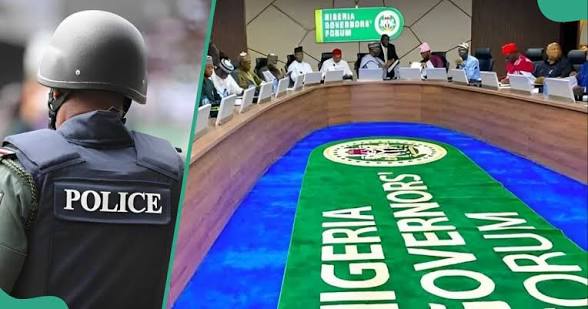
Governors across Nigeria have stepped up efforts toward the creation of state police, opening fresh consultations with Attorneys-General from the 36 states to shape the legal and constitutional framework for its implementation.
The move comes amid growing pressure to tackle insecurity across the country and decentralise policing powers.
The development was made public on Thursday after the Nigeria Governors’ Forum (NGF) held its second meeting of 2026 in Abuja.
Ogun State Governor, Dapo Abiodun, who addressed journalists after the meeting, said the discussions centered on ensuring that any structure for state police must have a strong constitutional backing and must fit into Nigeria’s federal system.
According to him, governors are united on the need to push the proposal forward, but insist that the legal foundation must be clear to prevent abuse and protect the rights of Nigerians.
He said the forum is working closely with state legal officers to fine-tune areas of concern before a final position is presented.
“The forum received a presentation from the NGF Secretariat and a delegation of the Honourable Attorneys-General of the states on efforts to support establishing state police in Nigeria.
“It noted a dedicated consultation with the Attorneys-General to review the proposed constitutional amendments and frameworks.
“Governors emphasised the need for the state police to be constitutionally sound and aligned with federalism and citizens’ rights.
“The forum noted the collaborative effort and added that the consultation outcomes would strengthen the states’ collective position,” he said.
The issue of state policing has remained one of Nigeria’s biggest constitutional debates, especially as security challenges continue to spread across many parts of the country.
From insurgency in the North-East to bandit attacks in the North-West and rising kidnappings in other regions, calls for localised policing have intensified.
Supporters argue that state governments, being closer to the people, are better positioned to respond quickly to threats and gather intelligence.
The push also gained momentum at the National Assembly earlier this month.
On June 10, the House of Representatives passed a constitutional amendment bill seeking to legalise state police, while the Senate followed a day later with a second reading of the same proposal.
The bill is now before the Senate Committee on Constitution Review.
Beyond security, governors also discussed national nutrition challenges during the meeting.
Abiodun said the forum reviewed progress under the National Nutrition 774 Initiative and restated commitment to reducing child malnutrition across the country.
“The forum received a presentation from the Federal Ministry of Budget and Economic Planning on progress under the National Nutrition 774 Initiative.
“The forum reaffirmed the governors’ commitment to improving nutrition outcomes and reducing child malnutrition across Nigeria.”
He added that governors called for stronger engagement among stakeholders to improve nutrition laws and policies, while noting ongoing progress on the National Nutrition Bill.
The meeting also featured a presentation from the World Bank on its proposed Country Partnership Framework for Nigeria between 2026 and 2032.
Governors said the framework would support agriculture, improve food security, strengthen value chains and boost private sector participation.
Abiodun said states would continue to partner with the Federal Government and development agencies to ensure effective delivery of the projects.
On electricity, the forum reviewed plans under the National Solar Super-Grid Initiative aimed at widening access to power through solar energy.
Governors said the initiative could improve electricity supply, support industrial growth and strengthen state-level energy markets.
“The forum noted the initiative’s potential to support industrialisation, improve energy security, strengthen state electricity markets, and accelerate economic growth.”
They also reaffirmed their support for ongoing reforms in the power sector, stressing the need for affordable and stable electricity across Nigeria.