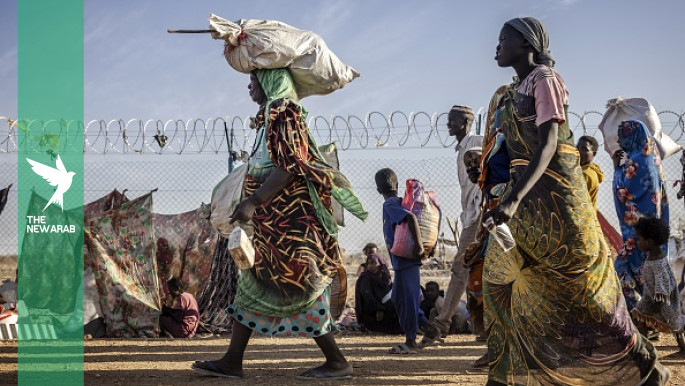
The conflict has displaced more than 14 million people and pushed several regions towards famine [Getty]
As Sudanese paramilitaries close in on the city of El-Obeid and fighting intensifies in the Kordofan region, hundreds of thousands of displaced people in the city are facing severe shortages of food, drinking water and medicine.
Local officials estimate that more than half a million people have sought refuge in the capital of North Kordofan state since the war in Sudan erupted in April 2023, overwhelming already fragile services and humanitarian resources.
Since the beginning of June, El-Obeid has increasingly come under attack by drones as war reaches the city. On 10 June, a drone strike hit a cemetery during a funeral, killing five mourners and wounding several others. At least 16 people were killed in further strikes the following day.
On 14 June, a drone strike hit several other locations across the city, including a petrol station. Three days later, the city’s main power station was bombed, plunging El-Obeid into darkness.
The crisis comes amid growing fears that the paramilitary Rapid Support Forces (RSF) could storm El-Obeid, one of Sudan’s largest cities and a strategic link between central Sudan and the western Darfur region. The deteriorating security situation has deepened an already severe humanitarian crisis.
Indiscriminate attacks
The RSF’s intensifying offensive has sent prices skyrocketing amid these dire conditions.
Residents told The New Arab that food prices have soared while access to basic necessities continues to deteriorate.
“We are suffering from hunger, thirst and a lack of medicine,” one displaced resident said, adding that many families now rely on community kitchens and charitable initiatives to survive.
Another resident said some households were surviving on a single meal per day as shortages worsen across the city.
Humanitarian workers warned that water supplies have become increasingly scarce, particularly in neighbourhoods hosting large numbers of displaced people.
One man told TNA that the price of a barrel of drinking water has risen to 25,000 Sudanese pounds (around $7). He added that even at such high prices, water is not always available, as tanker operators who transport supplies from outside the city have stopped working due to security threats and the risk of drone attacks.
“The RSF has begun targeting all moving vehicles in and around the city, making no distinction between military and civilian transport. Even vehicles carrying food supplies and drinking water have come under attack,” said Abdel Aziz Muhammad.
“Health conditions have also deteriorated due to power outages and security threats on the roads. Public transport has stopped entering the city, leading to shortages of essential medicines, particularly intravenous fluids and drugs used to treat injuries and wounds.”
Battered healthcare
Medical facilities are also struggling with shortages of medicines and essential equipment.
Suleiman Awad, a medical worker in El-Obeid, described the situation as critical, citing the continued deaths and injuries caused by shrapnel from drone strikes targeting residential neighbourhoods and homes.
“Work at the few hospitals that are still functioning is often disrupted by shelling. Medical staff are sometimes forced to switch off the lights to avoid being targeted, or to prevent patients from being targeted by drones. Healthcare workers are terrified while carrying out their duties inside hospitals, which are supposed to be among the safest places.”
Awad added that many health centres now operate only on certain days because they face severe shortages of even the most necessities, including drinking water.
“Many health facilities are functioning on limited schedules because they struggle to secure the simplest essentials, such as drinking water, while every neighbourhood in the city is suffering from a severe water crisis,” he said.
Preparing for an invasion
Dozens of Western nations and the UN have pleaded with the paramilitary Rapid Support Forces not to invade the city over fears of potential atrocities happening, like when the RSF overran the city of El-Fasher last year.
The RSF has encircled El-Obeid from three directions: the south, west and north. To the south, its fighters are positioned in the village of Umm Arda, around 20 kilometres from the city centre. To the west, they maintain checkpoints in the Abu Qaoud area, approximately 40 kilometres away, while to the northwest they are deployed around Jabal Abu Sanoun, about 30 kilometres from the city. The group has also established military camps in the Dankoj area, roughly 25 kilometres to the north.
To prevent infiltration into the city, government authorities have constructed a defensive earthen barrier around El-Obeid, reinforced with embankments and defensive trenches.
While the RSF controls much of Darfur – a region more than twice the size of the UK – the army retains control of most of northern, eastern and central Sudan. The Kordofan region in the south, where much of the fighting has been concentrated in recent weeks, remains contested.
Sudan’s war, now in its fourth year, has devastated much of the country and triggered what the UN describes as the world’s largest displacement crisis and one of its worst hunger emergencies.
The conflict has displaced more than 14 million people and pushed several regions towards famine, according to UN agencies.
With fighting continuing across Kordofan and aid access severely constrained, residents of El-Obeid fear the city could face an even deeper humanitarian catastrophe if aid does not arrive soon.
Hassan Ahmed told TNA that the heightened security measures inside the city had made daily life increasingly difficult for residents.
“The strict security measures have turned people’s lives into a nightmare and fuelled fears that such steps indicate the authorities have moved their last lines of defence into the city itself,” he said. “El-Obeid is now almost besieged – surrounded on the ground by RSF positions and from the air by its drones.”