
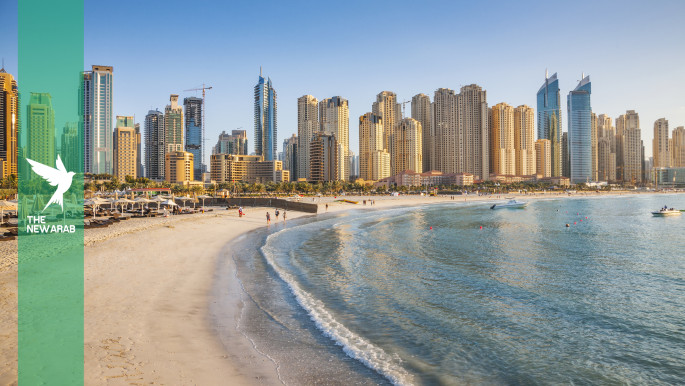
In an effort to contain the outflow of highly skilled foreign talent, UAE authorities have begun studying unprecedented tax and procedural facilitations aimed at encouraging professionals who left the country to return. [Getty]
The United Arab Emirates, in general, and Dubai in particular, are facing a critical test of their international image as an economic oasis of stability in a conflict-affected region.
Recent missile and air strikes on the Gulf state during a period of ceasefire, unlike other countries, have undermined confidence in the “safe haven” model that has attracted global talent for decades, highlighting the strategic impact of the US-Israeli war on the country and its economic framework.
As geopolitical tensions persist and Iran targets the UAE oil company Adnoc, authorities have had to respond to direct security threats.
These included intercepting cruise missiles over Gulf waters and activating advanced air defence systems such as Thaad and Barak-8 to protect critical infrastructure, according to a report published on 5 May by VisaHQ, which focuses on immigration and international business visas.
Despite the official announcement that airspace was fully reopened the day before yesterday and that normal flight operations were restored, the same report notes that security and risk firms continue to advise international employees to maintain a high level of vigilance.
This reflects a shift in Dubai’s security assessment, as it is no longer insulated from the direct consequences of regional conflict.
Human capital flight
In an effort to contain the outflow of highly skilled foreign talent, UAE authorities have begun studying unprecedented tax and procedural facilitations aimed at encouraging professionals who left the country at the outbreak of the conflict to return.
The proposals would allow foreign residents to retain their favourable tax status even if they spend longer periods outside the country due to security conditions, bypassing the previous 183-day residency requirement, according to a report published by the Economic Times on 18 March.
The move, the same report said, reflects a government recognition that the UAE’s core attractions, zero income tax and a perceived safe environment, have suffered significant damage.
This has created the need for additional incentives to maintain continuity in vital sectors such as technology and finance, particularly as several professional families have begun relocating their centres of life to areas beyond missile range.
At the level of major corporations, the “location premium” that global firms once paid to operate in Dubai is beginning to erode amid concerns over supply chain disruptions and threats to digital infrastructure.
Field data indicate that many wealthy individuals and regional offices have already activated contingency plans, relocating parts of their assets and operations to alternative hubs such as Singapore and Switzerland as a form of “insurance policy” against uncertainty, according to a Deutsche Welle report published on 4 May.
The search for stability is no longer a tactical choice but a strategic necessity for companies concerned about data centre disruption or restricted staff mobility.
This reinforces expectations of a shift from Dubai as a single regional hub to a “dual-hub” model that distributes risk between the Gulf and more stable regions, the report added.
It also noted that such a development poses a direct threat to non-oil sector growth, which has already shown a noticeable slowdown under rising shipping and insurance costs.
Fragile economic model
Political economy researcher Mustafa Youssef told The New Arab that the US-Israeli war on Iran’s impact has exposed the fragility of the model adopted by Dubai and the UAE.
He said policymakers had assumed that political alignment with the United States and Israel would shield the region from Middle East volatility.
However, he added, this calculation has been reversed, leading to growing regional isolation and reducing the UAE’s traditional attractiveness to many professionals in the Arab and Islamic worlds.
According to Youssef, skilled workers now view the UAE as a limited destination catering to specific groups aligned with certain political agendas, while attention is shifting towards other models perceived as more stable and more consistent with regional identity.
He said Saudi Arabia stands out in this context as a central economic power in the Gulf.
As a result, Riyadh has become the de facto capital of economic and investment activity in the region in recent periods.
Developments in the US-Israeli war on Iran have further reinforced this model, supported by the kingdom’s large market and diversified income sources.
Qatar has retained its second position due to its flexibility and appropriate scale, reducing the UAE’s relative share in attracting investment and talent, according to Youssef.
Dubai, therefore, faces major challenges in retaining multinational companies and independent global talent, who are increasingly seeking safer and more stable working environments.
Alternatives include Turkey, Morocco, particularly Tangier and Kénitra, and southern Spanish cities, which offer a dynamic environment and greater space for personal freedom and expression, he said.
Youssef added that the UAE development model suffers from a structural reliance on non-sustainable service sectors, making it highly vulnerable to rapid capital and talent outflows at the first sign of risk, as seen during the war.
He contrasted this with natural markets that have real demographic and economic depth.
He concluded that the ongoing trend of major companies relocating their regional offices from Dubai is likely to continue, favouring destinations that offer a development model based on sustainability and genuine integration with local markets.
Erosion of immunity
In this context, Dubai-based strategic adviser Nigel Lea said the security concerns have created a rupture in the perception of “immunity” that Dubai and the UAE previously enjoyed.
He noted that nearly 30,000 British nationals, around one-eighth of the UK community, have temporarily left the country since the outbreak of hostilities in February, according to a 22 April report by Invezz, an investment-focused platform.
Lea said these professionals are not necessarily returning to their countries of origin but are instead moving to alternative havens in Europe, such as Switzerland, Spain and Portugal, seeking a balance between personal security and favourable tax systems.
He said the movement is not merely a reaction to missile threats but a “strategic repositioning” by professional families who are no longer willing to accept high salaries in exchange for living in high-risk environments.
This, he added, is placing significant pressure on major companies to offer “risk premiums” or evacuation plans to retain senior staff.
Elsa Littlewood, tax partner at BDO International, warned that the erosion of the “absolute safety” advantage could reshape the rules of the game in Dubai.
She said stability had functioned as the true currency attracting wealthy individuals.
She noted that authorities’ consideration of easing tax residency rules and allowing longer absences without losing tax status amounts to an implicit recognition of the difficulty of retaining talent amid current tensions, according to a report published by IntelliNews on 19 March.
Littlewood said global companies are already activating business continuity plans that involve relocating data and decision-making centres to parallel offices, not as a full exit but as an operational “insurance policy”.
She added that this shift could lead to the emergence of a “dual-hub” model, in which Dubai remains a commercial interface while other, more militarily stable cities become centres for risk management and sensitive financial assets.
Article translated from Arabic by Afrah Almatwari. To read the original, click here.