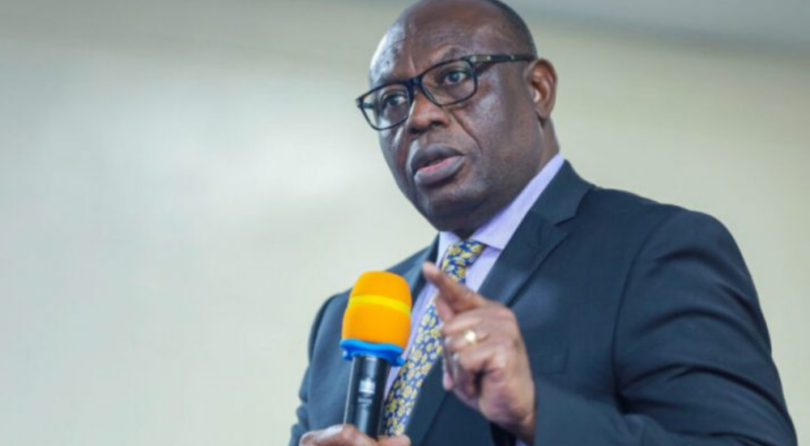
Former Independent National Electoral Commission (INEC) National Commissioner, Festus Okoye, has warned journalists against amplifying hate speech, inflammatory remarks and inciting statements by politicians, saying irresponsible election reporting could trigger violence and undermine Nigeria’s democratic process.
Okoye gave the warning on Friday while speaking at a one-day election coverage training workshop organised by The Whistler newspaper in Abuja.
He urged journalists to exercise caution when reporting provocative statements by political candidates, stressing that the media must not become a platform for spreading rhetoric capable of provoking violence or encouraging citizens to take up arms against political opponents.
The former INEC commissioner said journalists should not merely reproduce inflammatory statements for public consumption but must hold politicians accountable for their utterances and ensure that such comments receive sustained scrutiny.
He cited instances where politicians allegedly threatened violence against supporters of opposing political parties and made remarks suggesting that women whose husbands refused to vote for a particular party could face consequences in their marriages.
Okoye said such statements should not be treated as ordinary campaign rhetoric, warning that politicians must not be allowed to escape accountability by subsequently claiming they were misquoted or that their comments were generated using artificial intelligence.
He lamented what he described as the media’s lack of consistency in holding public figures accountable, noting that journalists often abandon controversial issues after the initial public reaction.
“The truth of the matter is that we do not have the temperament. We do not have the staying power to remain on a particular issue and deal with it and get through with it. We don’t forget at all. We don’t move on. We’ve moved on. The man doesn’t go away. The police only invite him,” he said.
Okoye reminded journalists of the provisions of Section 96 of the Electoral Act, which prohibits the use of abusive, intemperate, slanderous or inflammatory language capable of provoking violent reactions during political campaigns.
He also highlighted restrictions against using religious sentiments to incite hostility, as well as the prohibition of political campaigns in certain public institutions and places, including places of worship, police stations and public offices.
The former commissioner warned political parties and candidates against recruiting thugs to intimidate opponents, stressing that the law provides penalties for those involved in electoral violence, including individuals who aid and abet electoral offences.
Okoye also cautioned against the misuse of government institutions and state resources to advance the interests of particular political parties, insisting that public institutions must remain neutral during elections.
Addressing journalists’ professional responsibilities, he said reporters covering the 2027 general elections must familiarise themselves with the legal instruments governing elections, including the Electoral Act and INEC guidelines.
“A good journalist makes an effort to understand and have basic knowledge of the legal instruments that govern elections. A good journalist will read and ask questions when in doubt,” he said.
He further stressed that journalists must remain impartial irrespective of their personal political preferences, ideological beliefs or affiliations.
According to him, the responsibility of journalists is to provide accurate information and allow Nigerians to make informed decisions rather than use their platforms to promote political interests.
“The journalist’s ideological preferences and disposition are immaterial. The journalist should report and let the people be the ultimate judge. Leave the ideological leaning,” he said.
However, Okoye warned that impartiality must not be used as an excuse to give unlimited publicity to hate speech and statements encouraging violence.
“The journalist is not allowed to amplify hate speech or statements that encourage recourse to arms and violence. You go and amplify that you are reporting. In other words, the journalist should not aid and abet violation of the law,” he said.
He also warned journalists about the legal consequences of publishing defamatory allegations, explaining that attributing an unverified accusation to another person does not automatically protect a journalist or media organisation from liability.
Using a hypothetical example, he said journalists could expose themselves to legal action by publishing allegations describing an individual as an armed robber without establishing the truth of the claim.
He urged reporters to independently verify politically sensitive allegations before publication, advising: “If you are in doubt, leave it out.”
The workshop, organised ahead of the 2027 general elections, is designed to strengthen journalists’ capacity to report political campaigns and electoral processes accurately, responsibly and professionally.
The training also examines the legal and regulatory framework for elections, INEC guidelines, electoral offences, the use of the Bimodal Voter Accreditation System (BVAS) and INEC Result Viewing Portal (IReV), as well as the movement of results from polling units to collation centres.
Other sessions focus on reporting political campaigns, interpreting voter registration figures and Permanent Voter Card (PVC) data, interviewing political candidates and INEC officials, and identifying misinformation and manipulated digital content.
Participants are also being trained on deepfake detection, artificial intelligence-generated misinformation, digital verification tools, mobile journalism, journalists’ safety during elections and the establishment of an effective election results desk.
The workshop brings together media professionals and resource persons to equip journalists with the technical, legal and ethical skills required to provide credible election coverage and prevent the spread of misleading information ahead of the 2027 polls.