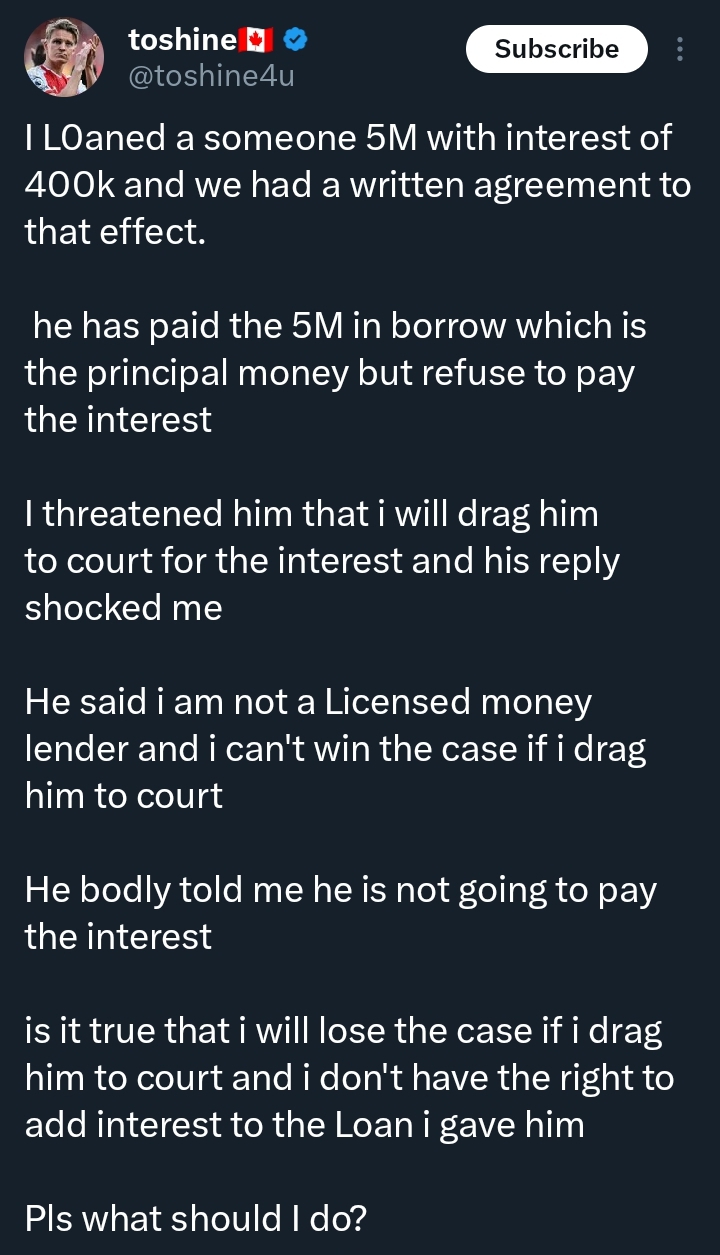
A Nigerian man has sparked debate online after revealing how a borrower allegedly refused to pay an agreed ₦400,000 interest on a ₦5 million loan, despite signing a written agreement.
In a viral post shared on social media, the man explained that the borrower had fully repaid the ₦5 million principal but declined to settle the agreed interest.
According to him, the borrower claimed he could not legally enforce the interest payment because he was not a licensed money lender.
The lender quoted the borrower as saying: “He said I am not a licensed money lender and I can’t win the case if I drag him to court.”
The man added that the borrower “boldly” insisted he would not pay the ₦400,000 interest, leaving him confused about his legal rights and possible next steps.
Mixed legal opinions trail dispute
The post quickly attracted reactions from Nigerians, especially legal commentators, with many offering different interpretations of the law surrounding private loans and interest agreements.
A legal commentator identified as Dammy Esquire said the borrower might be “partly correct,” noting that charging interest without a money lender’s licence could weaken the lender’s case in court.
“He is partly correct. In Nigeria, charging interest regularly without a money lender’s license can weaken your case for the interest, even if the principal loan was repaid,” he wrote.
He, however, added that the written agreement between both parties still carried legal weight and advised the lender to consult a lawyer for proper direction.
Another user, Mayokun, strongly criticised the borrower, describing him as dishonest and lacking integrity.
“He’s a thief who lacks integrity. Didn’t he know the office of licensed lender when he signed the agreement?” he stated.
Mayokun argued that the lender could still pursue a breach of contract claim if the transaction was simply a private loan between two individuals and not a formal money-lending business covered by the Money Lenders Act.
A third commenter, Catalyst, warned that the matter could become complicated depending on how it is handled legally or otherwise.
“It depends on the court. Legally, there’s a possibility of you losing. Illegally, he might decide to pay you an extra 5m or you may not live to get the 400k,” the comment read.