CYRIACUS IZUEKWE
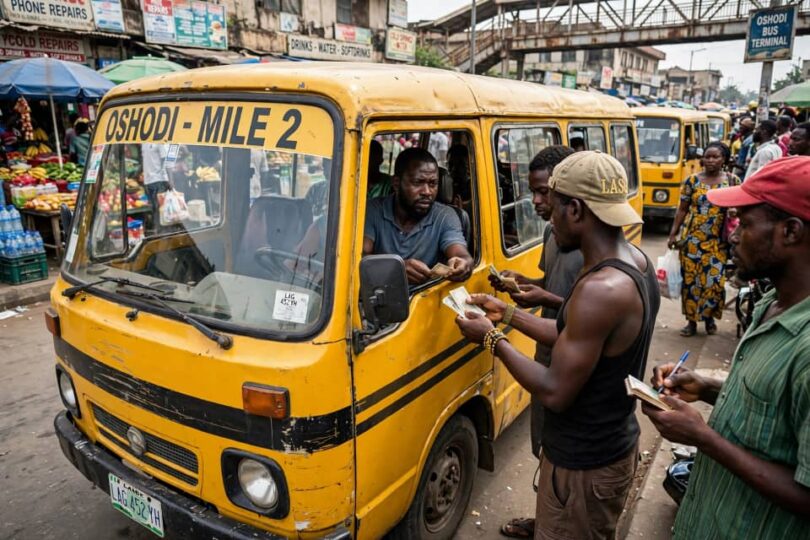
If you have entered a danfo or taken a bus from Oshodi to Mile 2, or from Ikotun to Iyana-Ipaja recently, you already know the new normal in Lagos.
Before your driver moves, he must pay. At every bus stop, someone is waiting with a stick, a used tyre, or a receipt book. Pay, or you don’t move. Argue, and your side mirror goes.
They call them agberos. Officially, they are members of transport unions and park managers. But to the average Lagos driver and commuter, they are tax collectors who work with force.
In a viral post that trended last week and sparked debate on Instagram, popular blogger Tunde Ednut lamented that begging culture in Lagos has escalated to “demand by force”. His post resonated because every Lagosian has experienced it at one point.
P.M.EXPRESS went to the streets to feel the pulse. At Trade Fair Complex, where a recent crisis between motorcycle union executives led to Police arraignment of two operators for alleged unlawful assembly, riders narrated their ordeal.
One okada rider at Trade Fair Under Bridge, who identified himself as Musa, said he pays over N3,500 daily to different groups before he can make any meaningful profit.
“In the morning, you pay chairman N500. Afternoon you pay task force N700. Evening you pay oga night N500. Loading point you pay N300 per trip. If you don’t pay, they will beat you or seize your bike. Police will still collect their own,” he lamented.
A danfo driver plying Iyana-Ipaja – Oshodi route said he spends between N5,000 and N7,000 daily on agbero levies, which he then transfers to passengers through increased fares.
“Fuel don cost, we still dey pay agbero. Na why transport fare from Iyana-Ipaja to Oshodi don become N800 from N500 last year. We are not happy too, but we must survive,” he said.
Commuters are also victims. At Oshodi, passengers told P.M.EXPRESS that they are sometimes forced to contribute money when a driver is harassed by agberos, or risk being stranded for hours.
“I was in a bus last Tuesday from Mile 2 to Orile, agberos blocked the driver because he didn’t pay morning ticket. They held us for 45 minutes. At the end, passengers contributed N1,000 to settle them so we could go,” Miss Blessing Okoro, a trader, narrated.
The extortion is not limited to motor parks. On major roads, hoodlums now place tyres on the road to force drivers to stop and pay. Those who refuse get their vehicles scratched or windscreens smashed. The Police, many drivers allege, look away.
Security experts say the agbero system thrives because it provides employment for thousands of touts and generates huge revenue running into billions of Naira monthly for powerful interests, but it fuels inflation, traffic chaos, and insecurity.
A transport economist, Mr. Chidi Ike, explained: “What we call agbero levy is multiple taxation. It adds over 30 percent to transport cost in Lagos. When transport cost rises, food prices rise, because food comes by road. So every Lagosian pays the agbero tax indirectly.”
The Lagos State Government has on several occasions promised to regulate the activities of transport unions, ban collection of levies by force, and introduce electronic ticketing. In 2023, it announced plans to introduce e-tickets for danfos. Two years after, nothing has changed on the streets.
Until the government matches words with action and enforces its own laws against extortion and harassment, Lagosians will continue to pay the agbero tax – by force, by fear, and by frustration.