
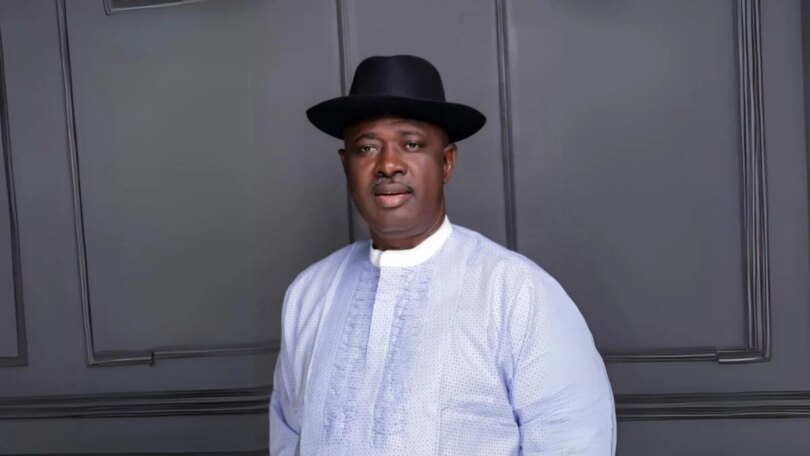
The Minister of State for Petroleum Resources (Oil), Heineken Lokpobiri, has stated that the country’s pump price remains lower than that of the United States and several other countries.
Lokpobiri said the price of petrol could not be arbitrarily reduced to N1,000, N800 or N700 per litre because crude oil and refined petroleum products are traded in a global market.
The minister spoke on Tuesday during an appearance on Channels Television’s Politics Today, following the recent increase in the pump price of petrol by the Nigerian National Petroleum Company Limited.
A market survey showed that several NNPCL retail outlets in Abuja and its environs recently adjusted their petrol prices to between N1,395 and N1,430 per litre.
The latest adjustment represents an increase of between N50 and N85 per litre at the affected outlets.
However, responding to questions on why Nigerians should continue to bear the impact of international crude prices when the country has crude oil and local refining capacity, Lokpobiri said Nigeria was already benefiting from local production and refining.
“We are already benefiting. That’s why our price is lower than that of the US,” the minister said.
He argued that the United States, despite being one of the world’s largest crude oil producers and having significant refining capacity, sells petrol at a price higher than Nigeria.
Lokpobiri maintained that the volume of crude oil produced by a country does not automatically determine the price of petrol because crude oil is a globally traded commodity.
According to him, even if Nigeria increases its crude production significantly, the increase would not materially alter the international price benchmark.
“Crude oil and refined product is a global business. Nigeria doesn’t exist in isolation,” he said, adding that Dangote Refinery would also have to purchase crude at internationally determined prices.
The minister also rejected the suggestion that the Federal Government could simply direct a reduction in petrol prices, stressing that the downstream petroleum sector had been deregulated.
“No, we don’t. Because it is completely deregulated in line with global best standards,” Lokpobiri said when asked whether the Tinubu administration had a direct role in increasing or reducing petrol prices.
He further defended President Bola Tinubu’s decision to remove petrol subsidy, arguing that retaining the subsidy would have placed Nigeria on a path similar to Venezuela.
“Nigeria would have been like Venezuela if President Tinubu didn’t make that decision at that time,” he said.
Lokpobiri cited Venezuela’s vast crude oil reserves while arguing that oil wealth alone does not guarantee affordable petroleum products or economic prosperity.
“Venezuela has the highest crude oil reserves in the world but is among the poorest countries in the world,” he said.
The minister also dismissed the argument that locally produced and locally refined petrol should be insulated from global crude price and exchange-rate movements.
Using Saudi Arabia as an example, he said oil-producing countries still sell crude to their refineries based on global market prices.
He maintained that Nigerians were benefiting from the shift towards domestic refining through improved availability, even though the price remained exposed to global market forces.
Lokpobiri said the situation was not peculiar to Nigeria, noting that countries around the world were dealing with similar pressures arising from the global nature of the oil market.