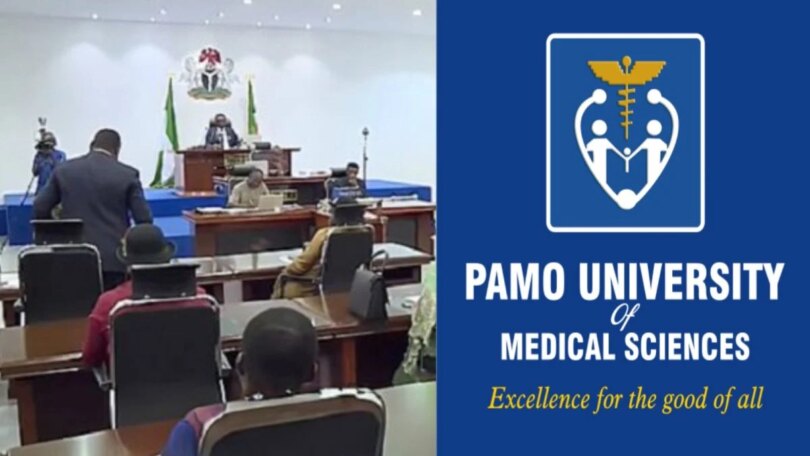
The Rivers State House of Assembly has ordered the arrest of the Vice-Chancellor of PAMO University of Medical Sciences (PUMS) over his failure to appear before a committee investigating billions of naira released to the institution by the state government.
The decision was taken after the Vice-Chancellor failed to honour repeated invitations by the ad hoc committee handling the investigation into the university’s financial dealings with the Rivers State Government.
The committee, chaired by the Deputy Speaker of the House, Dumle Maol, had earlier directed the Vice-Chancellor to appear in person and explain how funds released to the university under the state’s scholarship programme were utilised.
The lawmakers had also summoned the Rivers State Accountant-General, Commissioner for Finance, Commissioner for Education and the Permanent Secretary of the Ministry of Education as part of the inquiry.
While some of the government officials appeared before the committee, the Vice-Chancellor was absent.
The Commissioner for Education, Peters Nwagor, attended the sitting and responded to questions from the lawmakers.
The latest action marks an escalation in the dispute between the Assembly and the management of the privately owned university, which was founded by former Rivers State Governor, Peter Odili.
The investigation covers funds released to PAMO University over several years, particularly money provided by the state government to support Rivers indigenes studying at the institution.
The Assembly had become concerned about the funding arrangement after it removed a proposed N6 billion allocation for PAMO University from the 2026 Rivers State budget.
Following the budgetary decision, the House constituted a seven-member ad hoc committee to investigate the financial relationship between the state government and the university.
The committee was mandated to establish the total amount released to the institution since 2017, determine how the funds were spent and identify beneficiaries of the scholarship scheme.
The House had earlier said the investigation was necessary before further public funds could be committed to the university.
The committee subsequently invited the Vice-Chancellor and other officials to provide documents and explanations relating to the disbursements.
At one of the earlier sittings, Maol expressed dissatisfaction over the failure of the Vice-Chancellor, Commissioner for Finance and Accountant-General to appear before the committee.
He subsequently gave the affected officials another opportunity to appear on September 24, warning that the Assembly could invoke its constitutional powers if they failed to comply.
The committee had relied on Sections 128 and 129 of the 1999 Constitution, as amended, in asserting its power to conduct the investigation.
Maol had explained that the Vice-Chancellor was required to appear because of his position as the chief accounting officer of the university.
“The only person that can come and speak to this document presented by the Ministry of Finance to this committee is the Chief Accounting Officer of the university, which is the Vice-Chancellor, and that is in line with the Constitution”, he said.
The disagreement became more pronounced after lawyers representing PAMO University appeared before the committee instead of the Vice-Chancellor.
The university’s counsel, Chukwuma Chinwo, had questioned the jurisdiction of the Assembly over the institution and argued that the lawmakers could not compel the Vice-Chancellor to appear under the circumstances.
Chinwo said the university had advised its Vice-Chancellor not to appear before the committee.
“There were no funds appropriated to PAMO University. Now, if you give a scholarship to your student, which is quite good, it is like a father who is training his child in the university, and there are students of private sponsorship there.”
He further argued that the funds were connected to scholarships for students rather than a direct appropriation to the private university.
The Assembly, however, maintained that the funds under investigation were public resources and that it had a constitutional responsibility to establish how they were used.
The lawmakers also insisted that the Vice-Chancellor was the appropriate person to provide answers to financial records presented before the committee.
According to the committee, records obtained from the state Ministries of Finance and Education raised questions over the amount released to PAMO University and the corresponding number of students said to have benefited from the scholarship programme.
The committee also raised concerns over discrepancies in documents presented by government agencies.
Speaker Martin Amaewhule, while reacting to the committee’s report, said the Assembly was interested in establishing what happened to the funds released by the state government.
He acknowledged that the scholarship programme was designed with a good intention but expressed concern over the way the scheme was implemented.
Amaewhule said documents from the Ministry of Finance, Ministry of Education and the Office of the Accountant-General did not completely agree on the financial figures.
The Speaker also claimed that the records before the Assembly indicated that more than N29 billion had been released to PAMO University, while only about N5 billion could be accounted for as utilised.
The Assembly has consequently recommended that the Rivers State Government establish a committee to recover any funds found to be unaccounted for and return such money to the state’s Consolidated Revenue Account.
The lawmakers are also seeking clearer records of the students covered by the scholarship arrangement and the amounts spent on their education.
The committee’s investigation was initially scheduled to be concluded with a report to the House on or before September 30.