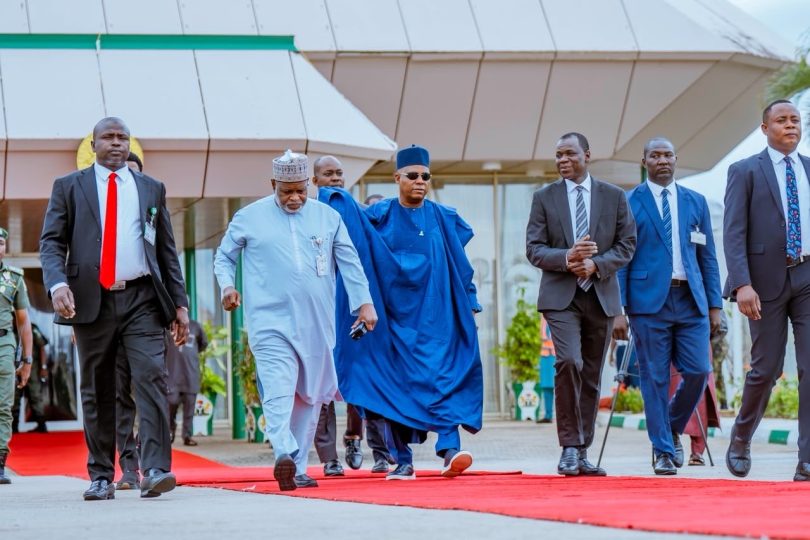
Vice President Kashim Shettima has departed Abuja for the Republic of Benin on a high-level working visit aimed at identifying strategies to revive Nigeria’s textile industry and strengthen the country’s agro-industrial development…
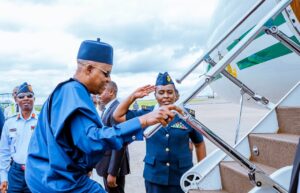
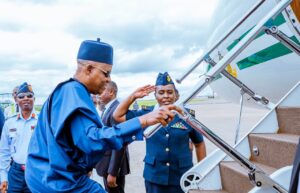
Vice President Kashim Shettima has departed Abuja for the Republic of Benin on a high-level working visit aimed at identifying strategies to revive Nigeria’s textile industry and strengthen the country’s agro-industrial development.
Shettima is leading a delegation comprising governors of Imo, Zamfara, Plateau, Kwara, Katsina and Jigawa states, alongside senior federal government officials, to the Glo-Djigbé Industrial Zone (GDIZ) near Cotonou.
During the visit, the delegation will engage with Beninese government officials, investors and private sector operators to study the industrial hub’s model for agricultural value addition, investment mobilisation, skills development and export-oriented manufacturing.
A key focus will be the GDIZ textile park, which integrates cotton spinning, weaving, fabric processing and garment production within a 1,640-hectare industrial zone designed to process agricultural commodities into finished products for export.
According to the Presidency, the visit is intended to support the implementation of Nigeria’s Special Agro-Industrial Processing Zones (SAPZ) Programme and provide practical lessons for rebuilding the country’s textile sector, which has suffered years of factory closures, weak local processing and competition from imported fabrics.
Official figures from the National Bureau of Statistics show that Nigeria’s textile, apparel and footwear industry was valued at about ₦8.15 trillion in 2024 and generated ₦2.45 trillion in nominal output in the first quarter of 2025.
The Federal Government said strengthening links between cotton farmers, ginneries, textile manufacturers, fashion businesses and export markets could reduce import dependence, conserve foreign exchange and create jobs across the value chain.
The delegation is also expected to examine opportunities for technology transfer, industrial training, modern machinery, reliable energy systems and public-private partnerships to improve the competitiveness of Nigeria’s textile industry.
The visit aligns with President Bola Tinubu’s Renewed Hope Agenda, which prioritises industrialisation, economic diversification, agricultural transformation, job creation and the expansion of non-oil exports.