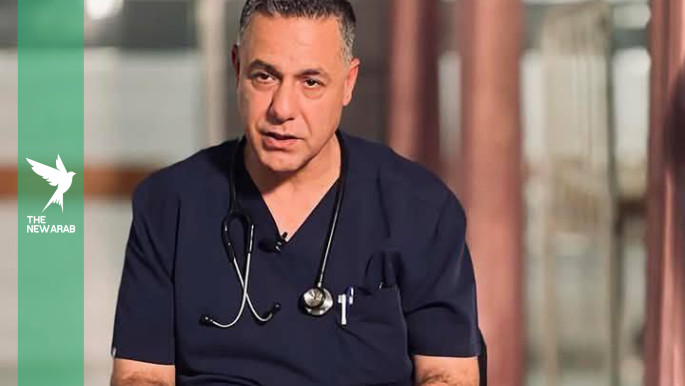
The son of imprisoned Gaza doctor Hussam Abu Safiya has described his devastation after Israel’s Supreme Court rejected his father’s appeal against detention on Tuesday, leaving the prominent physician jailed without charge despite mounting concerns over his health.
In comments to The New Arab, Elias Abu Safiya said seeing his father appear before the court last week in a visibly weakened condition had left the family heartbroken.
The ruling means Abu Safiya, 53, will continue to be held under Israel’s Unlawful Combatants Law despite no criminal charges being brought against him.
“This is an extremely difficult feeling, one that cannot be described in words, after seeing the last image of my father showing signs of pain, exhaustion, emaciation, a weakened body, and skin diseases,” Elias said.
“It is certainly a very sad feeling to see your father in such a condition while being unable to protect him or offer him anything beyond appeals and calls for action,” he added.
The doctor’s appearance via video link during last week’s hearing sparked alarm among supporters and rights groups after a bruised eye, severe weight loss and signs of skin disease were visible.
According to his lawyer, attorney Nasser Odeh, Abu Safiya will remain in solitary confinement at Nafha Prison under harsh detention conditions while continuing to be denied necessary medical treatment despite his deteriorating health.
Naji Abbas, director of the prisoners and detainees department at Physicians for Human Rights Israel (PHRI), condemned the court’s decision.
“The rejection of Dr. Hussam Abu Safiya’s appeal and his continued detention without charge represent a profound moral and legal failure,” Abbas said.
“Rather than upholding the fundamental principles of the rule of law and due process, the court has endorsed the indefinite detention of a hospital director who remains in solitary confinement while suffering from medical conditions that are not receiving appropriate treatment.”
He warned that the ruling set a dangerous precedent.
“The message sent by this decision is unmistakable: a medical professional can be deprived of his liberty indefinitely without being charged and without the authorities presenting evidence against him in open court.”
Elias Abu Safiya also argued that the ruling violated international law.
“He informed the court that he had been acting in accordance with international laws, regulations, and the Geneva Conventions, under which my father and the staff should have been protected,” he said.
“Rejecting the appeal without bringing any charges means that there will be even more victims of this unjust decision. However, we will not stop demanding my father’s release. Israel has failed to attribute any charges to him up to this moment because it possesses no evidence of wrongdoing.”
Abu Safiya was the director of Kamal Adwan Hospital in northern Gaza and was detained by Israeli forces on 27 December 2024 alongside other Palestinian medical workers.
He became one of the most recognisable figures in Gaza’s healthcare system after refusing to abandon patients despite repeated Israeli attacks on the hospital, severe shortages of medicine and equipment, and intense bombardment.
Since his detention, international campaigns led by medical professionals, rights groups and activists have called for his release.
Rights organisations have repeatedly raised concerns about his treatment in detention, particularly after reports that he was placed in solitary confinement, denied medication and struggled to move inside his cell.
Last week, Elias told The New Arab that his greatest fear was that his father could die behind bars.