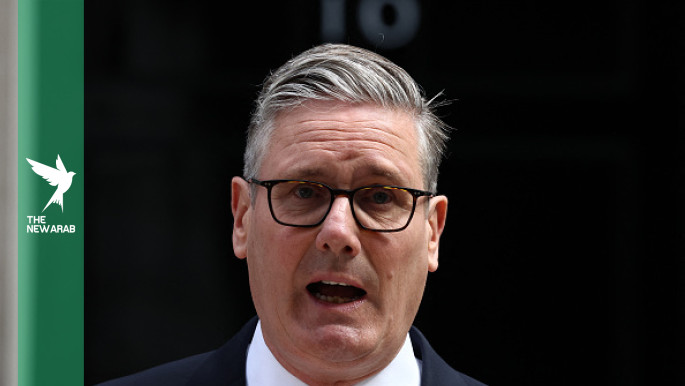
Critics of Keir Starmer say he leaves legacy of cracking down on civil liberties and supporting Israel’s rights violations [Getty]
Less than two years after winning a thumping parliamentary majority, albeit with a record-low voter turnout and a vote share of just 33%, UK Prime Minister Keir Starmer has announced his exit from office.
Starmer, a human rights lawyer by training, exits Number 10 with a record that rights groups say showed little respect for human rights and civil liberties, both at home and abroad.
The prime minister also leaves behind a country that appears increasingly divided, both politically and socially, with the far right on the rise and the country’s two-party system shattered by movements on both sides of the political spectrum.
The unpopular prime minister’s exit, it appears, is one issue that both the left and right have found common ground in celebrating.
Gaza
Israel’s war on Gaza did not begin during Starmer’s premiership, but in the opening weeks of the war the Labour leader gave his backing to Israel’s actions, including its siege on the territory.
“I think Israel does have that right. It’s an ongoing situation,” Starmer said on LBC in October 2023, referring to Israel’s withholding of water and electricity from Gaza’s civilian population.
As the siege and bombardment continued, Starmer also held off on calling for an immediate ceasefire, changing his position only months later, by which time Israel had killed close to 30,000 Palestinians.
The party tabled an amendment to a Scottish National Party motion in February 2024 that called for an immediate ceasefire, instead backing an “immediate humanitarian ceasefire”, prompting accusations that Labour was playing politics with a humanitarian issue.
Once in power, Starmer’s government imposed a partial ban on arms sales to Israel, suspending 30 out of 350 arms export licenses to the country. However, the government continues the supply of parts for F-35 jets used by Israel’s air force, and has resisted calls for a full embargo.
Rohan Talbot, Director of Advocacy and Campaigns at Medical Aid for Palestinians (MAP), said that Starmer’s record would be “forever be marred by half measures and inaction in the face of Israel’s atrocities”.
“Under Starmer’s leadership, the UK continued to provide arms to Israel while its forces bombed Gaza’s hospitals into rubble and deliberately starved an entire population of the food and medicines they needed to survive,” Talbot said in an emailed statement.
Civil liberties crackdown
The war on Gaza also had a chilling effect on civil liberties in Britain, with Starmer’s government taking extraordinary measures against protesters.
In 2025, the government proscribed Palestine Action as a terror group after members of the organisation sprayed red paint over two aircraft at a UK military base. Rights groups slammed the designation as an overreach, as it put the group on the same legal footing as international terror groups like al-Qaeda and the Islamic State group.
Moreover, it led to the arrest and detention of thousands of protesters who expressed solidarity with the group by holding up placards saying: “I oppose genocide, I support Palestine Action.” Among those arrested were elderly pensioners, church clerics, and retired British army veterans.
Those arrested face up to 14 years in prison under UK terror legislation, however this has not deterred supporters from continuing to express support for the group.
Starmer derided anti-war protests in the UK, claiming in an October 2025 op-ed for The Times that pro-Palestine demonstrations were being used as a “despicable excuse to attack British Jews”.
In May 2026, the prime minister also paved the way for the arrests of protesters who chanted “globalise the intifada”, which he called an example of “extreme racism”. At the time, Police Chief Mark Rowley said that protesters who chant the slogan, which refers to Palestinian uprising against Israeli occupation, would “likely to be arrested”.
Former Labour leader Jeremy Corbyn, who has been a vocal critic of Starmer, said on Monday that Starmer’s legacy would be one of “moral and political bankruptcy”.
“Keir Starmer could have ended child poverty, homelessness and the grotesque levels of inequality in this country. Instead, he abandoned those in need, destroyed our civil liberties and facilitated genocide in Gaza,” Corbyn wrote on X.
A country divided
Although leadership challenger Andy Burnham’s ascension into Parliament just days earlier appears to have been the last straw for Starmer’s time in office, it was Labour’s poor showing at the local elections in May which spelled the end for his premiership.
The council elections saw Labour bleed votes to the Green Party on the left and Reform UK on the right, leading to speculation over whether the UK was no longer a two-party country.
In taking over from Corbyn as Labour leader in 2020, Starmer led a purge of the party’s left-wing, expelling his predecessor from the party and installing loyalists to key posts.
Starmer’s time as party leader saw the rise of pro-Palestine independent MPs – three of whom won their parliamentary seats from Labour candidates. The election of four independent Muslim MPs, who stood on pro-Palestine platforms, reflected a growing disconnect between Labour and Muslim voters who had long supported the party.
Given Starmer’s divisive legacy, his successor will face the unenviable task of bringing together a deeply divided country, while also attempting to restore confidence among Labour’s lost voters.