The deeper truth is less dramatic, harder to weaponise and more enduring: in the everyday life of South Africa, migrants and locals are not enemies. They are partners in survival.
The spark was almost absurd in its smallness. A Nigerian national, Chief Solomon Ogbonna Eziko, was ceremonially crowned an “Igbo king.” It was meant to be symbolic, cultural, and contained. Instead, it metastasised. Political parties, traditional leaders and civic organisations mobilised under the banner of “defending sovereignty and customary law.” The Nigerian High Commission clarified that the coronation carried no legal authority. By then, it no longer mattered. People were injured, property destroyed, and the streets filled with smoke, rage and fear.
Some recognised the episode for what it was: a misunderstanding inflated into a crisis. But in a country where foreign nationals live precariously — always one incident away from becoming targets — the outcome was almost predictable.
Those attacked had nothing to do with the coronation. Many were not even Nigerians. Somali shopkeepers were among the victims. In the eyes of the mob, it was enough simply to be foreign.
This is how it almost always unfolds. What begins as an anti-migrant protest quickly mutates into looting, usually targeting spaza shops owned by foreign nationals. Even when grievances have some basis — expired food, allegations of criminality — the response is indiscriminate. The line between protest and predation disappears.
What happened in KuGompo did not stay there. Similar protests flared elsewhere. Social media amplified the anger. Since then, incidents have spread across the country, culminating in a mass protest that escalated into public thuggery in central Durban on 20 and 21 April.
The Match that Lit the Fuse
To describe this simply as another wave of xenophobia is to miss the mechanism behind it.
In East London, groups travelled from KwaZulu-Natal to ignite the protests. Buses carried young men and women into communities not their own, with a singular purpose: to inflame tensions.
Refugee-rights organisations, including groups such as the Consortium for Refugees and Migrants in South Africa, have described the violence as a “well-coordinated wave of xenophobic attacks.”
But who is behind it and why? We know that the recent unrest emanates from KwaZulu-Natal and there are associations — but no direct connection — with Jacob Zuma’s Umkhonto weSizwe Party (MKP). The Durban protests were supported not only by the MKP, but by ActionSA, the Patriotic Alliance (PA) and the Inkatha Freedom Party (IFP) as well.
March and March, a group linked to Jacinta Ngobese-Zuma and the homophobic podcaster Ngizwe Mchunu, played a role in organising the protests. In Tembisa, protests were organized by Mlungisi Zondi under the banner of the Labour and Civic Organisation (LACO), a formation that emerged from the labour desk of MKP. Groups moved from company to company, submitting CVs and demanding that employers stop hiring foreigners.
The timing is not coincidental. South Africa is heading into critical local government elections. Stirring hostility toward foreigners is a tried and tested political instrument—a way to mobilize support, redirect frustration and generate visibility. When politicians run out of ideas, they reach for an enemy.
But in the apparent determination to spread chaos it is likely that there is a more sinister hand behind the protests.
Another South Africa
Many people from the rest of the continent view the violence as shameful, something that places a question mark against South Africa’s claim to be a leader on the continent.
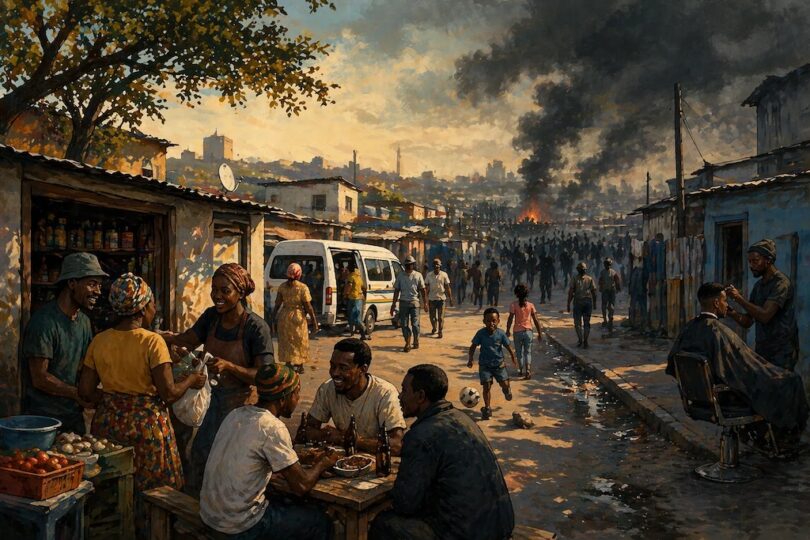
I have witnessed across much of South Africa, how people from different parts of the continent live side by side. They share a beer from a single ngudu, eat pap and chesanyama at local taverns, dance to the same music, and speak to one another in a fluid mix of languages shaped less by borders than by daily life. Men and women hustle together, lend each other what little they have, and protect one another when trouble comes.
It is common to find marriages that cross national lines — South Africans with Zimbabweans, Malawians, Nigerians — raising children who inhabit more than one identity without contradiction. In many communities, South Africans speak Shona, Chewa, Swahili or Hausa as easily as isiZulu or Sesotho.
This is the South Africa that exists beneath the noise: interdependent, multilingual, intertwined.
But it is also fragile. Daily life blurs the line between “us” and “them” — until, suddenly, it does not. When that line is redrawn, it is often redrawn violently, driven by small groups that mobilise not just weapons — petrol bombs and tyres — but narratives. Messaging that turns neighbour against neighbour.
Residents I have spoken to are often clear-eyed about where this comes from. They point to propaganda circulating on social media, to rhetoric at political rallies, to organised campaigns designed to inflame. Many insist they will not be used. Since the presidency of Thabo Mbeki, they argue, communities have lived alongside migrants with relatively little friction. When violence erupts, it is not organic. It is manufactured.
A Shared Survival System
Beneath the noise lies a deeper reality: South Africans and migrants are economically intertwined in ways that are both visible and essential.
In Diepsloot, a landlord named Lawrence Thela rents garages on his property to Somali and Bangladeshi shopkeepers. The income has enabled him to put his children through university. His tenants, in turn, employ local workers — nine people across three small shops. “They are creating jobs,” he says. “And we live like brothers and sisters.”
This is not an isolated case. Research from the Southern African Migration Programme indicates that immigration has a largely neutral — and sometimes positive — effect on employment. Migrants create demand, start businesses and sustain livelihoods, particularly in lower-income communities.
The claim that foreigners “steal jobs” does not withstand scrutiny. Nor does the perception that they drive crime. Data presented to Parliament shows that undocumented migrants accounted for just over 2 percent of convicted criminals between 2017 and 2021. Studies by the Institute for Security Studies and the Human Sciences Research Council consistently point to a gap between perception and evidence.
It is laughable that those promoting lawlessness and vigilantism claim to be doing it to support law and order.
For many South Africans, migrants are not competitors. They are part of a shared survival system.
In Olievenhoutbosch, a 74-year-old grandmother, Gogo Lindiwe Mahlangu, supports her grandchildren through social grants and rental income from backyard rooms occupied by migrants from Zimbabwe, Mozambique and Malawi. Her tenants work as gardeners and construction workers. They pay rent. They support families. “We lived like one family,” she says.