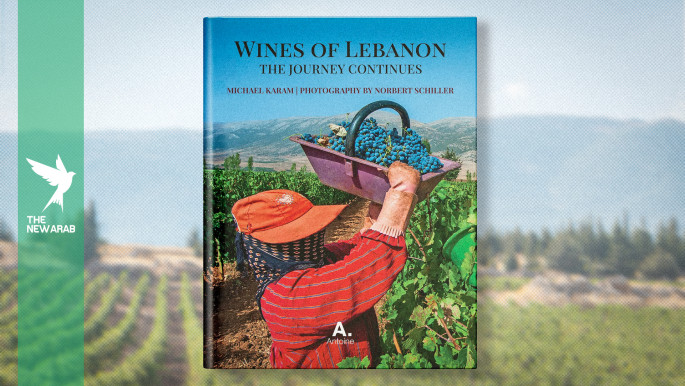
When Wines of Lebanon was first published in 2005, it offered an unusual and revealing portrait of a wine culture in a country more often associated, in the international imagination, with conflict than with vineyards.
Written by British Lebanese author Michael Karam and illustrated by veteran Middle East photographer Norbert Schiller, the book moves between the Bekaa Valley and the smaller mountain vineyards of Mount Lebanon, weaving together a practical wine guide and a cultural history that quickly became a reference point for wine enthusiasts and travellers.
While it stood as a celebration of one of the world’s oldest winemaking regions, both Michael and Norbert eventually felt the book was in need of renewal.
Twenty years later, they returned with Wines of Lebanon: The Journey Continues, revisiting the same landscape with a sharper awareness of change, tracing a winemaking tradition stretching back thousands of years while also documenting a modern industry that has expanded, adapted and endured through instability and uncertainty, including Israel’s longstanding aggression towards the country.
Speaking exclusively to The New Arab, Michael explains: “The original edition no longer reflected the reality on the ground. When it was first written, Lebanon had only around a dozen wine producers. By the late 2010s, that number had grown to roughly 75-80, with production rising from about six million bottles in 2004 to around 10.5-11 million, depending on the year.
“Alongside that growth, the industry itself began to shift in character. New winemakers entered the field, experimentation increased, and there was a gradual move away from the French grape varieties that had dominated in the years after the 1975 Civil War. In their place, producers began to rediscover indigenous varieties, helping to shape a more distinct Lebanese identity in wine.”
Ultimately, for Michael, this marked an important shift: not just expansion, but growing confidence in what Lebanese wine could become.
Soft power in a glass
Recently winning the 2025 André Simon Drink Book Award, a UK prize celebrating excellence in drinks writing, the 346-page book draws on years of research, much of which Michael says was made easier by Lebanon’s size and accessibility, as the country’s scale allowed relatively direct access to producers, vineyards and records.
Historical sources also played a key role. In particular, the Jesuits, who helped shape modern winemaking in Lebanon and founded what is now Château Ksara, maintain archives that Michael continues to explore.
In addition, his work with the late Patrick McGovern, a leading biomolecular archaeologist in the field of ancient alcoholic beverages — whom Michael refers to as “the ultimate booze archaeologist” — also helped place Lebanese wine within a much broader historical context.
Even so, he notes that Lebanon still lacks a formal national archive dedicated to its wine history.
From there, Michael sheds light on how Lebanon is understood beyond its borders, arguing that the country and the wider Levant region are often misrepresented or reduced to stereotypes that overlook their cultural depth.
“We are not just what people often imagine — sand, camels, and Gulf Arab stereotypes. We are a wine region, and wine reflects our tradition, our civilisation, our hospitality and generosity,” he says.
He adds that wine and food could play a much larger role in reshaping how Lebanon is seen abroad. Wine tourism and food tourism, he suggests, could become significant if the country were able to experience a sustained period of peace and stability, attracting not only visitors from the Gulf and the wider Arab world but also Western tourists drawn to its cultural richness.
He also sees wine as a form of soft power. By associating Lebanon more closely with food and wine, he argues, it becomes possible to shift attention away from long-held assumptions about war and instability. In his view, these cultural elements help present a more complete picture of the country, one rooted in everyday life, tradition and hospitality.
A heritage reborn
Looking further back, Michael highlights Lebanon’s long history of trade and winemaking. He points to the Bekaa Valley and the Temple of Bacchus at Baalbek as evidence of an ancient and established wine culture. Wine, he explains, has also been deeply embedded in Lebanon’s religious and cultural traditions, including Christian practice, placing it firmly within a wider Mediterranean heritage.
Modern Lebanese wine, however, was also shaped by more recent history. Michael notes the importance of the French Mandate period after the First World War, when the arrival of French officials and soldiers helped expand and modernise an already existing wine industry. Local production expanded to meet this demand, laying the foundations of a commercial industry that continued after independence in the mid-1940s.
Today, Lebanon holds a respected place in the global wine industry, and as Michael puts it, “We have earned our place among the leading wine regions. We are a respected wine-producing country, even though we produce far less than others like Italy, France, and Spain. But while our output is small, we punch above our weight in terms of quality and reputation, especially when it comes to our wine heritage.”
Altitude: Lebanon’s secret ingredient in winemaking
As for geography, the importance of the terrain becomes clear. Lebanon has a naturally hot climate, which would normally make fine winemaking difficult. What makes the difference is altitude.
Vines are planted at remarkable heights, from around 900 metres in the Bekaa Valley to as high as 2,400 metres in some areas. In the northern hemisphere, few wine regions plant higher. This elevation, Michael explains, provides the lower temperatures, especially at night, needed to give balance and freshness to the wines.
“The cool air from the mountains is essential. It gives the wines freshness, elegance and complexity that you would not get at sea level. Without that, white wines would be flat, and the reds would be heavy and jammy, without acidity or structure,” Michael explains.
Stylistically, Lebanese wines follow familiar international patterns but with a distinct expression shaped by place. Red wines tend to be fruit-driven when young, while more premium examples develop greater complexity with age, showing notes of spice, leather, and forest floor. Grapes such as Cabernet Sauvignon, Cinsault, Carignan, Syrah, and Grenache, among others, are widely planted, reflecting both French heritage and terroir.
Michael shares that he prefers a minimal-intervention approach to winemaking, explaining, “I’m not a huge fan of oak. I like limited intervention wines that show a real sense of place. Sometimes oak masks that. I prefer purity — purity of fruit.”
Speaking of white wines, in particular, they have seen significant improvement in the past 20 years.
Michael believes they are now, in many cases, as exciting as, if not more exciting than, the reds for which Lebanon is traditionally known. He attributes this again to gaining greater confidence and experience in working with new grape varieties at altitude. The popularity of the local Merwah and Obeideh grapes has also added a new dimension to the white wine offering.
“People taste them blind and think they are from Burgundy or California. When they find out they are from Lebanon, they are surprised that such a hot climate can produce such freshness,” he says, laughing.
‘We are a country of humanity’
Looking ahead, Michael reflects on what he hopes readers will take from the book and the wider story it tells.
As he puts it, “People should see Lebanon differently. Our wine story is a strong one in itself, and the people involved in the industry, particularly over the past 50 years, have a great story to tell.
“But we are more than war, more than conflict, more than instability. We are a people who embrace and celebrate life, and one way we do that is through food and wine,” he adds.
“The Lebanese table — the dining table — is a metaphor for everything that is so good about the country. I know it may sound as if we are simply sitting around eating all the time, but that is not the point.
“It is about tradition, it is about gathering, it is about humanity. We are a country of humanity.”
Purchase Wine of Lebanon: The Journey Continues here.
Zainab Mehdi is The New Arab’s Associate Editor and researcher specialising in governance, development, and conflict in the Middle East and North Africa region
Follow her on Instagram: @zaiamehdi_/@zainabmehdiwrites_