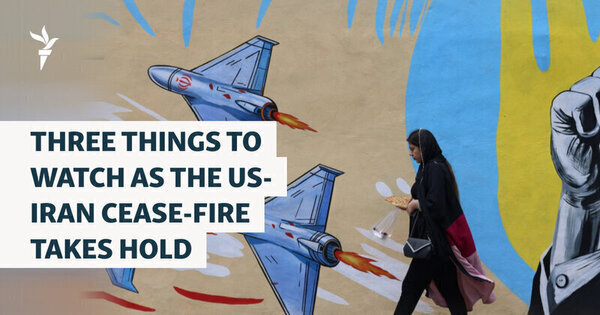
The United States and Iran have agreed to a two-week cease-fire, brokered by Pakistan, premised on Iran reopening the Strait of Hormuz.
The announcement came less than two hours before US President Donald Trump’s self-imposed deadline was set to expire at 8 pm ET on April 7.
Global markets rallied. Oil prices fell. Leaders around the world expressed relief.
But the cease-fire is already proving to be fragile, with Iranian strikes reported across Arab states in the Persian Gulf just hours after the pause in fighting went into effect. Meanwhile, Israel has continued its attacks in Lebanon on Hezbollah, an Iranian proxy that has been designated a terror organization by Washington.
Talks in Islamabad to secure a permanent peace deal will begin on April 10. Both sides have said the cease-fire is temporary and does not constitute an end to the war.
Here are three things that can determine whether the cease-fire morphs into a peace deal or simply marks a pause in the fighting.
One: State Of The Strait
For decades, the Strait of Hormuz was treated as something close to a global commons — a narrow passage with a 3.7 kilometer shipping channel between Iran and Oman through which roughly one-fifth of the world’s oil and liquefied natural gas flowed freely, unimpeded, and untaxed. That era may now be over.
The cease-fire framework is said toincludea provision allowing both Iran and Oman to collect transit fees from ships passing through the strait. This is without precedent. The United Nations Convention on the Law of the Seaexplicitly barsstates with territorial waters in the strait from charging fees for passage, and no state has ever successfully imposed such tolls on a recognized international strait.
Map: The Strait Of Hormuz
Iran’s system, alreadyoperational in practice, is more elaborate than a simple toll booth. The Islamic Revolutionary Guards Corps (IRGC) hasreportedly developeda ranking system for nations, with ships from countries deemed friendly receiving better terms. Once the toll is paid, the IRGC issues a permit code and route instructions; ships are expected to fly the flag of the nation that negotiated their passage.
But who actually pays? The instinctive answer — global consumers — turns out to be largely wrong, according to Guntram Wolff, a senior fellow at the Brussels-based think tank Bruegel.
Because Arab states in the Persian Gulf are responsible for approximately 20 percent of global oil supply, they absorb the bulk of any toll imposed on that supply.
“The Gulf states will have to actually pay, in my computations, around 80 or 85 percent of the toll value,” Wolff told RFE/RL. “While global consumers would only have to bear something like 20 percent of the toll cost.”