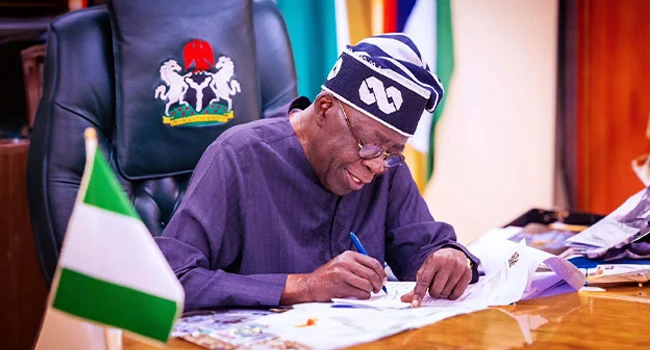
President Bola Tinubu has signed into law the amended 2025 budget, extending the implementation period of the 2025 budget from September 30 to December 31, 2026.
The assent followed the passage of the amendment by both chambers of the National Assembly on Tuesday, September 29.
This allows Ministries, Departments and Agencies (MDAs) an additional three months to execute capital projects captured in the 2025 budget.
A statement issued on Wednesday by Bayo Onanuga, the special adviser to the president on information and strategy, said the extension would enable MDAs to complete ongoing capital projects and ensure that funds already appropriated were fully utilised.
According to the statement, the measure was intended to prevent disruption to critical programmes and allow the government to complete projects already under implementation.
“The extension gives Ministries, Departments and Agencies more time to complete ongoing capital projects. It ensures that funds already appropriated are fully put to work for Nigerians, without disrupting critical programmes,” Onanuga said.
The President also commended the leadership and members of the National Assembly for what he described as their prompt consideration of the amendment bill, saying the development further demonstrated cooperation between the Executive and Legislature.
The latest amendment marks the fourth extension of the implementation period for the capital component of the 2025 budget.
The original deadline of December 31, 2025, was first extended to March 31, 2026, before being moved to June 30 and subsequently September 30, 2026. The latest extension now pushes the deadline to December 31, 2026.
In the Senate, the amendment was sponsored by Senate Leader Opeyemi Bamidele and considered after an executive session and clause-by-clause consideration at the Committee of Supply.
Bamidele said the extension was necessary to provide an administrative window for the completion of capital projects for which funds had already been released, particularly projects at advanced stages.
He said the measure would also facilitate the utilisation of released funds and support the completion of critical national projects.
The House of Representatives similarly approved the extension after considering an executive request from Tinubu for additional time to enable MDAs to complete critical infrastructure projects and other capital expenditures under the 2025 budget.
The latest extension, however, has drawn criticism from the Democratic and Leadership Alliance (DLA).
Reacting to the decision, the Head of Media and Publicity of the DLA National Campaign Council, Tosin Odeyemi, said the repeated extensions raised concerns about budget implementation and the management of public funds.
Odeyemi alleged that the extension reflected what the party described as worsening fiscal and economic conditions and argued that outstanding capital expenditure could be rolled over into subsequent budgets.
He also criticised the administration’s fiscal management and called for greater accountability over public funds.
“We hereby call on Nigerians to join us in asking the Tinubu administration to account for the humongous funds it received in 2025 if it couldn’t fund the budget.
“President Bola Tinubu has at every slight opportunity asked Nigerians to hold Governors of states accountable over huge amount accrued to them from the subsidy removal but he has not at any point told us what he does with larger percentage of the nation’s resources and debilitating loans he took to warrant budgets implementations suffering unprecedented extensions under his leadership,” he said.
The DLA spokesman further urged Nigerians to reject Tinubu in the 2027 presidential election, while claiming that his party had presented an alternative programme.
The latest extension means federal MDAs now have until December 31, 2026, to execute the affected capital allocations under the 2025 budget framework.