President Donald Trump has imposed 50 percent tariffs on a range of Canadian imports from alcohol to hockey sticks, accusing the country of “continued discrimination” against American products.
Trump’s latest move has led to fears of a deepening trade war between the two historically close allies, as the relationship between the president and Canada’s prime minister Mark Carney continues to deteriorate.
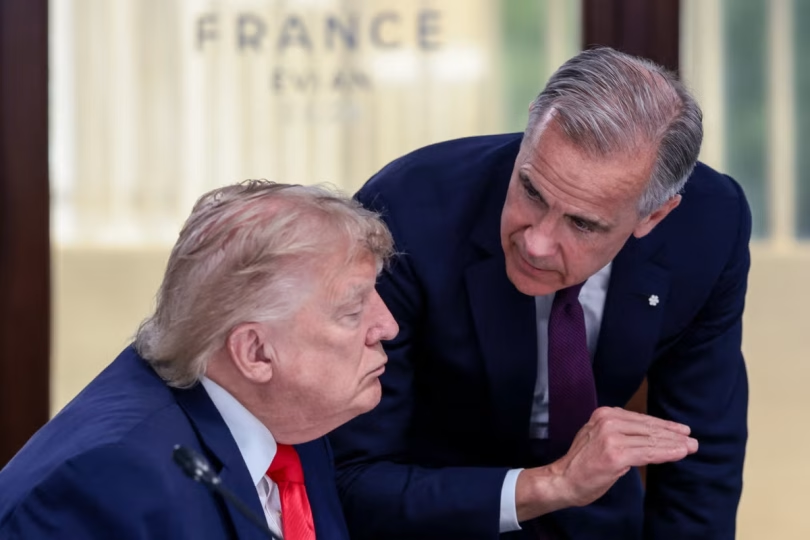
It comes after Trump confronted Carney at Sunday’s FIFA World Cup Final over the smoke from Canadian wildfires that has swept down into northeastern U.S. cities, including New York and Detroit, over the last week, blanketing them in a thick haze of air pollution.
The president accused the PM of not doing enough to anticipate the disaster in terms of forest management and told him: “Our air’s being poisoned.”
An administration official, speaking anonymously to reporters, justified the tariffs by stating that Canada, alongside China, had been among the few nations to retaliate against previous levies imposed by Trump.
The new levies were enacted through three proclamations under Section 338 of the 1930 Trade Act. The clause in question has drawn criticism, with several Democratic lawmakers last year advocating for its repeal due to concerns that Trump could wield it to destabilize the national economy.
The new 50 percent tariffs will exclude energy products, potash, fish and critical minerals, but will include goods that had previously been protected from import taxes by the United States-Mexico-Canada Agreement, or USMCA. That 2020 trade pact was not renewed by the U.S., triggering a new set of negotiations that could run until 2036.
The White House said in a fact sheet that the tariffs would go into effect in 30 days, meaning there is time for negotiations. Trump has not always followed through on the tax hikes on imports he has announced.
Responding in a statement, Carney said his latest move came in “direct violation” of USMCA but that his country had made “detailed and comprehensive proposals to resolve this dispute” and stood ready to “intensify” its discussions with the U.S. in the weeks ahead.
Despite the PM’s appeal for calm, the tariffs could yet escalate into a wider trade war.
Ontario Premier Doug Ford has already pointed to a possible showdown. “If these tariffs proceed, Canada should respond tariff for tariff, dollar for dollar,” he posted on X.
Candace Laing, CEO of the Canadian Chamber of Commerce, said the Trump administration’s moves were “regrettable” but the two countries needed to use the 30-day window “to make meaningful progress in advancing formal talks.”
The tariffs also pose a threat to other U.S. trading partners, not just Canada, and inject “massive uncertainty” into the global economy, said Scott Lincicome, vice president of general economics at the Cato Institute, a libertarian think tank.
“We crossed the Rubicon,” he said. “The invocation of 338 is the nuclear option for Trump tariffs.”
The new measures carry serious political and economic risks for Trump ahead of the November midterm elections for control of Congress.
His “Liberation Day” tariffs in April 2025 provoked a financial market meltdown, forcing him to walk back the rates for a period of negotiation.
The Supreme Court then ruled this February that Trump had lacked the legal authority to impose the tariffs by declaring an economic emergency, causing the administration to find alternative ways to raise import duties.
Canada was on 35 percent tariffs at that time but dropped back down to the standard 10 percent following the ruling.
The president maintains that the costs created by his tariffs strategy will prompt manufacturing to relocate to the U.S., although there is little evidence of that in the economic data.
The latest aggression could worsen Trump’s weak ratings on the economy. He promised voters when running for the presidency that he would bring prices down and deliver a new “golden age,” but the annual inflation rate has risen since he became president, with the tariffs and war in Iran are pushing up oil prices.
Trump claims in the proclamations that Canada discriminates against American autos, alcohol and cheese relative to other nations, but his argument rests in large part on retaliatory actions taken by Canada after the U.S. president imposed tariffs on Canada under the pretext that it should do more to stop fentanyl smuggling.
Trump noted in his autos proclamation that Canada maintained, starting in April 2025, a 25 percent tariff on the imports of U.S. motor vehicles that did not qualify for preferential treatment under the USMCA.
The White House said that, regarding alcohol, all but two Canadian provinces and territories halted the purchase and retailing of American alcoholic beverages beginning last year, which was also a response to Trump’s tariffs and taunts of making Canada the 51st state.
But Trump has long objected to Canada’s treatment of U.S. cheese, saying in his proclamation that Canada discriminates against the U.S. compared to Europe on dairy products.
Trump and Carney have had a frosty relationship, with Carney, a former central banker, who pledged to stand up for Canada during his election campaign last year.