
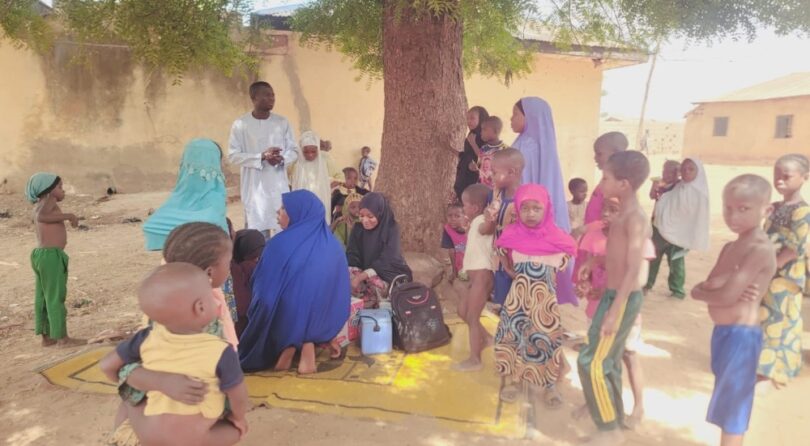
A team of poliovirus vaccinators gathered under a shaded neem tree at Kwannawa, a bustling community in Dange/Shuni Local Government Area of Sokoto, North-Western state, Nigeria.
They are all surrounded by leagues of playful children whose laughter and screams resonated with the determined strides of the polio workers. Among them were; Shahuda Idris, 22, and Nabila Tambuwal, 19. They are part of the vaccinators engaged in the state to take the lead role at the frontline of Nigeria’s fight against polio.
While Nabila is tasked to carefully review any missing child who has not received the oral polio vaccine to ensure they are accounted for during the immunization drive, Shahuda is moving from one house to another at a brisk pace, hanging on to her cooler, containing oral polio vaccine.
“I see this work as a service to humanity. If I do it well, I believe it will count for me in the hereafter,” Nabila said, as she prepared to vaccinate the first eligible child of the day.
In between her immunisation duty, she laughed with more children who surfaced, coaxed the hesitant ones, and handed out small gifts to them, an action that literally turned their fears into comfort and trust.
Nabila’s volunteering journey started in 2024, when she joined the immunization campaign through a neighbor. Since then, she has been making more of an impact in the community.
She recalled how she used her first payment of N66,000 from the immunisation exercise to buy a laptop, a tool she still uses in advancing her academics as a Diploma student of Community Health.
Looking inwardly today, Nabila said the immunisation fieldwork has given her life experience to everything she learned in school.
“I didn’t expect to love this work this much,” she said, smiling as she adjusted a child on her lap. “But now, I feel proud knowing I am part of something meaningful in my community.”
THE HOUSE-TO-HOUSE
JOURNEY
While Nabila sat for hours attending to the children who volunteered to turn themselves in for immunization, Shahuda was on the move with her vaccine carrier balanced on her right shoulder.
She enters from one compound to another using her most soothing voice to talk to unwilling mothers to remind them of the need for immunization.
Oftentimes, the mothers are willing to allow her administer the oral vaccine to their children. Afterward, her teammate marked the child’s finger and recorded the details.
On her exit, she picked up a piece of chalk and marked the house wall, a quiet but critical sign that the house had been reached.
NOT EVERY ENCOUNTER ENDED IN SMILES
Occasionally, not every polio vaccinators’ encounter with parents ends in a smile. “Sometimes, they came with both resistance and rejection,” says Shahuda after she encountered resistance in one of the households.
“I told them I was immunised too, and nothing happened to me still, the women stood firm.
“It hurts. Because this is something that can protect their children.” She admitted.
Standing outdoors, Shahuda quietly marked the house wall with a code: ‘RX’, meaning Non-compliance.
The house would be revisited with the support of the community and religious leaders.
Many field Immunization officials say elites in the rural areas had, in many instances, rejected the vaccines for their wards, with no or flimsy reasons given to the local vaccinators in their areas.
“Many people of a religious sect refused to allow their kids to participate in the exercise despite persuasion from traditional, religious, and opinion leaders,” a community leader said.
Shahuda said most of our women believed in and wanted the vaccine for their children, but the marital burden placed the final say on the husband.
“This has made so many of them lose interest and now find the exercise frustrating, especially in the northern States,” she maintains.
THE MOTIVATIONS
For Shahuda, the work is personal. She remembers meeting a polio survivor who is a talented handball player. From his wheelchair he plays wonderfully, but “his body could not fully match his ability”
“He was so good, but he couldn’t move properly.” She paused, then continued, ” I kept thinking, what if he had been vaccinated in his childhood?”
That question stayed with her, it still does. And it is why she keeps knocking on doors.
Before this, Shahuda had dreamed of becoming a medical doctor. But after secondary school, that path slipped out of reach.
Immunisation, she said, brought her closer to that dream. “Sometimes people call me ‘Doctor Shahuda,’” she said with a soft laugh. But beyond the nickname lies something deeper.
In her community, she is no longer just a young woman but a reference point. “Parents even point at me when advising their daughters, It makes me want to do more.”
Though she is not yet married, her convictions are firm that she will never joke about her children’s vaccination when she becomes a mother.
Nabila also shared the same belief. For her, she has a broader ambition to build a youth-led initiative that will strengthen awareness and mobilize more young people into immunisation campaigns.
She also said that, like Shahuda, her motivation runs deeper beyond the academic gains. “These children belong to all of us,” she said. “Protecting them means protecting our future, and it goes beyond any monetary gains.”
Hassan Nuradeen UNICEF-SBC facilitator, describes both Nabila and Shahuda as guardians of optimism, striving to protect the children of their community from a disease that has, ever so silently, endeavored to reverse Nigeria’s relentless march toward eradication.
POLIO, STILL A BURDEN