United Capital PLC has unveiled an ambitious roadmap to cross the ₦2 trillion total asset mark by the end of 2026, following a first-half performance characterised by a 58% rise in gross earnings to ₦37.9 billion and 80% appreciation in its Profits Before Tax. This was disclosed during the company’s……
United Capital PLC has unveiled an ambitious roadmap to cross the ₦2 trillion total asset mark by the end of 2026, following a first-half performance characterised by a 58% rise in gross earnings to ₦37.9 billion and 80% appreciation in its Profits Before Tax.
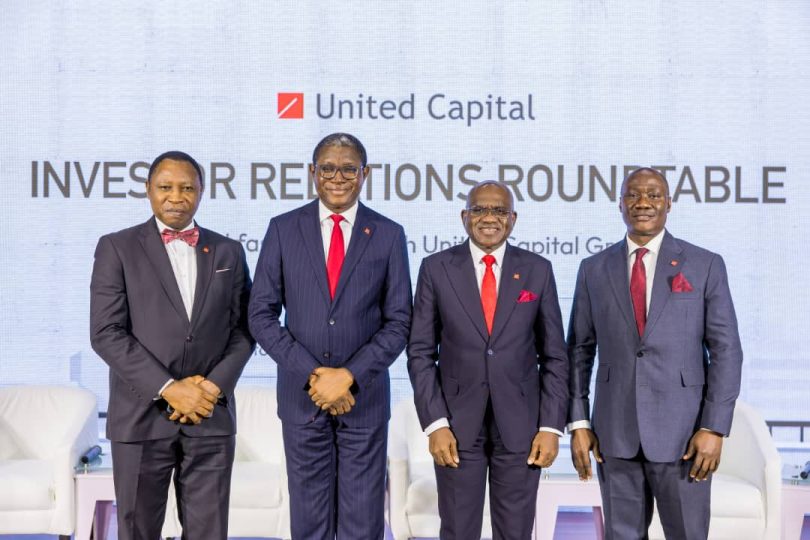
This was disclosed during the company’s H1 investor relations call on Wednesday, themed ‘Decoding Performance: Insights into United Capital’s Growth Drivers and Outlook.’ The group’s executive leadership detailed how a blend of digital transformation, aggressive Pan-African expansion, and disciplined capital management is reshaping the firm’s trajectory.
The Group Managing Director, Peter Ashade, in his comments, emphasised that the firm is currently undergoing a massive “retooling” phase to prepare for a future that spans far beyond Nigerian borders.
“We are equipping from people, technology, governance, and our structure as we retool because what we see ahead is bigger than where we are today,” Ashade stated. “The future we see is a platform that will give every one of our clientele access to trade in any market they wish across our footprint, whether in Nigeria, Cote d’Ivoire, Ethiopia, Rwanda, Senegal, or Burkina Faso”.
READ MORE: Meta Misses Wall Street Profit Expectations As AI Spending Weighs On Earnings
Ashade further highlighted the resilience of the firm’s diversified earnings model, noting that the company is no longer tethered to the performance of a single sector. “Our philosophy has always been to solve customers’ problems, and every investment or expansion is carefully designed to create sustainable long-term value,” he explained. “Whether capital markets perform strongly or interest rates become favourable, we have businesses positioned to generate sustainable earnings that are no longer dependent on a single market segment.”
The Group Chief Financial Officer, Shedrack Onakpoma, provided a deep dive into the numbers, revealing that Profit Before Tax (PBT) grew by 80% to N24.78bn, reaching far beyond the revenue growth rate due to enhanced operational efficiency.
“We are building a resilient and thriving institution of great repute that focuses on sustainable value creation and delivery across multiple markets,” Onakpoma said. “The numbers tell a story of innovation and how we are building a lasting legacy that goes beyond mere revenue growth or short-term profitability”.
Addressing the strategic shift in the balance sheet, which saw total assets move to ₦1.6 trillion as the firm exited high-cost borrowings, Onakpoma noted that the move was intentional to improve returns. “It is not just about growing the revenue, as you can grow revenue by 100% while your PBT only grows by 10%,” he noted. “We have decided deliberately to reduce our borrowing so that we can focus on growing managed funds to about 71% of our funding size, which is where we see the greatest opportunities for the group.
“As we speak, managed funds have grown astronomically. Our total assets, again, Peter (Ashade) talked about the fact that we have crossed the N1 trillion mark. Our target for this year is to do over ₦2 trillion in terms of total assets.”
Responding to shareholders’ concerns regarding the 30 kobo interim dividend, Chief Economist Ayodele Akunwunmi defended the payout through the lens of long-term growth and “residual dividend theory”.
“Residual dividend theory says that a company must finance all profitable investments available from internally generated cash flows before paying the residual to shareholders,” Akunwunmi explained. “By financing our expansion this way rather than borrowing money that would dilute earnings, we have the opportunity to grow the bottom line and potentially double profitability in the future”.
He urged investors to look at the broader trajectory of the firm’s value creation. “Don’t worry, let us finance all these opportunities that we have seen from internally generated cash flows,” he added. “If we do not double the performance in the next two years, then you and I will have a very serious conversation, but for now, we must stay focused on the expansion”.
READ MORE: Indigenous Oil Firms Face Test Of Delivering More Gas To Nigeria’s Economy
The MD of United Capital Investment Banking, Dr Gbadebo Adenrele, highlighted the firm’s pivotal role in the banking sector recapitalisation and its extensive work with sovereign entities across Africa.
“During the banking recapitalisation, we were very active in supporting a number of major banks, including UBA, Stanbic, First Bank, and FCMB,” Adenrele stated. “We acted as the lead issuing house for several significant rights issues and infrastructure funds, reinforcing our position as the preeminent advisor for funds in the market.”
He also touched upon the firm’s growing influence in project and sovereign finance across the continent. “Our clients include the federal government of Nigeria and the government of Congo, where we facilitated a $250 million pre-export financing transaction,” he said. “With a presence in 12 African countries, each of those governments and their sub-nationals represent potential candidates for our strategic financial services”.
MD of United Capital Asset Management, Dr Odiri Oginni, during her presentation emphasised the need for a retail revolution to deepen the Nigerian capital market.
“For the over 200 million people we have in Nigeria, we are still just scratching the surface of the asset management industry,” Oginni observed. “We should aim to reach the stage where a single asset manager has over a thousand funds, similar to global giants like BlackRock, rather than the handful currently available in our market”.
She challenged the misconception that investing requires significant capital, pointing to the firm’s 11 mutual funds as a solution for the everyday Nigerian. “A lot of people think they need a lot of money before they can invest, but we should have debunked that by now,” she asserted. “With as little as 1,000 Naira or 10,000 Naira, anyone can begin investing in mutual funds to create a disciplined portfolio management structure for their future.”