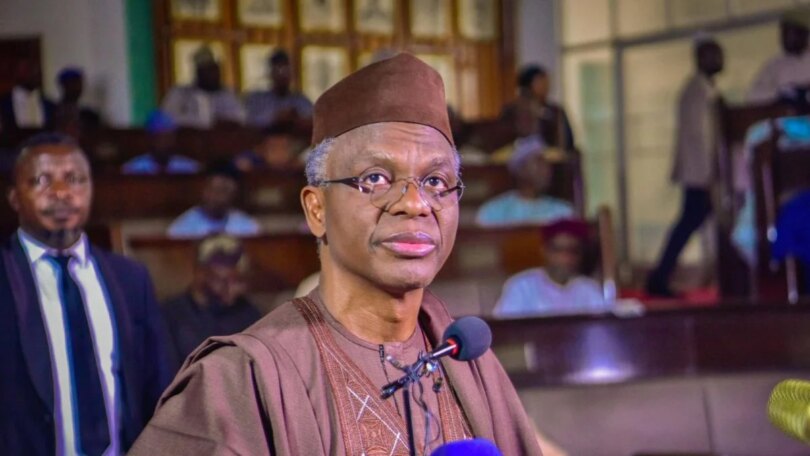
Former commissioners, political appointees and grassroots associates of former Kaduna State Governor Nasir El-Rufai have defended their decision to leave his political camp, saying they supported him because of shared political interests and not because they became permanently tied to him.
The former allies said their political relationship with El-Rufai did not take away their right to make independent decisions about their political future.
They also rejected the suggestion that their movement away from the former governor amounted to betrayal.
Their position was contained in a statement signed by former Deputy Speaker of the Kaduna State House of Assembly, Mukthar Isa Hazo, and former Kaduna State SDP Chairman and four-time House of Assembly member for Ungwan Sanusi Constituency, Nasiru Abdullahi Maikano.
The statement followed the recent movement of several prominent politicians previously associated with El-Rufai from the African Democratic Congress, ADC, back to the All Progressives Congress, APC.
Among those involved are former Chief of Staff to El-Rufai, Bashir Saidu, former commissioners Ja’afaru Sani and Shehu Usman Makarfi, and former Kaduna North Senator Abdu Kwari.
The group maintained that many of those who worked with El-Rufai played important roles in building the political structures that supported his administration and electoral campaigns.
It therefore argued that those relationships should not be interpreted as permanent political ownership.
The former allies said political partnerships are often influenced by changing circumstances, interests and objectives.
They added that people who once worked with El-Rufai could decide to pursue a different political direction without necessarily being enemies of the former governor.
“Are we not adults who can take our own political decisions?” the group quoted Bashir Saidu as asking.
The statement said the question reflected what the former allies described as their basic right to determine their political future.
The group also pointed to Saidu’s recent return to the APC as part of the wider realignment in Kaduna ahead of the 2027 elections.
Saidu, who served as El-Rufai’s Commissioner for Finance and later Chief of Staff, recently announced his return to the APC.
He said he had moved with thousands of supporters and pledged to work for the re-election of Governor Uba Sani.
Saidu also claimed that his political network remained strong across parts of Kaduna State.
He specifically referred to the 11 local government areas that make up the Zazzau Emirate and said his supporters would demonstrate their strength during the elections.
He further said his movement to the APC was not an individual decision, claiming that about 10,000 supporters had joined him.
Earlier in September, Ja’afaru Sani also confirmed that a group of former El-Rufai associates had left the ADC and returned to the APC.
He said the group was taking more than 150,000 registered ADC members along with it.
The former allies said the reasons behind the political split did not begin with their latest defections.
According to them, disagreements had been building since El-Rufai’s second term as Kaduna governor.
They claimed that some of his former political associates gradually felt pushed away from the centre of political decision-making.
The group also alleged that members of El-Rufai’s family were perceived to have gained increasing influence during the later part of his administration.
It stressed, however, that its complaint was not about El-Rufai choosing to work with family members or people he trusted.
Rather, it said the concern was about what it considered the gradual weakening of the broader political structure that had helped sustain his political influence.
The disagreement became more visible after El-Rufai left office in 2023.
The former governor and his successor, Uba Sani, who had previously worked closely together, later developed political differences.
The ADC governorship primary also became a major point of disagreement among members of El-Rufai’s political network.
Former House of Representatives member Isah Ashiru emerged as the ADC candidate after securing 86,113 votes in the direct primary.
Ja’afaru Sani came second with 29,580 votes.
Sani rejected the outcome and alleged irregularities in the process.
The disagreement surrounding the primary further exposed differences within the group of politicians that had previously operated under El-Rufai’s political structure.
The former allies also alleged that El-Rufai’s support for Ashiru, whom they described as a former political opponent of the ex-governor, contributed to their decision to reconsider their political relationship with him.
They went further to make claims about an alleged arrangement involving a possible future ADC administration and appointments for members of El-Rufai’s family.
However, the group acknowledged that those allegations had not been established by a court or backed by a publicly available formal agreement.
It said the allegation was presented as part of the political disagreements surrounding the situation and not as an established fact.
The former allies argued that the focus should not only be on why individuals left El-Rufai’s camp but also on the circumstances that led to their departure.
They said political supporters should be allowed to reassess their positions when they believe their interests or objectives have changed.
The group further referred to El-Rufai’s own political history, arguing that the former governor had worked with different political figures and groups at various stages of his career before eventually finding himself in political disagreement with some of them.
“If El-Rufai could make political choices based on his assessment of circumstances and interests, why should his former associates be denied that same right?” the group asked.
The former governor has also recently spoken about changes in some of his relationships.
In a statement titled “My Relationships and the Aftermath,” dated September 23, El-Rufai reflected on the changing relationships around him and said some former colleagues, friends and family members had become distant during his current difficulties.
He said the experience had made him reconsider some relationships but maintained that he had no desire for revenge or retribution.